

leading to the same low energy picture. For theoretical purposes we can
take any model we like if it has desirable low energy properties.
In this section we shall discuss the most fundamental symmetry
properties of particle physics in context of such specially chosen models.
Perhaps the most important discovery of modern particle physics is the
gauge principle. According to it, all interactions in nature arise from the
claim that the Lagrangian has to be invariant under local symmetry
transformations, i.e. symmetry rotations that may be different at
different space-time points. It is remarkable that this claim predicts the
low energy structure of the Lagrangian.
The first (and most complicated) example of this phenomenon was
general relativity, in which, due to the presence of the gravitational field,
it is possible to perform Lorentz rotations, different at each point. The
second (and easiest) example was quantum electrodynamics, in which
the gauge group is abelian (the arbitrariness of the phase of the electron
wave function). And lastly, we have the Yang-Mills fields, which are
supposed to mediate strong and weak interactions. The study of the
dynamics of gauge fields is the most important problem of modern
physics.
Using the analogies described in the preceeding section, we shall first
examine certain classical systems, and then formulate results in the
language of particle theory.
STATISTICAL MECHANICS AND QUANTUM FIELD THEORY
5
1.3 Discrete Global Symmetries
Let us begin with the case of global (nongauge) symmetries. The
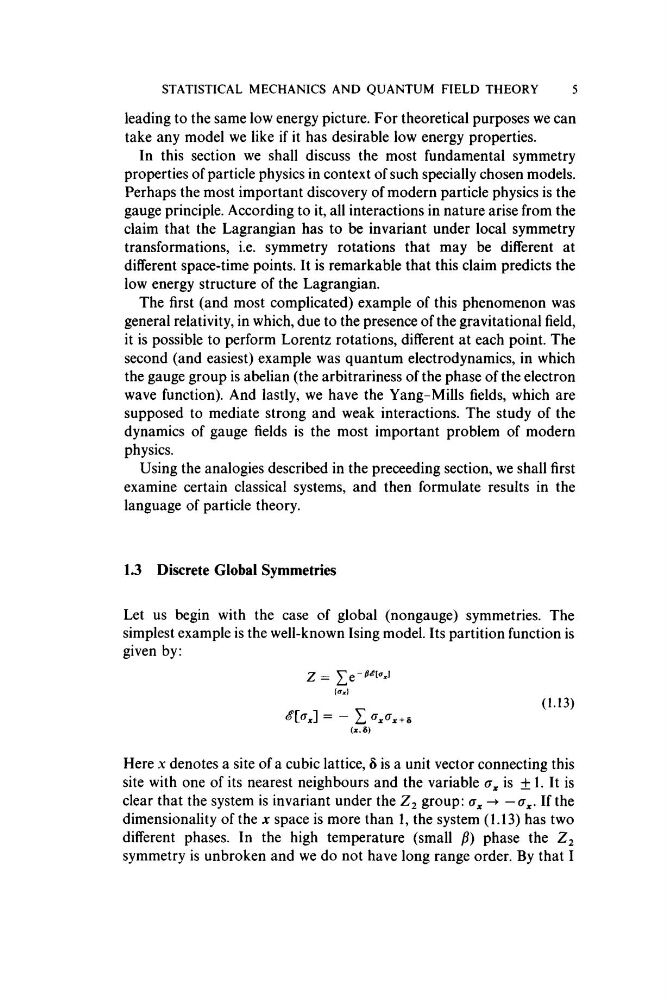
simplest example is the well-known Ising model. Its partition function is
given by:
Z =
{ (T x )
^[^x] — ~ Yj ^x^x + 6
(x,6)
(1.13)
Here x denotes a site of a cubic lattice, 8 is a unit vector connecting this
site with one of its nearest neighbours and the variable is ± 1. It is
clear that the system is invariant under the Z2 group:
— (7^^. If the
dimensionality of the x space is more than 1, the system (1.13) has two
different phases. In the high temperature (small P) phase the Z2
symmetry is unbroken and we do not have long range order. By that I
take any model we like if it has desirable low energy properties.
In this section we shall discuss the most fundamental symmetry
properties of particle physics in context of such specially chosen models.
Perhaps the most important discovery of modern particle physics is the
gauge principle. According to it, all interactions in nature arise from the
claim that the Lagrangian has to be invariant under local symmetry
transformations, i.e. symmetry rotations that may be different at
different space-time points. It is remarkable that this claim predicts the
low energy structure of the Lagrangian.
The first (and most complicated) example of this phenomenon was
general relativity, in which, due to the presence of the gravitational field,
it is possible to perform Lorentz rotations, different at each point. The
second (and easiest) example was quantum electrodynamics, in which
the gauge group is abelian (the arbitrariness of the phase of the electron
wave function). And lastly, we have the Yang-Mills fields, which are
supposed to mediate strong and weak interactions. The study of the
dynamics of gauge fields is the most important problem of modern
physics.
Using the analogies described in the preceeding section, we shall first
examine certain classical systems, and then formulate results in the
language of particle theory.
STATISTICAL MECHANICS AND QUANTUM FIELD THEORY
5
1.3 Discrete Global Symmetries
Let us begin with the case of global (nongauge) symmetries. The
simplest example is the well-known Ising model. Its partition function is
given by:
Z =
{ (T x )
^[^x] — ~ Yj ^x^x + 6
(x,6)
(1.13)
Here x denotes a site of a cubic lattice, 8 is a unit vector connecting this
site with one of its nearest neighbours and the variable is ± 1. It is
clear that the system is invariant under the Z2 group:
— (7^^. If the
dimensionality of the x space is more than 1, the system (1.13) has two
different phases. In the high temperature (small P) phase the Z2
symmetry is unbroken and we do not have long range order. By that I