

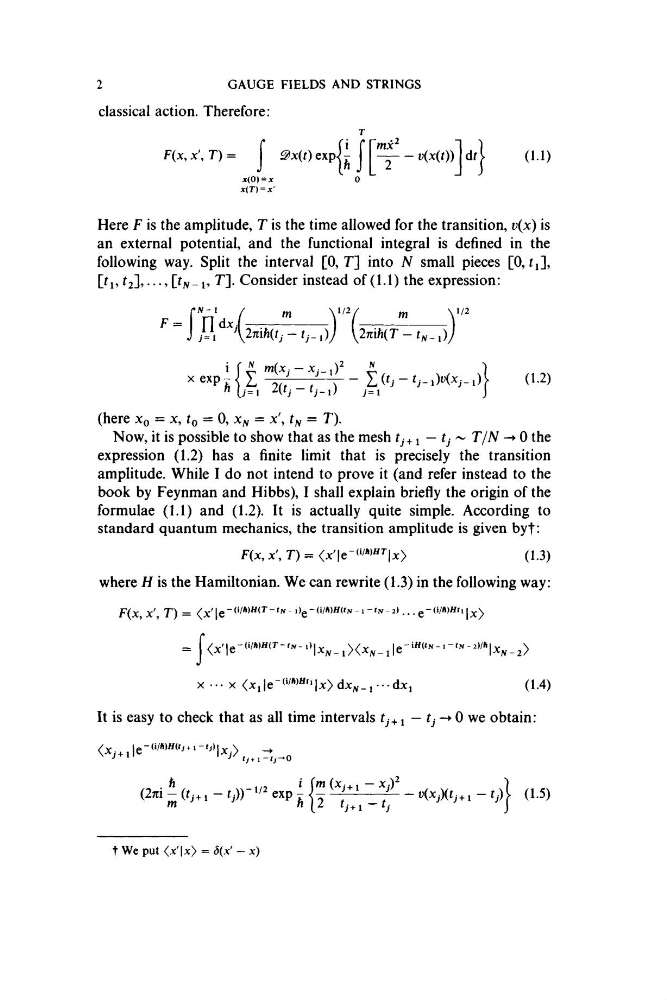
classical action. Therefore:
2
GAUGE FIELDS AND STRINGS
F(x, x\ T) = I ®x(t) expj^ I ^ ~
df|
(11)
x(0) = x
x(T) = x'
Here F is the amplitude, T is the time allowed for the transition, v(x) is
an external potential, and the functional integral is defined in the
following way. Split the interval [0, T] into N small pieces [0, i j .
Consider instead of (1.1) the expression:
rN- 1
= J
X exp
m
1/2
27ri^(i^. - tj_i)
i [ ^ m{xj-Xj_i)
^h= i
2mh(T -
-
(1-2)
(here Xq = x, to = 0, x^ = x \
= T).
Now, it is possible to show that as the mesh
^ T/N ^ 0 the
expression (1.2) has a finite limit that is precisely the transition
amplitude. While I do not intend to prove it (and refer instead to the
book by Feynman and Hibbs), I shall explain briefly the origin of the
formulae (1.1) and (1.2). It is actually quite simple. According to
standard quantum mechanics, the transition amplitude is given byt*.
F(x, x', T) =
(1.3)
where H is the Hamiltonian. We can rewrite (1.3) in the following way:
F(x, x', F ) =
- 1 - »jv - 2 )... g- imHti |
= I dx^_, •••dx,
X -2 >
(1.4)
It is easy to check that as all time intervals tj+i — tj -+ 0 we obtain;
<^j+ile
(27ti - (i +i - tj))
m ‘
^
i (m ( X : + , — x Y
-------T---- - tj)^ (1-5)
^ [2 h + i- h
t We put = S(x' — x)
2
GAUGE FIELDS AND STRINGS
F(x, x\ T) = I ®x(t) expj^ I ^ ~
df|
(11)
x(0) = x
x(T) = x'
Here F is the amplitude, T is the time allowed for the transition, v(x) is
an external potential, and the functional integral is defined in the
following way. Split the interval [0, T] into N small pieces [0, i j .
Consider instead of (1.1) the expression:
rN- 1
= J
X exp
m
1/2
27ri^(i^. - tj_i)
i [ ^ m{xj-Xj_i)
^h= i
2mh(T -
-
(1-2)
(here Xq = x, to = 0, x^ = x \
= T).
Now, it is possible to show that as the mesh
^ T/N ^ 0 the
expression (1.2) has a finite limit that is precisely the transition
amplitude. While I do not intend to prove it (and refer instead to the
book by Feynman and Hibbs), I shall explain briefly the origin of the
formulae (1.1) and (1.2). It is actually quite simple. According to
standard quantum mechanics, the transition amplitude is given byt*.
F(x, x', T) =
(1.3)
where H is the Hamiltonian. We can rewrite (1.3) in the following way:
F(x, x', F ) =
- 1 - »jv - 2 )... g- imHti |
= I
X -2 >
(1.4)
It is easy to check that as all time intervals tj+i — tj -+ 0 we obtain;
<^j+ile
(27ti - (i +i - tj))
m ‘
^
i (m ( X : + , — x Y
-------T---- - tj)^ (1-5)
^ [2 h + i- h
t We put