

118
GAUGE FIELDS AND STRINGS
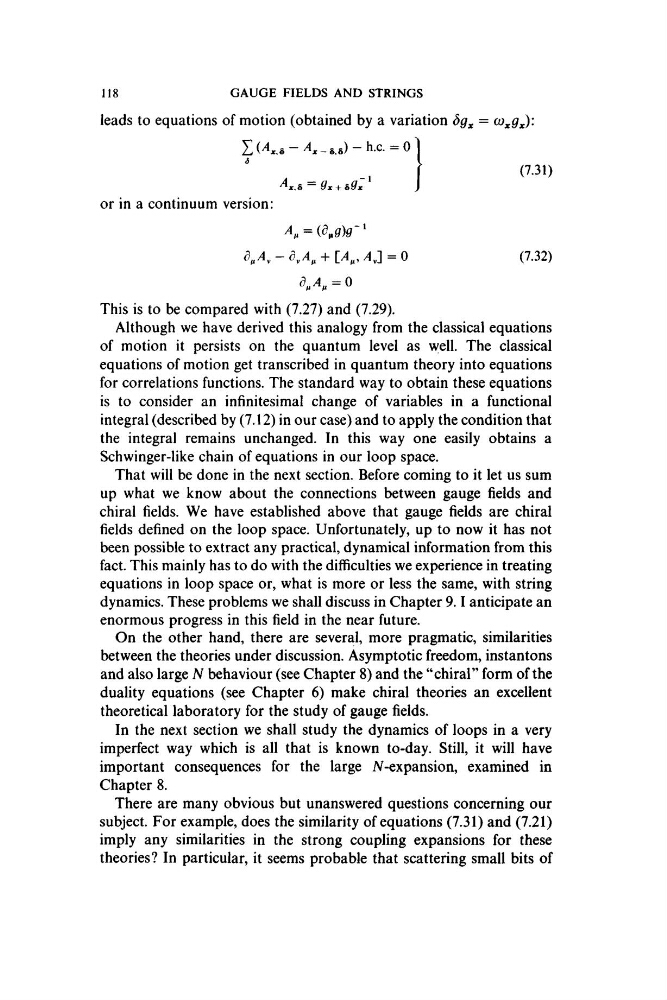
leads to equations of motion (obtained by a variation
= co^^x)X (^x,S
- 8,6 ,) - h.c. = 0
^x,6 = Q x + sQ x
or in a continuum version:
= i^u9)d ^
d — d^A H - [/I , /IJ — 0
(7.31)
(7.32)
This is to be compared with (7.27) and (7.29).
Although we have derived this analogy from the classical equations
of motion it persists on the quantum level as well. The classical
equations of motion get transcribed in quantum theory into equations
for correlations functions. The standard way to obtain these equations
is to consider an infinitesimal change of variables in a functional
integral (described by (7.12) in our case) and to apply the condition that
the integral remains unchanged. In this way one easily obtains a
Schwinger-like chain of equations in our loop space.
That will be done in the next section. Before coming to it let us sum
up what we know about the connections between gauge fields and
chiral fields. We have established above that gauge fields are chiral
fields defined on the loop space. Unfortunately, up to now it has not
been possible to extract any practical, dynamical information from this
fact. This mainly has to do with the difficulties we experience in treating
equations in loop space or, what is more or less the same, with string
dynamics. These problems we shall discuss in Chapter 9 .1 anticipate an
enormous progress in this field in the near future.
On the other hand, there are several, more pragmatic, similarities
between the theories under discussion. Asymptotic freedom, instantons
and also large N behaviour (see Chapter 8) and the “chiral” form of the
duality equations (see Chapter 6) make chiral theories an excellent
theoretical laboratory for the study of gauge fields.
In the next section we shall study the dynamics of loops in a very
imperfect way which is all that is known to-day. Still, it will have
important consequences for the large N-expansion, examined in
Chapter 8.
There are many obvious but unanswered questions concerning our
subject. For example, does the similarity of equations (7.31) and (7.21)
imply any similarities in the strong coupling expansions for these
theories? In particular, it seems probable that scattering small bits of
GAUGE FIELDS AND STRINGS
leads to equations of motion (obtained by a variation
= co^^x)X (^x,S
- 8,6 ,) - h.c. = 0
^x,6 = Q x + sQ x
or in a continuum version:
= i^u9)d ^
d — d^A H - [/I , /IJ — 0
(7.31)
(7.32)
This is to be compared with (7.27) and (7.29).
Although we have derived this analogy from the classical equations
of motion it persists on the quantum level as well. The classical
equations of motion get transcribed in quantum theory into equations
for correlations functions. The standard way to obtain these equations
is to consider an infinitesimal change of variables in a functional
integral (described by (7.12) in our case) and to apply the condition that
the integral remains unchanged. In this way one easily obtains a
Schwinger-like chain of equations in our loop space.
That will be done in the next section. Before coming to it let us sum
up what we know about the connections between gauge fields and
chiral fields. We have established above that gauge fields are chiral
fields defined on the loop space. Unfortunately, up to now it has not
been possible to extract any practical, dynamical information from this
fact. This mainly has to do with the difficulties we experience in treating
equations in loop space or, what is more or less the same, with string
dynamics. These problems we shall discuss in Chapter 9 .1 anticipate an
enormous progress in this field in the near future.
On the other hand, there are several, more pragmatic, similarities
between the theories under discussion. Asymptotic freedom, instantons
and also large N behaviour (see Chapter 8) and the “chiral” form of the
duality equations (see Chapter 6) make chiral theories an excellent
theoretical laboratory for the study of gauge fields.
In the next section we shall study the dynamics of loops in a very
imperfect way which is all that is known to-day. Still, it will have
important consequences for the large N-expansion, examined in
Chapter 8.
There are many obvious but unanswered questions concerning our
subject. For example, does the similarity of equations (7.31) and (7.21)
imply any similarities in the strong coupling expansions for these
theories? In particular, it seems probable that scattering small bits of