

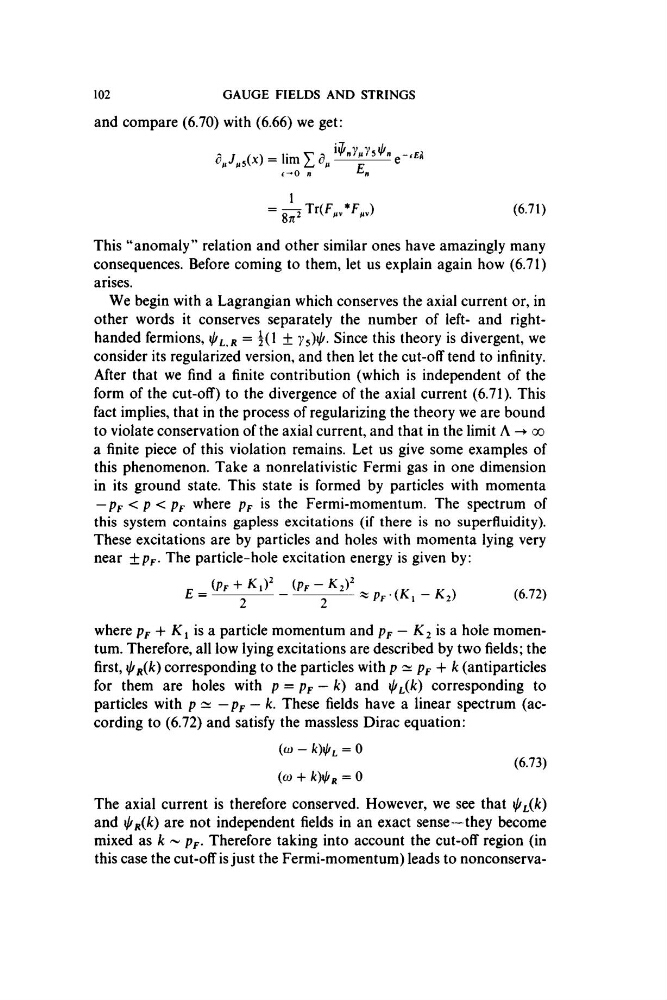
and compare (6.70) with (6.66) we get:
102
GAUGE FIELDS AND STRINGS
= lim X 5,
'i'ny„75'/'n
^ T r ( F ,v % v )
(6.71)
This “anomaly” relation and other similar ones have amazingly many
consequences. Before coming to them, let us explain again how (6.71)
arises.
We begin with a Lagrangian which conserves the axial current or, in
other words it conserves separately the number of left- and righthanded fermions, «A l,/? =
±
Since this theory is divergent, we
consider its regularized version, and then let the cut-off tend to infinity.
After that we find a finite contribution (which is independent of the
form of the cut-off) to the divergence of the axial current (6.71). This
fact implies, that in the process of regularizing the theory we are bound
to violate conservation of the axial current, and that in the limit A -► cx)
a finite piece of this violation remains. Let us give some examples of
this phenomenon. Take a nonrelativistic Fermi gas in one dimension
in its ground state. This state is formed by particles with momenta
~ P f < P < P f where pp is the Fermi-momentum. The spectrum of
this system contains gapless excitations (if there is no superfluidity).
These excitations are by particles and holes with momenta lying very
near ±pp. The particle-hole excitation energy is given by:
E =
( P f + Ki)"
(Pf - K , Ÿ
Pp-{K,-K,)
(6.72)
where pp +
is a . particle momentum and
— X2 is a hole momentum. Therefore, all low lying excitations are described by two fields; the
first, il/jiik) corresponding to the particles with p ^ pp k (antiparticles
for them are holes with p = Pp — k) and iAl(^) corresponding to
particles with p —pp — k. These fields have a linear spectrum (according to (6.72) and satisfy the massless Dirac equation:
{(D - k)il/L = 0
{co + k)il/p = 0
(6.73)
The axial current is therefore conserved. However, we see that iA l(^)
and il/R(k) are not independent fields in an exact sense—they become
mixed as fc ^ p^. Therefore taking into account the cut-off region (in
this case the cut-off is just the Fermi-momentum) leads to nonconserva
102
GAUGE FIELDS AND STRINGS
= lim X 5,
'i'ny„75'/'n
^ T r ( F ,v % v )
(6.71)
This “anomaly” relation and other similar ones have amazingly many
consequences. Before coming to them, let us explain again how (6.71)
arises.
We begin with a Lagrangian which conserves the axial current or, in
other words it conserves separately the number of left- and righthanded fermions, «A l,/? =
±
Since this theory is divergent, we
consider its regularized version, and then let the cut-off tend to infinity.
After that we find a finite contribution (which is independent of the
form of the cut-off) to the divergence of the axial current (6.71). This
fact implies, that in the process of regularizing the theory we are bound
to violate conservation of the axial current, and that in the limit A -► cx)
a finite piece of this violation remains. Let us give some examples of
this phenomenon. Take a nonrelativistic Fermi gas in one dimension
in its ground state. This state is formed by particles with momenta
~ P f < P < P f where pp is the Fermi-momentum. The spectrum of
this system contains gapless excitations (if there is no superfluidity).
These excitations are by particles and holes with momenta lying very
near ±pp. The particle-hole excitation energy is given by:
E =
( P f + Ki)"
(Pf - K , Ÿ
Pp-{K,-K,)
(6.72)
where pp +
is a . particle momentum and
— X2 is a hole momentum. Therefore, all low lying excitations are described by two fields; the
first, il/jiik) corresponding to the particles with p ^ pp k (antiparticles
for them are holes with p = Pp — k) and iAl(^) corresponding to
particles with p —pp — k. These fields have a linear spectrum (according to (6.72) and satisfy the massless Dirac equation:
{(D - k)il/L = 0
{co + k)il/p = 0
(6.73)
The axial current is therefore conserved. However, we see that iA l(^)
and il/R(k) are not independent fields in an exact sense—they become
mixed as fc ^ p^. Therefore taking into account the cut-off region (in
this case the cut-off is just the Fermi-momentum) leads to nonconserva