

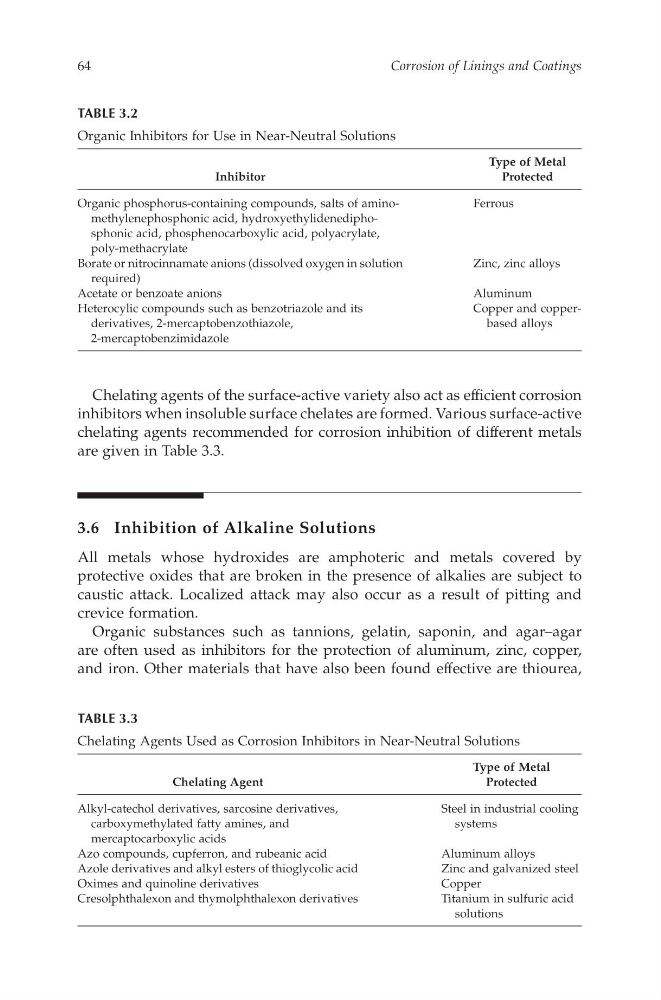
Chelatingagents of the surface-active variety also act as efficient corrosion
inhibitors when insoluble surfacechelates are formed. Various surface-active
chelating agents recommended for corrosion inhibition of different metals
are given in Table 3.3.
3.6I nhibition of Alkaline Solutions
All metals whose hydroxides are amphoteric and metals covered by
protective oxides that are broken in the presence of alkaliesa re subject to
caustic attack. Localizeda ttackm ay also occur as ar esult of pitting and
crevice formation.
Organic substances sucha st annions, gelatin,s aponin, and agar–agar
are oftenu sed as inhibitors for the protection of aluminum, zinc, copper,
and iron. Other materials that have also been found effective are thiourea,
TABLE 3.3
Chelating Agents Used as Corrosion Inhibitors in Near-Neutral Solutions
Chelating Agent
Type of Metal
Protected
Alkyl-catecholderivatives, sarcosine derivatives,
carboxymethylated fatty amines, and
mercaptocarboxylic acids
Steel in industrial cooling
systems
Azo compounds, cupferron, and rubeanic acid
Aluminum alloys
Azole derivatives and alkyl esters of thioglycolic acid
Zinc and galvanized steel
Oximes and quinoline derivatives
Copper
Cresolphthalexon and thymolphthalexon derivatives
Titanium in sulfuric acid
solutions
TABLE 3.2
Organic Inhibitors for Use in Near-Neutral Solutions
Inhibitor
Type of Metal
Protected
Organic phosphorus-containing compounds, salts of aminomethylenephosphonic acid, hydroxyethylidenediphosphonic acid, phosphenocarboxylic acid, polyacrylate,
poly-methacrylate
Ferrous
Borate or nitrocinnamate anions (dissolved oxygen in solution
required)
Zinc, zinc alloys
Acetate or benzoate anions
Aluminum
Heterocylic compounds such as benzotriazole and its
derivatives, 2-mercaptobenzothiazole,
2-mercaptobenzimidazole
Copper and copperbased alloys
Corrosion of Linings and Coatings
64
CAT8247—CHAPTER 3—6/10/2006—19:23—KADAMBADI—XMLMODEL B–p p. 55–68
inhibitors when insoluble surfacechelates are formed. Various surface-active
chelating agents recommended for corrosion inhibition of different metals
are given in Table 3.3.
3.6I nhibition of Alkaline Solutions
All metals whose hydroxides are amphoteric and metals covered by
protective oxides that are broken in the presence of alkaliesa re subject to
caustic attack. Localizeda ttackm ay also occur as ar esult of pitting and
crevice formation.
Organic substances sucha st annions, gelatin,s aponin, and agar–agar
are oftenu sed as inhibitors for the protection of aluminum, zinc, copper,
and iron. Other materials that have also been found effective are thiourea,
TABLE 3.3
Chelating Agents Used as Corrosion Inhibitors in Near-Neutral Solutions
Chelating Agent
Type of Metal
Protected
Alkyl-catecholderivatives, sarcosine derivatives,
carboxymethylated fatty amines, and
mercaptocarboxylic acids
Steel in industrial cooling
systems
Azo compounds, cupferron, and rubeanic acid
Aluminum alloys
Azole derivatives and alkyl esters of thioglycolic acid
Zinc and galvanized steel
Oximes and quinoline derivatives
Copper
Cresolphthalexon and thymolphthalexon derivatives
Titanium in sulfuric acid
solutions
TABLE 3.2
Organic Inhibitors for Use in Near-Neutral Solutions
Inhibitor
Type of Metal
Protected
Organic phosphorus-containing compounds, salts of aminomethylenephosphonic acid, hydroxyethylidenediphosphonic acid, phosphenocarboxylic acid, polyacrylate,
poly-methacrylate
Ferrous
Borate or nitrocinnamate anions (dissolved oxygen in solution
required)
Zinc, zinc alloys
Acetate or benzoate anions
Aluminum
Heterocylic compounds such as benzotriazole and its
derivatives, 2-mercaptobenzothiazole,
2-mercaptobenzimidazole
Copper and copperbased alloys
Corrosion of Linings and Coatings
64
CAT8247—CHAPTER 3—6/10/2006—19:23—KADAMBADI—XMLMODEL B–p p. 55–68