

is mainly observed in neutral media with the formationo fp orous or
nonporous layers. Clearly,the inhibition efficiency strongly depends on the
properties of the formed three-dimensional layer.
3.2I nhibitor Evaluation
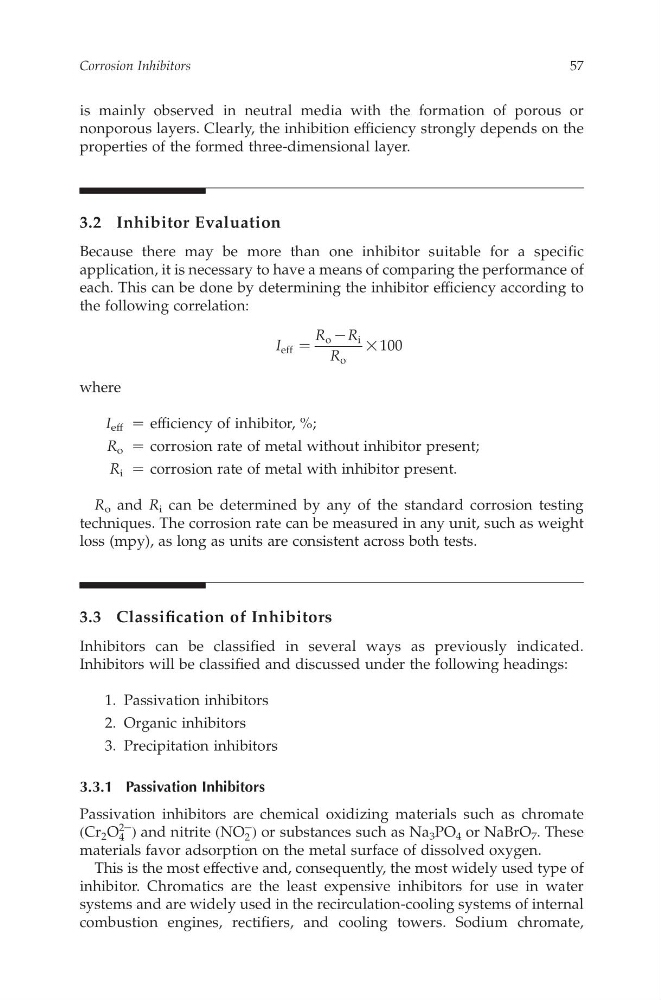
Because there may be more than one inhibitor suitablef or as pecific
application, it is necessary to have ameans of comparingthe performance of
each. This can be done by determiningt he inhibitor efficiency according to
the followingcorrelation:
I eff Z
R o K R i
R o
! 100
where
I eff Z efficiency of inhibitor,% ;
R o Z corrosion rate of metal without inhibitor present;
R i Z corrosion rate of metal with inhibitorpresent.
R o and R i can be determined by any of the standard corrosion testing
techniques. The corrosionrate can be measured in any unit, such as weight
loss (mpy),asl onga su nits are consistent across bothtests.
3.3C lassification of Inhibitors
Inhibitors canb ec lassified in severalw aysa sp reviouslyi ndicated.
Inhibitors will be classified and discussedu nder the following headings:
1. Passivation inhibitors
2. Organic inhibitors
3. Precipitation inhibitors
3.3.1 Passivation Inhibitors
Passivation inhibitors are chemical oxidizingm aterials sucha sc hromate
ð Cr 2 O
2 K
4 Þ and nitrite ð NO
K
2 Þ or substances suchasNa 3 PO 4 or NaBrO 7 .These
materials favoradsorption on the metal surface of dissolved oxygen.
This is the most effective and, consequently,the most widely used type of
inhibitor.C hromatics are the least expensive inhibitors foru se in water
systemsand are widely used in the recirculation-cooling systems of internal
combustione ngines,r ectifiers,a nd cooling towers.S odiumc hromate,
Corrosion Inhibitors
57
CAT8247—CHAPTER 3—6/10/2006—19:23—KADAMBADI—XMLMODEL B–p p. 55–68
nonporous layers. Clearly,the inhibition efficiency strongly depends on the
properties of the formed three-dimensional layer.
3.2I nhibitor Evaluation
Because there may be more than one inhibitor suitablef or as pecific
application, it is necessary to have ameans of comparingthe performance of
each. This can be done by determiningt he inhibitor efficiency according to
the followingcorrelation:
I eff Z
R o K R i
R o
! 100
where
I eff Z efficiency of inhibitor,% ;
R o Z corrosion rate of metal without inhibitor present;
R i Z corrosion rate of metal with inhibitorpresent.
R o and R i can be determined by any of the standard corrosion testing
techniques. The corrosionrate can be measured in any unit, such as weight
loss (mpy),asl onga su nits are consistent across bothtests.
3.3C lassification of Inhibitors
Inhibitors canb ec lassified in severalw aysa sp reviouslyi ndicated.
Inhibitors will be classified and discussedu nder the following headings:
1. Passivation inhibitors
2. Organic inhibitors
3. Precipitation inhibitors
3.3.1 Passivation Inhibitors
Passivation inhibitors are chemical oxidizingm aterials sucha sc hromate
ð Cr 2 O
2 K
4 Þ and nitrite ð NO
K
2 Þ or substances suchasNa 3 PO 4 or NaBrO 7 .These
materials favoradsorption on the metal surface of dissolved oxygen.
This is the most effective and, consequently,the most widely used type of
inhibitor.C hromatics are the least expensive inhibitors foru se in water
systemsand are widely used in the recirculation-cooling systems of internal
combustione ngines,r ectifiers,a nd cooling towers.S odiumc hromate,
Corrosion Inhibitors
57
CAT8247—CHAPTER 3—6/10/2006—19:23—KADAMBADI—XMLMODEL B–p p. 55–68