

andh eavy castings. The inherent flexibility andi mpactr esistance of
urethanes offerpotential for theset ypes of applications.
Precast andpoured-in-place polymer concrete has been successfully used
in am ultitude of indoor and outdoorapplications in various industries.
Acrylic polymer concrete has been used for precast trenches and covers,
delta bus supports, and insulators. Ease of pigmenting to match corporate
colors, good weatherr esistance, resistance to airborne SO 2 ,S O 3 ,a nd NO X ,
and dielectric properties have madea crylics particularly attractive in the
electric utility industry.
The chemical, steel, electronic, automotive, and pharmaceutical industries
have taken advantage of the ease of mixing and placing, as wella st he
high early strength and chemical resistance properties, of variousp olymer
concretes.
1.4.2A pplications
Carbon steel and reinforced concrete are outstanding general construction
materials. Theyhave an enviable recordofsuccess in amultitude of industries and applications. Unfortunately,s teel and concrete willc orrode when
oxygen and water are present. Weather and chemicals are catalysts that
accelerate the corrosion process.
The costattributable to corrosion in the United States is estimated to be in
ar ange of $9–$90 billion. This figure was confirmed from as tudy initiated
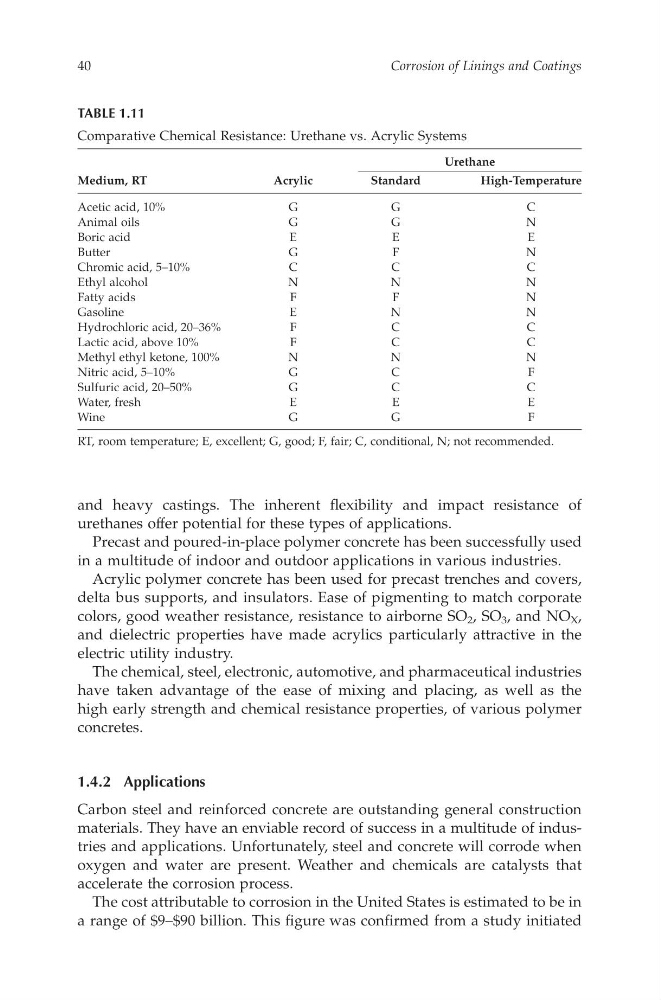
TABLE 1.11
Comparative Chemical Resistance: Urethane vs. Acrylic Systems
Urethane
Medium, RT
Acrylic
Standard
High-Temperature
Acetic acid, 10%
GG
C
Animal oils
GG
N
Boric acid
EE
E
Butter
GF
N
Chromic acid, 5–10%
CC
C
Ethyl alcohol
NN
N
Fatty acids
FF
N
Gasoline
EN
N
Hydrochloric acid, 20–36%
FC
C
Lactic acid, above 10%
FC
C
Methyl ethyl ketone, 100%
NN
N
Nitric acid, 5–10%
GC
F
Sulfuric acid, 20–50%
GC
C
Water,fresh
EE
E
Wine
GG
F
RT,room temperature; E, excellent; G, good; F, fair; C, conditional, N; not recommended.
Corrosion of Linings and Coatings
40
CAT8247—CHAPTER 1—6/10/2006—12:02—SRIDHAR—XML MODEL B–pp. 1–42
urethanes offerpotential for theset ypes of applications.
Precast andpoured-in-place polymer concrete has been successfully used
in am ultitude of indoor and outdoorapplications in various industries.
Acrylic polymer concrete has been used for precast trenches and covers,
delta bus supports, and insulators. Ease of pigmenting to match corporate
colors, good weatherr esistance, resistance to airborne SO 2 ,S O 3 ,a nd NO X ,
and dielectric properties have madea crylics particularly attractive in the
electric utility industry.
The chemical, steel, electronic, automotive, and pharmaceutical industries
have taken advantage of the ease of mixing and placing, as wella st he
high early strength and chemical resistance properties, of variousp olymer
concretes.
1.4.2A pplications
Carbon steel and reinforced concrete are outstanding general construction
materials. Theyhave an enviable recordofsuccess in amultitude of industries and applications. Unfortunately,s teel and concrete willc orrode when
oxygen and water are present. Weather and chemicals are catalysts that
accelerate the corrosion process.
The costattributable to corrosion in the United States is estimated to be in
ar ange of $9–$90 billion. This figure was confirmed from as tudy initiated
TABLE 1.11
Comparative Chemical Resistance: Urethane vs. Acrylic Systems
Urethane
Medium, RT
Acrylic
Standard
High-Temperature
Acetic acid, 10%
GG
C
Animal oils
GG
N
Boric acid
EE
E
Butter
GF
N
Chromic acid, 5–10%
CC
C
Ethyl alcohol
NN
N
Fatty acids
FF
N
Gasoline
EN
N
Hydrochloric acid, 20–36%
FC
C
Lactic acid, above 10%
FC
C
Methyl ethyl ketone, 100%
NN
N
Nitric acid, 5–10%
GC
F
Sulfuric acid, 20–50%
GC
C
Water,fresh
EE
E
Wine
GG
F
RT,room temperature; E, excellent; G, good; F, fair; C, conditional, N; not recommended.
Corrosion of Linings and Coatings
40
CAT8247—CHAPTER 1—6/10/2006—12:02—SRIDHAR—XML MODEL B–pp. 1–42