

Choiceo fm aterials is dependent on stream composition,p rocess
conditions, and performance requirements. Cylindrical elements utilize
specially made, thin wall tubing as the measurement element. Cylindrical
probes aregenerally“all metal,” i.e., thereisnoother material exposed to the
process. There are, however,s omec ylindrical probes available that join the
probe body at ahermetic glass seal. Avariety offlush-mounted probes are also
available, so called because the measuring element is mounted parallel to the
flow stream, flush with the inside pipe wall.
Some typeso fC ORROSOMETER (ER) probes areb etter suited to the
requirements of particular applications than others. Wherep itting or substantial iron sulfide(Fe x S y )depositionare expected to be problems,cylindrical
probes should be chosen over loop stylep robesi fp ossible. It is possible
that wire loop andt ubel oope lementsm ay be severedb yap itting attack,
necessitating probereplacement.Wireloopand tube loop elements also have a
tendency to be electrically shortedbyabridge of iron sulfide corrosionproduct.
This is especially prevalentinlow-velocitystreams over an extended period.
Theeffectofsuchbridgingistoreducethe measured metallossofthe probe,
creating amisleadinglylow corrosion rate.
Cylindrical elements, on the other hand, area ffected to am uch lesser
degree by pitting because of the much larger circumference of the measuring
element. Cylindricalprobes also demonstrate more resistance to iron-sulfide
bridging because of theirconstruction and lower inherent resistance per unit
length, thus, minimizing the effect of the shunt resistance.
Most cylindricalp robes areo fa ll-weldedc onstructioni no rder to
eliminate the need for sealing metal elements to nonmetallic glass, epoxy,
or ceramic.This all-welded constructiongives the probe superior resistance
to leaking. Probes with higher temperature ratings can also be constructed in
the all-welded style. Adrawback to the all-welded style is that the element is
electrically connected to the pipe wall that can, under certain conditions,
interfere with the corrosionreaction on the probe. Also, because cylindrical
probes arewelded, undersomeconditions, preferential corrosion can occur
in the heat-affected zonesneart he weld or end grain attack can occur.
Flush probe elements are thin, flat metal sections embedded in epoxy or a
hermetic glass seal inside ametal probe body.Flush probes also experience
certain characteristic problems, most notably lack of adhesion of the metal
Strip loop
Tube loop
Wire loop
Cylindrical
Atmospheric
Flush end view
Flush end view
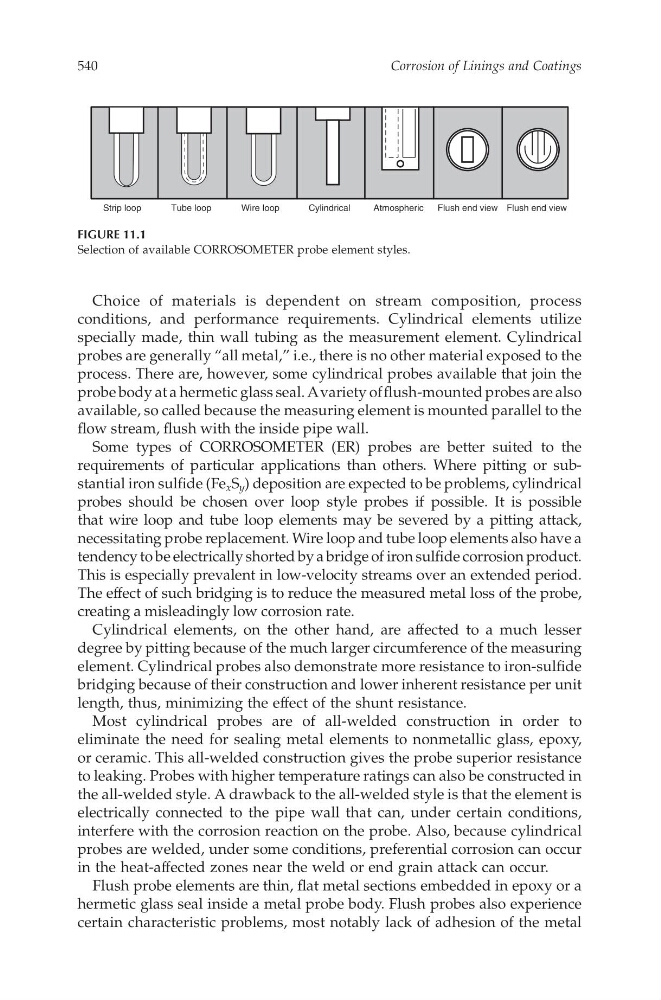
FIGURE 11.1
Selection of available CORROSOMETER probee lement styles.
Corrosion of Linings and Coatings
540
CAT8247—CHAPTER 11—6/10/2006—12:56—SRIDHAR—XML MODEL B–pp. 533–547