

The principal advantages for their use are as follows:
1. They are the easiest of the resin systems to mix and apply by using
pour-in-place and self-leveling techniques.
2. Because of their outstanding weatherr esistance, they aree qually
appropriate for indoor and outdoor applications.
3. They are the only system that can be installed at below freezing
temperatures, 258 F( K 4 8 C), without havingt ou se special hardening or catalyst systems.
4. They aret he fastests et andc ure of allr esin systems.T he
monolithics will support foot and light-wheeled traffic in 1h,
whereas, the thicker cross-section polymer concrete willa lso
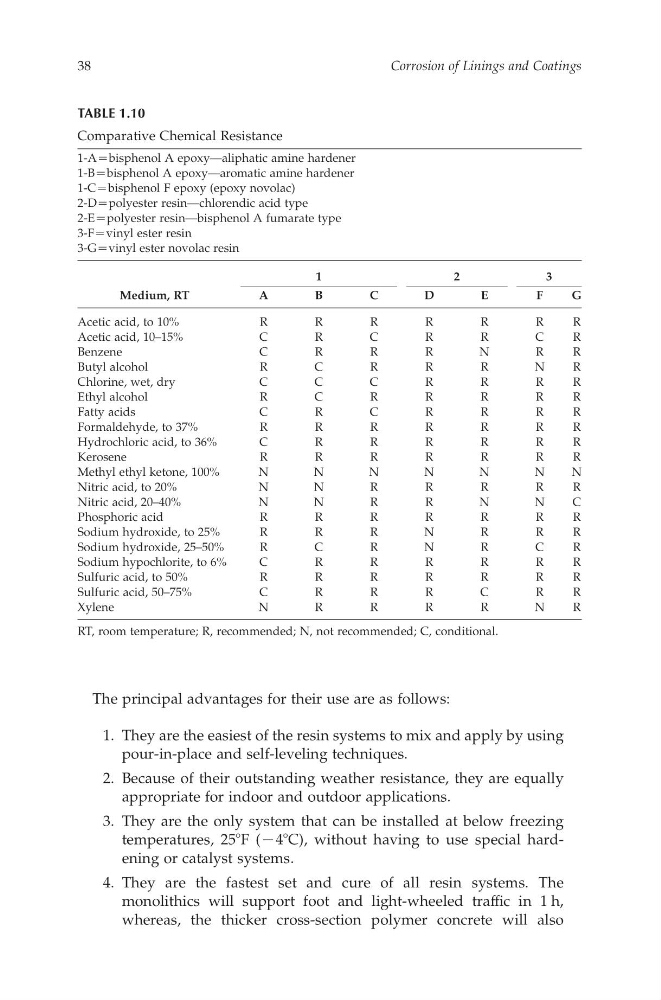
TABLE 1.10
Comparative Chemical Resistance
1-AZ bisphenolAepoxy—aliphatic amine hardener
1-BZ bisphenol Ae poxy—aromatic amine hardener
1-CZ bisphenolFepoxy (epoxy novolac)
2-DZ polyester resin—chlorendic acid type
2-EZ polyester resin—bisphenol Af umarate type
3-FZ vinyl ester resin
3-GZ vinyl ester novolac resin
12
3
Medium, RT
ABCDEF
G
Acetic acid, to 10%
RRRRRR
R
Acetic acid, 10–15%
CRCRRC
R
Benzene
CRRRNR
R
Butyl alcohol
RCRRRN
R
Chlorine, wet, dry
CCCRRR
R
Ethyl alcohol
RCRRRR
R
Fatty acids
CRCRRR
R
Formaldehyde,to3 7%
RRRRRR
R
Hydrochloric acid, to 36%
CRRRRR
R
Kerosene
RRRRRR
R
Methyl ethyl ketone, 100%
NNNNNN
N
Nitric acid, to 20%
NNRRRR
R
Nitric acid, 20–40%
NNRRNN
C
Phosphoric acid
RRRRRR
R
Sodium hydroxide, to 25%
RRRNRR
R
Sodium hydroxide, 25–50%
RCRNRC
R
Sodium hypochlorite,to6 %C
RRRRRR
Sulfuric acid, to 50%
RRRRRR
R
Sulfuric acid, 50–75%
CRRRCR
R
Xylene
NRRRRN
R
RT,room temperature; R, recommended; N, not recommended; C, conditional.
Corrosion of Linings and Coatings
38
CAT8247—CHAPTER 1—6/10/2006—12:02—SRIDHAR—XML MODEL B–pp. 1–42
1. They are the easiest of the resin systems to mix and apply by using
pour-in-place and self-leveling techniques.
2. Because of their outstanding weatherr esistance, they aree qually
appropriate for indoor and outdoor applications.
3. They are the only system that can be installed at below freezing
temperatures, 258 F( K 4 8 C), without havingt ou se special hardening or catalyst systems.
4. They aret he fastests et andc ure of allr esin systems.T he
monolithics will support foot and light-wheeled traffic in 1h,
whereas, the thicker cross-section polymer concrete willa lso
TABLE 1.10
Comparative Chemical Resistance
1-AZ bisphenolAepoxy—aliphatic amine hardener
1-BZ bisphenol Ae poxy—aromatic amine hardener
1-CZ bisphenolFepoxy (epoxy novolac)
2-DZ polyester resin—chlorendic acid type
2-EZ polyester resin—bisphenol Af umarate type
3-FZ vinyl ester resin
3-GZ vinyl ester novolac resin
12
3
Medium, RT
ABCDEF
G
Acetic acid, to 10%
RRRRRR
R
Acetic acid, 10–15%
CRCRRC
R
Benzene
CRRRNR
R
Butyl alcohol
RCRRRN
R
Chlorine, wet, dry
CCCRRR
R
Ethyl alcohol
RCRRRR
R
Fatty acids
CRCRRR
R
Formaldehyde,to3 7%
RRRRRR
R
Hydrochloric acid, to 36%
CRRRRR
R
Kerosene
RRRRRR
R
Methyl ethyl ketone, 100%
NNNNNN
N
Nitric acid, to 20%
NNRRRR
R
Nitric acid, 20–40%
NNRRNN
C
Phosphoric acid
RRRRRR
R
Sodium hydroxide, to 25%
RRRNRR
R
Sodium hydroxide, 25–50%
RCRNRC
R
Sodium hypochlorite,to6 %C
RRRRRR
Sulfuric acid, to 50%
RRRRRR
R
Sulfuric acid, 50–75%
CRRRCR
R
Xylene
NRRRRN
R
RT,room temperature; R, recommended; N, not recommended; C, conditional.
Corrosion of Linings and Coatings
38
CAT8247—CHAPTER 1—6/10/2006—12:02—SRIDHAR—XML MODEL B–pp. 1–42