

1. Substrate mustbefreeofcracks and be properly slopedtodrains.
2. New,aswell as existing slabs, should have acoarse surface profile,
be clean and dry,a nd be free of contaminants.
3. In general, slab and materials to be installed should have a
temperature of 65–858 F/18–298 C. If necessary,s pecial catalysts
and hardening systems are available to accommodate highero r
lower temperatures.
4. Manufacturers’ directions should be adhered to regarding the
primingo ft he substratep rior to applying them onolithic
surfacing.
5. Individual and combined components should be mixed thoroughly
at amaximum speed of 500 rpm to minimize air entrapment.
6. Prior to curing, the surface must be protected from moisture
and contamination.
Monolithic surfacingsmay be installed by avariety of methods, many that
are the same methods used in the portland cement concrete industry.
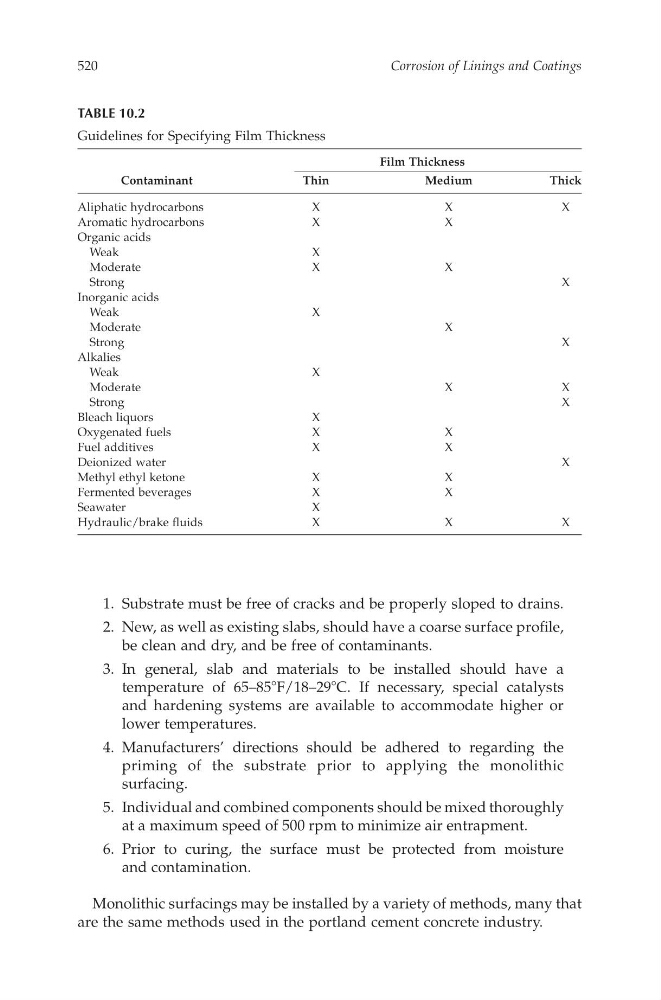
TABLE 10.2
Guidelines for Specifying Film Thickness
Film Thickness
Contaminant
Thin
Medium
Thick
Aliphatic hydrocarbons
XX
X
Aromatic hydrocarbons
XX
Organic acids
Weak
X
Moderate
XX
Strong
X
Inorganic acids
Weak
X
Moderate
X
Strong
X
Alkalies
Weak
X
Moderate
XX
Strong
X
Bleach liquors
X
Oxygenated fuels
XX
Fuel additives
XX
Deionized water
X
Methyl ethyl ketone
XX
Fermented beverages
XX
Seawater
X
Hydraulic/brake fluids
XX
X
Corrosion of Linings and Coatings
520
CAT8247—CHAPTER 10—6/10/2006—12:52—SRIDHAR—XML MODEL B–pp. 515–532
2. New,aswell as existing slabs, should have acoarse surface profile,
be clean and dry,a nd be free of contaminants.
3. In general, slab and materials to be installed should have a
temperature of 65–858 F/18–298 C. If necessary,s pecial catalysts
and hardening systems are available to accommodate highero r
lower temperatures.
4. Manufacturers’ directions should be adhered to regarding the
primingo ft he substratep rior to applying them onolithic
surfacing.
5. Individual and combined components should be mixed thoroughly
at amaximum speed of 500 rpm to minimize air entrapment.
6. Prior to curing, the surface must be protected from moisture
and contamination.
Monolithic surfacingsmay be installed by avariety of methods, many that
are the same methods used in the portland cement concrete industry.
TABLE 10.2
Guidelines for Specifying Film Thickness
Film Thickness
Contaminant
Thin
Medium
Thick
Aliphatic hydrocarbons
XX
X
Aromatic hydrocarbons
XX
Organic acids
Weak
X
Moderate
XX
Strong
X
Inorganic acids
Weak
X
Moderate
X
Strong
X
Alkalies
Weak
X
Moderate
XX
Strong
X
Bleach liquors
X
Oxygenated fuels
XX
Fuel additives
XX
Deionized water
X
Methyl ethyl ketone
XX
Fermented beverages
XX
Seawater
X
Hydraulic/brake fluids
XX
X
Corrosion of Linings and Coatings
520
CAT8247—CHAPTER 10—6/10/2006—12:52—SRIDHAR—XML MODEL B–pp. 515–532