

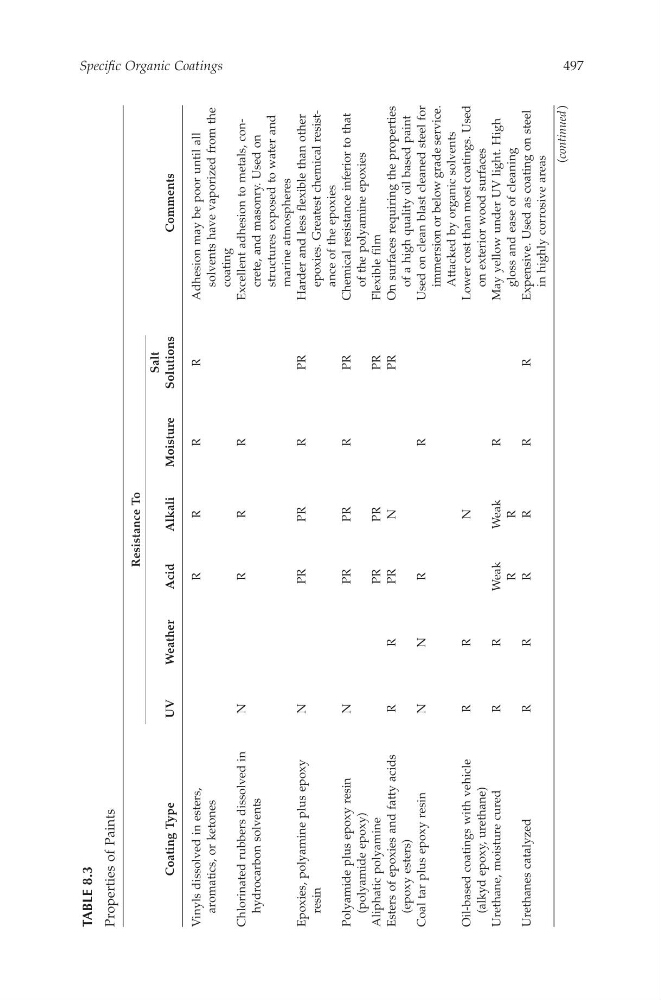
TABLE 8.3
Properties of Paints
Resistance
To
Coating Type UV
Weather
A cid Alkali Moisture
Salt
Solutions Comments
Vinyls
dissolved in esters,
aromatics, or ketones
R R
R R
Adhesion may be poor until all
solvents have
vaporized from
the
coating
Chlorinated rubbers dissolved in
hydrocarbon solvents
N R
R R Excellent adhesion to metals, concrete, and masonry.
Used on
structures
exposed to water and
marine atmospheres
Epoxies, polyamine plus epoxy
resin
N P
R P
R R
PR Harder and less flexible than other
epoxies. Greatest chemical
resistance of the epoxies
Polyamide plus epoxy
resin
(polyamide
epoxy)
N P
R P
R R
PR Chemical
resistance
inferior to
that
of the polyamine
epoxies
Aliphatic polyamine PR PR PR Flexible film
Esters of epoxies
and
fatty acids
(epoxy esters)
R R
PR
N P
R O
n surfaces
requiring the properties
of a high quality oil based
paint
Coal tar plus epoxy
resin
N N
R R
Used on clean blast cleaned steel
for
immersion or below
grade
service.
Attacked by organic solvents
Oil-based
coatings
with vehicle
(alkyd epoxy,
urethane)
R R
N L
ower
cost than most coatings. Used
on exterior
wood
surfaces
Urethane, moisture
cured R R
Weak
R
Weak
R
R M
ay yellow
under UV light.
High
gloss and
ease of cleaning
Urethanes catalyzed R
R R
R R
R E
xpensive. Used as coating on steel
in highly corrosive areas
(continued
)
Specific Organic Coatings
497
CAT8247—CHAPTER 8—17/10/2006—14:20—SRIDHAR—XML MODEL B–pp. 487–507
Properties of Paints
Resistance
To
Coating Type UV
Weather
A cid Alkali Moisture
Salt
Solutions Comments
Vinyls
dissolved in esters,
aromatics, or ketones
R R
R R
Adhesion may be poor until all
solvents have
vaporized from
the
coating
Chlorinated rubbers dissolved in
hydrocarbon solvents
N R
R R Excellent adhesion to metals, concrete, and masonry.
Used on
structures
exposed to water and
marine atmospheres
Epoxies, polyamine plus epoxy
resin
N P
R P
R R
PR Harder and less flexible than other
epoxies. Greatest chemical
resistance of the epoxies
Polyamide plus epoxy
resin
(polyamide
epoxy)
N P
R P
R R
PR Chemical
resistance
inferior to
that
of the polyamine
epoxies
Aliphatic polyamine PR PR PR Flexible film
Esters of epoxies
and
fatty acids
(epoxy esters)
R R
PR
N P
R O
n surfaces
requiring the properties
of a high quality oil based
paint
Coal tar plus epoxy
resin
N N
R R
Used on clean blast cleaned steel
for
immersion or below
grade
service.
Attacked by organic solvents
Oil-based
coatings
with vehicle
(alkyd epoxy,
urethane)
R R
N L
ower
cost than most coatings. Used
on exterior
wood
surfaces
Urethane, moisture
cured R R
Weak
R
Weak
R
R M
ay yellow
under UV light.
High
gloss and
ease of cleaning
Urethanes catalyzed R
R R
R R
R E
xpensive. Used as coating on steel
in highly corrosive areas
(continued
)
Specific Organic Coatings
497
CAT8247—CHAPTER 8—17/10/2006—14:20—SRIDHAR—XML MODEL B–pp. 487–507