

barriers. Monolithic surfacingsa re not intended to replace brick floors in
heavy-duty chemical or physical applications. However, they are economical
corrosion barriers for ab road range of applications.
Them ost popular monolithics urfacingsa re formulated from the
following resins:
1. Epoxy including epoxy Novolac
2. Polyester
3. Vinyl ester,i ncluding vinyl ester Novolac
4. Acrylic
5. Urethane, rigid and flexible
Chemical-resistant polymerc oncretes are formulated from someo ft he
same generic resins. The more popular resins used are
1. Furan
2. Epoxy,i ncluding epoxy Novolac
3. Polyester
4. Vinyl ester,i ncluding vinyl ester Novolac
5. Acrylics
6. Sulfur
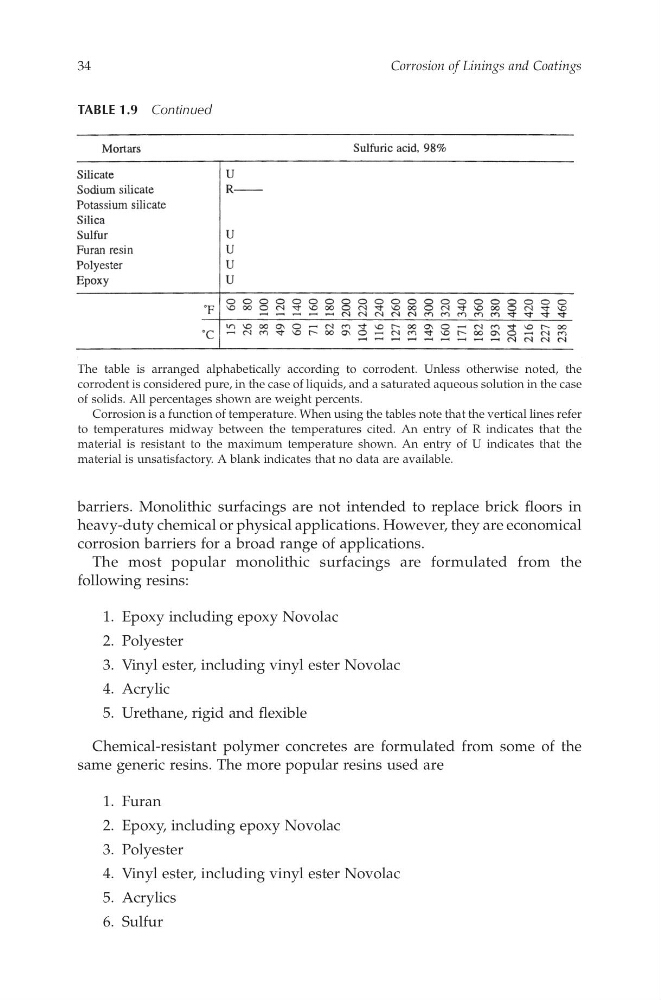
The table is arranged alphabetically according to corrodent. Unless otherwise noted, the
corrodent is considered pure, in the case of liquids, and asaturated aqueous solution in the case
of solids. All percentages shown are weight percents.
Corrosion is afunction of temperature. When using the tables note that the vertical lines refer
to temperatures midway between the temperatures cited. An entry of Ri ndicates that the
material is resistant to the maximum temperatures hown. An entry of Ui ndicates that the
material is unsatisfactory. Ab lank indicates that no data are available.
TABLE 1.9 Continued
Corrosion of Linings and Coatings
34
CAT8247—CHAPTER 1—6/10/2006—12:02—SRIDHAR—XML MODEL B–pp. 1–42
heavy-duty chemical or physical applications. However, they are economical
corrosion barriers for ab road range of applications.
Them ost popular monolithics urfacingsa re formulated from the
following resins:
1. Epoxy including epoxy Novolac
2. Polyester
3. Vinyl ester,i ncluding vinyl ester Novolac
4. Acrylic
5. Urethane, rigid and flexible
Chemical-resistant polymerc oncretes are formulated from someo ft he
same generic resins. The more popular resins used are
1. Furan
2. Epoxy,i ncluding epoxy Novolac
3. Polyester
4. Vinyl ester,i ncluding vinyl ester Novolac
5. Acrylics
6. Sulfur
The table is arranged alphabetically according to corrodent. Unless otherwise noted, the
corrodent is considered pure, in the case of liquids, and asaturated aqueous solution in the case
of solids. All percentages shown are weight percents.
Corrosion is afunction of temperature. When using the tables note that the vertical lines refer
to temperatures midway between the temperatures cited. An entry of Ri ndicates that the
material is resistant to the maximum temperatures hown. An entry of Ui ndicates that the
material is unsatisfactory. Ab lank indicates that no data are available.
TABLE 1.9 Continued
Corrosion of Linings and Coatings
34
CAT8247—CHAPTER 1—6/10/2006—12:02—SRIDHAR—XML MODEL B–pp. 1–42