

5. Failures around weld areas. Coating adhesion can be hampered by
weldfl ux that may also accelerate corrosion under the film. Relatively large projections of weld spatter causep ossible gaps and
cavities that may not be coated sufficiently to provide protection.
6. Edge failures. Edge failures usuallytake the form of rusting through
the film at the edge where the coating is normally the thinnest. This
is usually followed by eventual rust creepageunder the film.
7. Pinholing, tiny holes that expose the substrate, caused by improper
paints pray atomizationo rs egregation of resin in the coating. If
practical during application, brush out coating. After application
and proper cure,apply additional coating.
Polymer coatings are exposed to the environment and, therefore, are
subject to degradation by environmental constituents. The primary factors
promoting degradation are thermal, mechanical, radiant,a nd chemical.
Polymers may also be degraded by living organisms such as mildew.A ny
atmospheric environment is subject to dry andw et cycles. Since water and
moisture have ad ecided effect on the degradationo facoating, the time of
wetness of ac oating is important. Moisture and water that attacko rganic
films are from rain, fog,d ew,s now,a nd water vapors in the atmosphere.
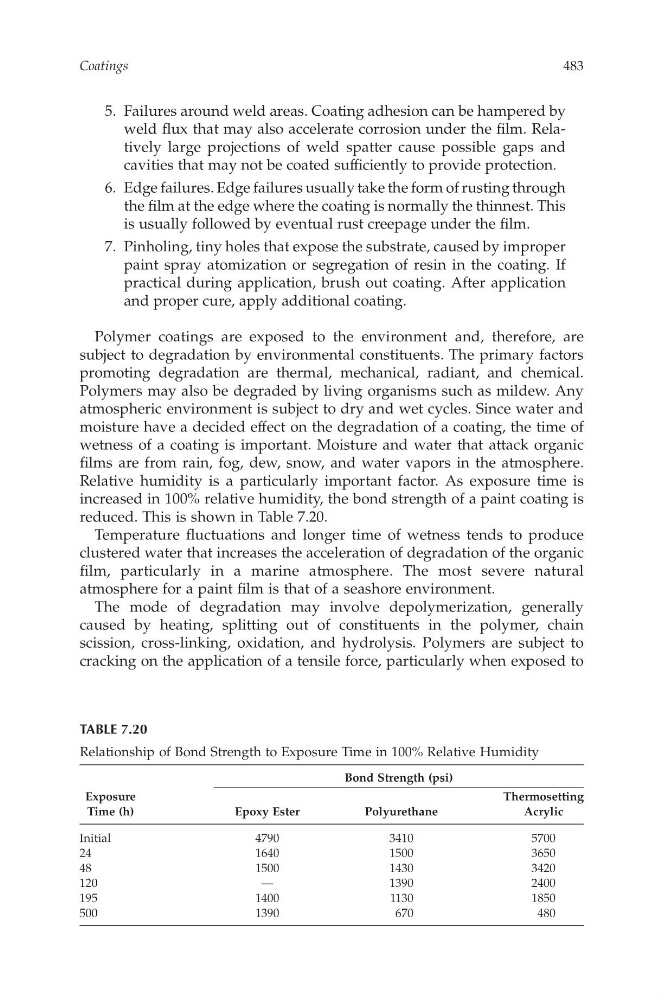
Relative humidity is ap articularly important factor.A se xposure time is
increased in 100% relative humidity,the bond strength of apaintcoating is
reduced. This is shown in Table 7.20.
Temperature fluctuations and longer time of wetness tends to produce
clustered water that increases the acceleration of degradationofthe organic
film, particularlyi namarine atmosphere.T he most severe natural
atmosphere for ap aint film is that of as eashore environment.
The mode of degradation mayi nvolve depolymerization,g enerally
caused by heating, splittingo ut of constituents in the polymer,c hain
scission, cross-linking, oxidation, and hydrolysis. Polymers are subject to
cracking on the application of at ensile force, particularly when exposed to
TABLE 7.20
Relationship of Bond Strength to Exposure Time in 100% Relative Humidity
Bond Strength (psi)
Exposure
Time (h)
Epoxy Ester
Polyurethane
Thermosetting
Acrylic
Initial
4790
3410
5700
24
1640
1500
3650
48
1500
1430
3420
120
—1 390
2400
195
1400
1130
1850
500
1390
670
480
Coatings
483
CAT8247—CHAPTER 7—17/10/2006—15:04—TRGANESH—XMLM ODEL B–pp. 403–485
weldfl ux that may also accelerate corrosion under the film. Relatively large projections of weld spatter causep ossible gaps and
cavities that may not be coated sufficiently to provide protection.
6. Edge failures. Edge failures usuallytake the form of rusting through
the film at the edge where the coating is normally the thinnest. This
is usually followed by eventual rust creepageunder the film.
7. Pinholing, tiny holes that expose the substrate, caused by improper
paints pray atomizationo rs egregation of resin in the coating. If
practical during application, brush out coating. After application
and proper cure,apply additional coating.
Polymer coatings are exposed to the environment and, therefore, are
subject to degradation by environmental constituents. The primary factors
promoting degradation are thermal, mechanical, radiant,a nd chemical.
Polymers may also be degraded by living organisms such as mildew.A ny
atmospheric environment is subject to dry andw et cycles. Since water and
moisture have ad ecided effect on the degradationo facoating, the time of
wetness of ac oating is important. Moisture and water that attacko rganic
films are from rain, fog,d ew,s now,a nd water vapors in the atmosphere.
Relative humidity is ap articularly important factor.A se xposure time is
increased in 100% relative humidity,the bond strength of apaintcoating is
reduced. This is shown in Table 7.20.
Temperature fluctuations and longer time of wetness tends to produce
clustered water that increases the acceleration of degradationofthe organic
film, particularlyi namarine atmosphere.T he most severe natural
atmosphere for ap aint film is that of as eashore environment.
The mode of degradation mayi nvolve depolymerization,g enerally
caused by heating, splittingo ut of constituents in the polymer,c hain
scission, cross-linking, oxidation, and hydrolysis. Polymers are subject to
cracking on the application of at ensile force, particularly when exposed to
TABLE 7.20
Relationship of Bond Strength to Exposure Time in 100% Relative Humidity
Bond Strength (psi)
Exposure
Time (h)
Epoxy Ester
Polyurethane
Thermosetting
Acrylic
Initial
4790
3410
5700
24
1640
1500
3650
48
1500
1430
3420
120
—1 390
2400
195
1400
1130
1850
500
1390
670
480
Coatings
483
CAT8247—CHAPTER 7—17/10/2006—15:04—TRGANESH—XMLM ODEL B–pp. 403–485