

7.13.1.3 Fillers (Extenders)
In addition to lowering the cost, extenders also provide sag resistance to
the liquidpaint so that the edges remain covered. When the painthas dried,
they reduce the permeability to water and oxygen and provide reinforcing
structure within the film. Talc andm ica are used extensively as extenders.
Mica is limited to approximately 10% of the total pigment. Both talc and
mica, but particularly mica, reduce the permeability through the film as
platelike particles block permeation, forcing water and oxygen to seek
al onger paththrough the binder around the particle.
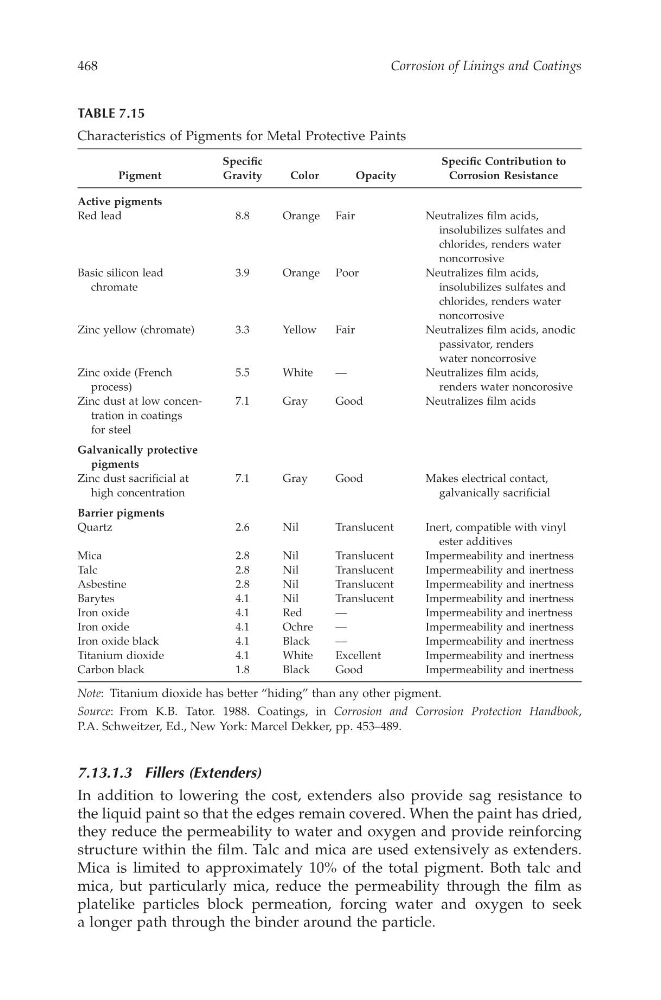
TABLE 7.15
Characteristics of Pigments for Metal Protective Paints
Pigment
Specific
Gravity
Color
Opacity
Specific Contributiont o
Corrosion Resistance
Active pigments
Red lead
8.8
Orange Fair
Neutralizes film acids,
insolubilizes sulfates and
chlorides, renders water
noncorrosive
Basic silicon lead
chromate
3.9
Orange Poor
Neutralizes film acids,
insolubilizes sulfates and
chlorides, renders water
noncorrosive
Zinc yellow (chromate)
3.3
Yellow
Fair
Neutralizes film acids, anodic
passivator,r enders
water noncorrosive
Zinc oxide (French
process)
5.5
White
—N eutralizes film acids,
renders water noncorosive
Zinc dust at low concentration in coatings
for steel
7.1
Gray
GoodN eutralizes film acids
Galvanically protective
pigments
Zinc dust sacrificial at
high concentration
7.1
Gray
GoodM akes electrical contact,
galvanically sacrificial
Barrier pigments
Quartz
2.6
Nil
Translucent
Inert, compatible with vinyl
ester additives
Mica
2.8
Nil
Translucent
Impermeability and inertness
Talc
2.8
Nil
Translucent
Impermeability and inertness
Asbestine
2.8
Nil
Translucent
Impermeability and inertness
Barytes
4.1
Nil
Translucent
Impermeability and inertness
Iron oxide
4.1
Red
—I mpermeability and inertness
Iron oxide
4.1
Ochre
—I mpermeability and inertness
Iron oxide black
4.1
Black
—I mpermeability and inertness
Titanium dioxide
4.1
White
Excellent
Impermeability and inertness
Carbon black
1.8
Black
GoodI mpermeability and inertness
Note:T itanium dioxide has better “hiding”t han any other pigment.
Source:F rom K.B. Tator. 1988. Coatings, in Corrosion and CorrosionP rotection Handbook,
P. A. Schweitzer,E d., New York: Marcel Dekker,p p. 453–489.
Corrosion of Linings and Coatings
468
CAT8247—CHAPTER 7—17/10/2006—15:03—TRGANESH—XMLM ODEL B–pp. 403–485
In addition to lowering the cost, extenders also provide sag resistance to
the liquidpaint so that the edges remain covered. When the painthas dried,
they reduce the permeability to water and oxygen and provide reinforcing
structure within the film. Talc andm ica are used extensively as extenders.
Mica is limited to approximately 10% of the total pigment. Both talc and
mica, but particularly mica, reduce the permeability through the film as
platelike particles block permeation, forcing water and oxygen to seek
al onger paththrough the binder around the particle.
TABLE 7.15
Characteristics of Pigments for Metal Protective Paints
Pigment
Specific
Gravity
Color
Opacity
Specific Contributiont o
Corrosion Resistance
Active pigments
Red lead
8.8
Orange Fair
Neutralizes film acids,
insolubilizes sulfates and
chlorides, renders water
noncorrosive
Basic silicon lead
chromate
3.9
Orange Poor
Neutralizes film acids,
insolubilizes sulfates and
chlorides, renders water
noncorrosive
Zinc yellow (chromate)
3.3
Yellow
Fair
Neutralizes film acids, anodic
passivator,r enders
water noncorrosive
Zinc oxide (French
process)
5.5
White
—N eutralizes film acids,
renders water noncorosive
Zinc dust at low concentration in coatings
for steel
7.1
Gray
GoodN eutralizes film acids
Galvanically protective
pigments
Zinc dust sacrificial at
high concentration
7.1
Gray
GoodM akes electrical contact,
galvanically sacrificial
Barrier pigments
Quartz
2.6
Nil
Translucent
Inert, compatible with vinyl
ester additives
Mica
2.8
Nil
Translucent
Impermeability and inertness
Talc
2.8
Nil
Translucent
Impermeability and inertness
Asbestine
2.8
Nil
Translucent
Impermeability and inertness
Barytes
4.1
Nil
Translucent
Impermeability and inertness
Iron oxide
4.1
Red
—I mpermeability and inertness
Iron oxide
4.1
Ochre
—I mpermeability and inertness
Iron oxide black
4.1
Black
—I mpermeability and inertness
Titanium dioxide
4.1
White
Excellent
Impermeability and inertness
Carbon black
1.8
Black
GoodI mpermeability and inertness
Note:T itanium dioxide has better “hiding”t han any other pigment.
Source:F rom K.B. Tator. 1988. Coatings, in Corrosion and CorrosionP rotection Handbook,
P. A. Schweitzer,E d., New York: Marcel Dekker,p p. 453–489.
Corrosion of Linings and Coatings
468
CAT8247—CHAPTER 7—17/10/2006—15:03—TRGANESH—XMLM ODEL B–pp. 403–485