

7.13.1.1.5 Urethanes
Urethanes arer eaction products of isocyanates with materialsh aving
hydroxyl groups and simply contain as ubstantial number of urethane
groups (–N–C–O–) regardless of what the rest of the molecule may be.
The hydroxyl containing side might consist of av ariety of compounds
including water (moisture cured urethanes), epoxies, polyesters, acrylics,
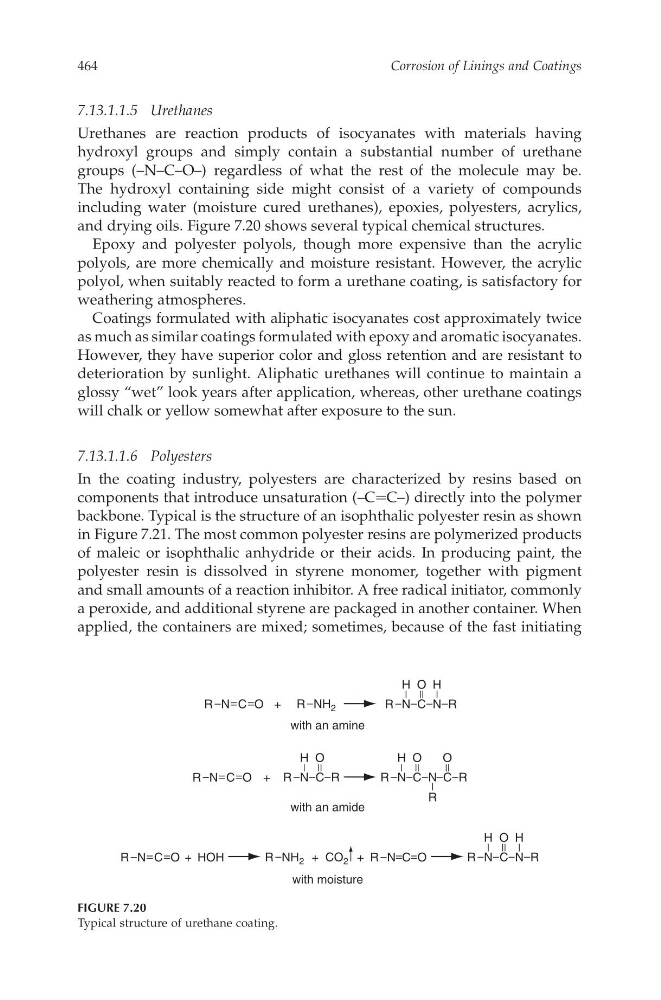
and drying oils. Figure 7.20 shows several typical chemical structures.
Epoxya nd polyester polyols, though more expensive than the acrylic
polyols, are more chemically and moisture resistant. However, the acrylic
polyol, when suitably reacted to form aurethane coating, is satisfactory for
weathering atmospheres.
Coatings formulated with aliphatic isocyanates cost approximately twice
as much as similar coatings formulated with epoxy and aromatic isocyanates.
However, they have superior color and gloss retention and are resistant to
deteriorationb ys unlight. Aliphatic urethanes willc ontinue to maintain a
glossy“ wet” looky ears after application, whereas, other urethane coatings
willchalk or yellow somewhat after exposure to the sun.
7.13.1.1.6 Polyesters
In the coating industry,p olyesters are characterized by resins based on
components that introduce unsaturation (–Ca C–) directly into the polymer
backbone. Typical is the structureofanisophthalic polyester resin as shown
in Figure 7.21.The most common polyester resins are polymerized products
of maleic or isophthalic anhydride or theira cids. In producing paint, the
polyester resin is dissolvedi ns tyrene monomer, together with pigment
and small amounts of areaction inhibitor.Afree radical initiator,commonly
aperoxide, and additional styrene are packaged in another container.When
applied, the containers are mixed; sometimes, because of the fast initiating
with moisture
with an amine
with an amide
RNCO +
+
++
+
RNC N
H
R
RN H 2
CO 2
RN H 2
HO
RNC N
H
R
HO
RNC R
HO
RNC N
R
HOH
HO
C R
O
RNCO
RNCO
RNCO
FIGURE 7.20
Typical structureofurethane coating.
Corrosion of Linings and Coatings
464
CAT8247—CHAPTER 7—17/10/2006—15:03—TRGANESH—XMLM ODEL B–pp. 403–485
Urethanes arer eaction products of isocyanates with materialsh aving
hydroxyl groups and simply contain as ubstantial number of urethane
groups (–N–C–O–) regardless of what the rest of the molecule may be.
The hydroxyl containing side might consist of av ariety of compounds
including water (moisture cured urethanes), epoxies, polyesters, acrylics,
and drying oils. Figure 7.20 shows several typical chemical structures.
Epoxya nd polyester polyols, though more expensive than the acrylic
polyols, are more chemically and moisture resistant. However, the acrylic
polyol, when suitably reacted to form aurethane coating, is satisfactory for
weathering atmospheres.
Coatings formulated with aliphatic isocyanates cost approximately twice
as much as similar coatings formulated with epoxy and aromatic isocyanates.
However, they have superior color and gloss retention and are resistant to
deteriorationb ys unlight. Aliphatic urethanes willc ontinue to maintain a
glossy“ wet” looky ears after application, whereas, other urethane coatings
willchalk or yellow somewhat after exposure to the sun.
7.13.1.1.6 Polyesters
In the coating industry,p olyesters are characterized by resins based on
components that introduce unsaturation (–Ca C–) directly into the polymer
backbone. Typical is the structureofanisophthalic polyester resin as shown
in Figure 7.21.The most common polyester resins are polymerized products
of maleic or isophthalic anhydride or theira cids. In producing paint, the
polyester resin is dissolvedi ns tyrene monomer, together with pigment
and small amounts of areaction inhibitor.Afree radical initiator,commonly
aperoxide, and additional styrene are packaged in another container.When
applied, the containers are mixed; sometimes, because of the fast initiating
with moisture
with an amine
with an amide
RNCO +
+
++
+
RNC N
H
R
RN H 2
CO 2
RN H 2
HO
RNC N
H
R
HO
RNC R
HO
RNC N
R
HOH
HO
C R
O
RNCO
RNCO
RNCO
FIGURE 7.20
Typical structureofurethane coating.
Corrosion of Linings and Coatings
464
CAT8247—CHAPTER 7—17/10/2006—15:03—TRGANESH—XMLM ODEL B–pp. 403–485