

Chrome baths always contain asource of hexavalent chromium ion (e.g.,
chromate, dichromate.o rc hromic acid) and an acidt op roduce al ow pH
that usually is in the range of 0–3. As ource of fluoride ionsi sa lso usually
present. These fluoride ions willa ttackt he original (natural) aluminum
oxide film, exposingt he base metal substrate to the bath solution. Fluoride
also prevents the aluminum ions( that arer eleased by the dissolution
of the oxide layer)f romp recipitating by forming complex ions. The
fluoridec oncentration is critical.I ft he concentration is tool ow,a
conversion layer will not form because of the failure of the fluoride to
attackt he natural oxide layer,w hereas, too highaconcentration results in
poor adherence of the coating because of reaction of the fluoride with the
aluminum metal substrate.
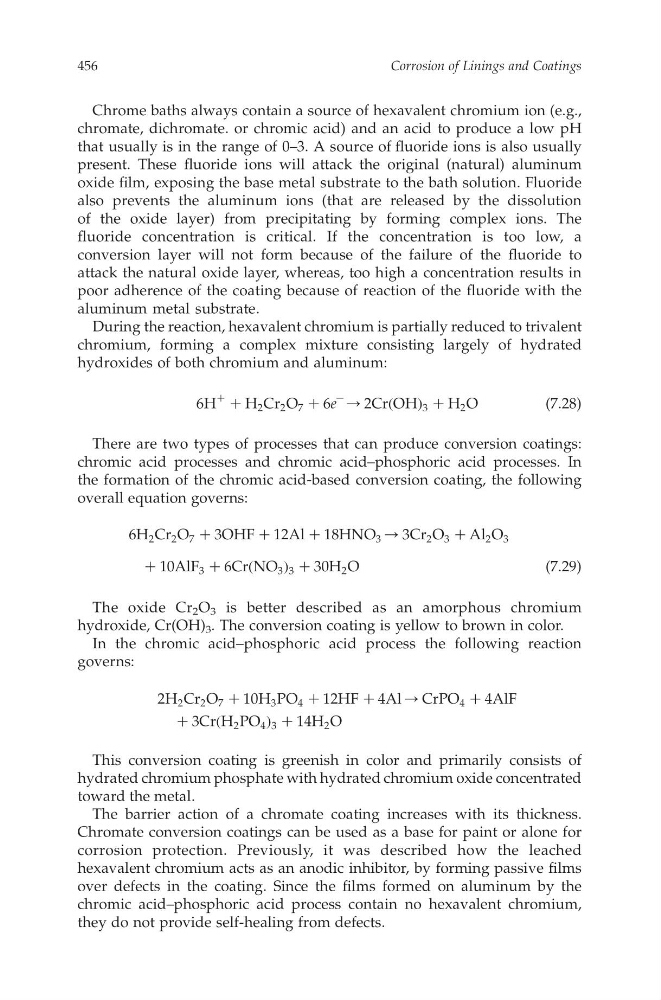
Duringthe reaction, hexavalent chromium is partiallyreduced to trivalent
chromium, forming ac omplex mixture consisting largely of hydrated
hydroxides of both chromium and aluminum:
6H
C C H 2 Cr 2 O 7 C 6 e
K
/ 2Crð OHÞ 3 C H 2 O( 7.28)
There are two types of processes that can produce conversion coatings:
chromic acid processes and chromic acid–phosphoric acid processes. In
the formation of the chromic acid-based conversion coating, the following
overall equation governs:
6H 2 Cr 2 O 7 C 3OHF C 12Al C 18HNO 3 / 3Cr 2 O 3 C Al 2 O 3
C 10AlF 3 C 6Crð NO 3 Þ 3 C 30H 2 O( 7.29)
Theo xide Cr 2 O 3 is better described as an amorphousc hromium
hydroxide, Cr(OH) 3 .T he conversioncoating is yellow to brown in color.
In thec hromic acid–phosphoric acid processt he followingr eaction
governs:
2H 2 Cr 2 O 7 C 10H 3 PO 4 C 12HF C 4Al/ CrPO 4 C 4AlF
C 3Crð H 2 PO 4 Þ 3 C 14H 2 O
This conversionc oating is greenish in color and primarilyc onsists of
hydrated chromium phosphate with hydrated chromium oxide concentrated
toward the metal.
The barrier actiono fachromate coating increases with its thickness.
Chromate conversion coatings can be used as ab ase for paint or alonef or
corrosionp rotection.P reviously,i tw as described howt he leached
hexavalentc hromium acts as an anodic inhibitor,b yf orming passive films
over defects in the coating. Since the films formed on aluminum by the
chromic acid–phosphoric acid process contain no hexavalent chromium,
they do not provide self-healing from defects.
Corrosion of Linings and Coatings
456
CAT8247—CHAPTER 7—17/10/2006—15:03—TRGANESH—XMLM ODEL B–pp. 403–485
chromate, dichromate.o rc hromic acid) and an acidt op roduce al ow pH
that usually is in the range of 0–3. As ource of fluoride ionsi sa lso usually
present. These fluoride ions willa ttackt he original (natural) aluminum
oxide film, exposingt he base metal substrate to the bath solution. Fluoride
also prevents the aluminum ions( that arer eleased by the dissolution
of the oxide layer)f romp recipitating by forming complex ions. The
fluoridec oncentration is critical.I ft he concentration is tool ow,a
conversion layer will not form because of the failure of the fluoride to
attackt he natural oxide layer,w hereas, too highaconcentration results in
poor adherence of the coating because of reaction of the fluoride with the
aluminum metal substrate.
Duringthe reaction, hexavalent chromium is partiallyreduced to trivalent
chromium, forming ac omplex mixture consisting largely of hydrated
hydroxides of both chromium and aluminum:
6H
C C H 2 Cr 2 O 7 C 6 e
K
/ 2Crð OHÞ 3 C H 2 O( 7.28)
There are two types of processes that can produce conversion coatings:
chromic acid processes and chromic acid–phosphoric acid processes. In
the formation of the chromic acid-based conversion coating, the following
overall equation governs:
6H 2 Cr 2 O 7 C 3OHF C 12Al C 18HNO 3 / 3Cr 2 O 3 C Al 2 O 3
C 10AlF 3 C 6Crð NO 3 Þ 3 C 30H 2 O( 7.29)
Theo xide Cr 2 O 3 is better described as an amorphousc hromium
hydroxide, Cr(OH) 3 .T he conversioncoating is yellow to brown in color.
In thec hromic acid–phosphoric acid processt he followingr eaction
governs:
2H 2 Cr 2 O 7 C 10H 3 PO 4 C 12HF C 4Al/ CrPO 4 C 4AlF
C 3Crð H 2 PO 4 Þ 3 C 14H 2 O
This conversionc oating is greenish in color and primarilyc onsists of
hydrated chromium phosphate with hydrated chromium oxide concentrated
toward the metal.
The barrier actiono fachromate coating increases with its thickness.
Chromate conversion coatings can be used as ab ase for paint or alonef or
corrosionp rotection.P reviously,i tw as described howt he leached
hexavalentc hromium acts as an anodic inhibitor,b yf orming passive films
over defects in the coating. Since the films formed on aluminum by the
chromic acid–phosphoric acid process contain no hexavalent chromium,
they do not provide self-healing from defects.
Corrosion of Linings and Coatings
456
CAT8247—CHAPTER 7—17/10/2006—15:03—TRGANESH—XMLM ODEL B–pp. 403–485