

An air formed film of Al 2 O 3 approximately 25 A ˚ thick formsonaluminum.
This film is chemically inert, and its rapidformation of oxide film by aselfhealing ability leads to satisfactory performance in natural environments.
Zinc, however,does not produce asurface oxide film that is as effective a
barrier as the oxide film on aluminum. The original barriers of zinc and zinc
alloy coatings result from electrochemical properties based on the structure
of the coating layer.
Nonuniformity of the surfacec ondition generally induces the formation
of ac orrosion cell. Such nonuniformity results from defects in the surface
oxidefi lm, localized distribution of elements, and the difference in crystal
face or phase.These nonuniformities of surfacecause the potential difference
betweenp ortions of the surface, thereby,p romoting the formation of a
corrosion cell.
Many corrosion cells are formed on the surface, accelerating the corrosion
rate, as as acrificial metal and its alloy-coated materials are exposed in the
natural atmosphere. During this time,c orrosion products are gradually
formed and converted to as tablel ayer after af ew monthso fe xposure.
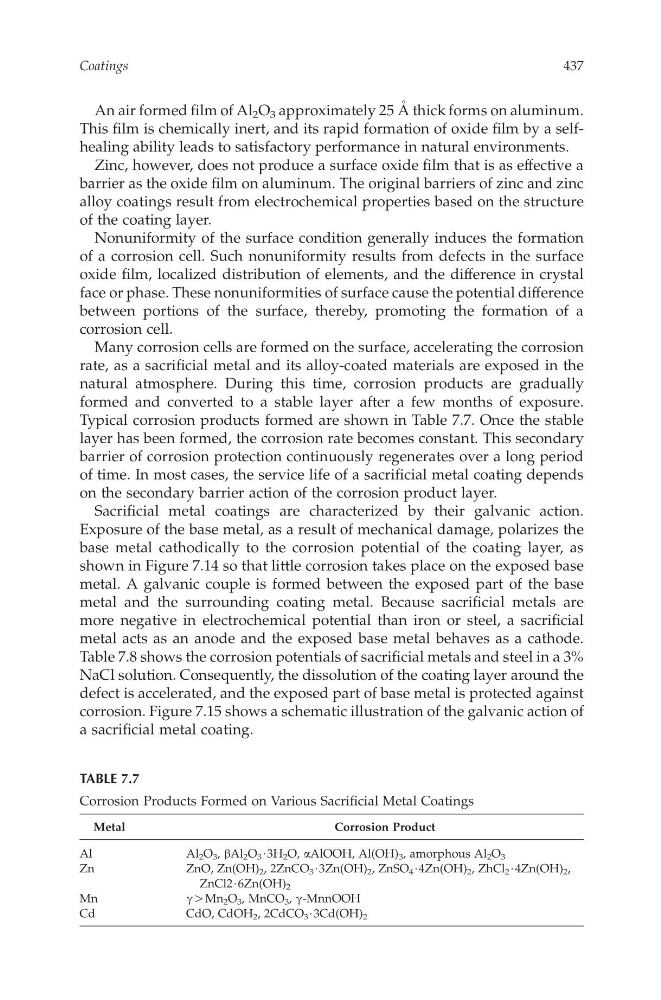
Typical corrosion products formed are shown in Table7 .7.O nce the stable
layer has been formed, the corrosion rate becomes constant. Thissecondary
barrier of corrosion protection continuously regenerates over al ong period
of time.Inmostcases, the service life of asacrificial metal coating depends
on the secondary barrier action of the corrosion product layer.
Sacrificial metal coatings are characterized by their galvanic action.
Exposure of the base metal,asaresult of mechanical damage, polarizesthe
base metal cathodically to the corrosion potential of the coating layer,a s
shown in Figure 7.14 so that little corrosiontakes place on the exposed base
metal. Ag alvanic couplei sf ormed between the exposed part of the base
metal and the surrounding coating metal.B ecause sacrificial metals are
more negative in electrochemicalp otential than iron or steel, as acrificial
metal acts as an anode and the exposed base metal behaves as ac athode.
Table 7.8 shows the corrosion potentials of sacrificial metals and steel in a3%
NaCl solution. Consequently,the dissolution of the coating layer aroundthe
defect is accelerated, and the exposed part of base metal is protected against
corrosion. Figure 7.15 shows aschematic illustration of the galvanicaction of
as acrificial metal coating.
TABLE 7.7
Corrosion Products Formed on Various Sacrificial Metal Coatings
Metal
CorrosionP roduct
Al
Al 2 O 3 , b Al 2 O 3 $ 3H 2 O, a AlOOH, Al(OH) 3 ,amorphous Al 2 O 3
Zn
ZnO, Zn(OH) 2 ,2ZnCO 3 $ 3Zn(OH) 2 ,ZnSO 4 $ 4Zn(OH) 2 ,ZhCl 2 $ 4Zn(OH) 2 ,
ZnCl2$ 6Zn(OH) 2
Mn
g O Mn 2 O 3 ,MnCO 3 , g -MnnOOH
Cd
CdO, CdOH 2 ,2CdCO 3 $ 3Cd(OH) 2
Coatings
437
CAT8247—CHAPTER 7—17/10/2006—15:02—TRGANESH—XMLM ODEL B–pp. 403–485
This film is chemically inert, and its rapidformation of oxide film by aselfhealing ability leads to satisfactory performance in natural environments.
Zinc, however,does not produce asurface oxide film that is as effective a
barrier as the oxide film on aluminum. The original barriers of zinc and zinc
alloy coatings result from electrochemical properties based on the structure
of the coating layer.
Nonuniformity of the surfacec ondition generally induces the formation
of ac orrosion cell. Such nonuniformity results from defects in the surface
oxidefi lm, localized distribution of elements, and the difference in crystal
face or phase.These nonuniformities of surfacecause the potential difference
betweenp ortions of the surface, thereby,p romoting the formation of a
corrosion cell.
Many corrosion cells are formed on the surface, accelerating the corrosion
rate, as as acrificial metal and its alloy-coated materials are exposed in the
natural atmosphere. During this time,c orrosion products are gradually
formed and converted to as tablel ayer after af ew monthso fe xposure.
Typical corrosion products formed are shown in Table7 .7.O nce the stable
layer has been formed, the corrosion rate becomes constant. Thissecondary
barrier of corrosion protection continuously regenerates over al ong period
of time.Inmostcases, the service life of asacrificial metal coating depends
on the secondary barrier action of the corrosion product layer.
Sacrificial metal coatings are characterized by their galvanic action.
Exposure of the base metal,asaresult of mechanical damage, polarizesthe
base metal cathodically to the corrosion potential of the coating layer,a s
shown in Figure 7.14 so that little corrosiontakes place on the exposed base
metal. Ag alvanic couplei sf ormed between the exposed part of the base
metal and the surrounding coating metal.B ecause sacrificial metals are
more negative in electrochemicalp otential than iron or steel, as acrificial
metal acts as an anode and the exposed base metal behaves as ac athode.
Table 7.8 shows the corrosion potentials of sacrificial metals and steel in a3%
NaCl solution. Consequently,the dissolution of the coating layer aroundthe
defect is accelerated, and the exposed part of base metal is protected against
corrosion. Figure 7.15 shows aschematic illustration of the galvanicaction of
as acrificial metal coating.
TABLE 7.7
Corrosion Products Formed on Various Sacrificial Metal Coatings
Metal
CorrosionP roduct
Al
Al 2 O 3 , b Al 2 O 3 $ 3H 2 O, a AlOOH, Al(OH) 3 ,amorphous Al 2 O 3
Zn
ZnO, Zn(OH) 2 ,2ZnCO 3 $ 3Zn(OH) 2 ,ZnSO 4 $ 4Zn(OH) 2 ,ZhCl 2 $ 4Zn(OH) 2 ,
ZnCl2$ 6Zn(OH) 2
Mn
g O Mn 2 O 3 ,MnCO 3 , g -MnnOOH
Cd
CdO, CdOH 2 ,2CdCO 3 $ 3Cd(OH) 2
Coatings
437
CAT8247—CHAPTER 7—17/10/2006—15:02—TRGANESH—XMLM ODEL B–pp. 403–485