

This coating has the disadvantage of forming red rust when immersed
in water;c onsequently,n ickel–iron alloy coating is suitable for use in
mild atmospheres only.T ypical applications include kitchenware and
tubular furniture.
7.3.4 Chromium Coatings
In the northern parts of the United States, immediately after World WarII, it
was not unusualf or the chromium plated bumpers on the most expensive
cars to shows evere signso fr ustw ithin af ew months of winter exposure.
This was partially the result of trying to extend the short supply of strategic
metals by economizing on the amount used. However,the more basic reason
was the lack of sufficientk nowledge of the corrosion process in order to
control the attackbythe atmosphere. Consequently,anaggressive industrial
program was undertaken to obtain ab etter understanding of the corrosion
process and ways to controli t.
Chromium-plated parts on automobiles consist of steel substrateswith an
intermediate layer of nickel, or in some cases, layered deposits of copper and
nickel.T he thin chromium depositp rovides bright appearance and stain
free surfacew hile the nickell ayer provides the corrosion protection to the
steel substrate. With this system, it is essential that the nickelc ompletely
covert he steel substrate because the iron will be the anode and nickel the
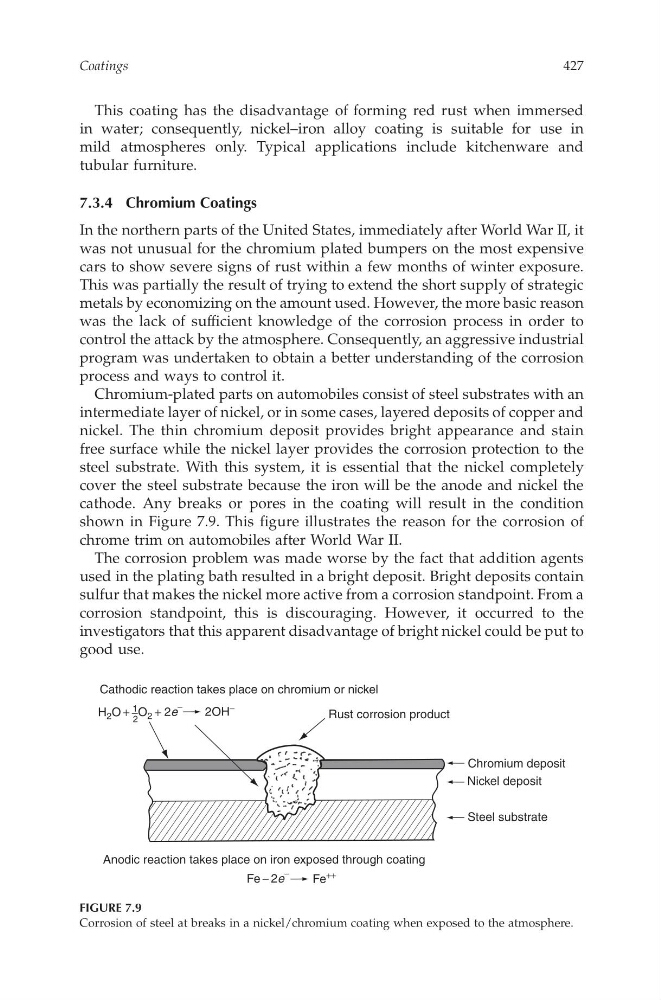
cathode. Any breaks or pores in the coating willr esult in the condition
shown in Figure 7.9.T his figure illustrates the reason for the corrosiono f
chrome trim on automobiles after World WarI I.
The corrosionp roblem was made worse by the fact that addition agents
used in the platingbath resulted in abright deposit. Bright deposits contain
sulfur that makes the nickel more active from acorrosion standpoint. From a
corrosion standpoint, this is discouraging. However,i to ccurred to the
investigators that this apparent disadvantage of bright nickel could be put to
good use.
Cathodic reaction takes place on chromium or nickel
Anodic reaction takes place on iron exposed through coating
Chromium deposit
Rust corrosion product
Nickeldeposit
Steel substrate
Fe − 2 e
−
Fe
++
H 2 O +
1
2
O 2 + 2 e
−
2OH
−
FIGURE 7.9
Corrosion of steel at breaksinanickel/chromium coating when exposed to the atmosphere.
Coatings
427
CAT8247—CHAPTER 7—17/10/2006—15:02—TRGANESH—XMLM ODEL B–pp. 403–485
in water;c onsequently,n ickel–iron alloy coating is suitable for use in
mild atmospheres only.T ypical applications include kitchenware and
tubular furniture.
7.3.4 Chromium Coatings
In the northern parts of the United States, immediately after World WarII, it
was not unusualf or the chromium plated bumpers on the most expensive
cars to shows evere signso fr ustw ithin af ew months of winter exposure.
This was partially the result of trying to extend the short supply of strategic
metals by economizing on the amount used. However,the more basic reason
was the lack of sufficientk nowledge of the corrosion process in order to
control the attackbythe atmosphere. Consequently,anaggressive industrial
program was undertaken to obtain ab etter understanding of the corrosion
process and ways to controli t.
Chromium-plated parts on automobiles consist of steel substrateswith an
intermediate layer of nickel, or in some cases, layered deposits of copper and
nickel.T he thin chromium depositp rovides bright appearance and stain
free surfacew hile the nickell ayer provides the corrosion protection to the
steel substrate. With this system, it is essential that the nickelc ompletely
covert he steel substrate because the iron will be the anode and nickel the
cathode. Any breaks or pores in the coating willr esult in the condition
shown in Figure 7.9.T his figure illustrates the reason for the corrosiono f
chrome trim on automobiles after World WarI I.
The corrosionp roblem was made worse by the fact that addition agents
used in the platingbath resulted in abright deposit. Bright deposits contain
sulfur that makes the nickel more active from acorrosion standpoint. From a
corrosion standpoint, this is discouraging. However,i to ccurred to the
investigators that this apparent disadvantage of bright nickel could be put to
good use.
Cathodic reaction takes place on chromium or nickel
Anodic reaction takes place on iron exposed through coating
Chromium deposit
Rust corrosion product
Nickeldeposit
Steel substrate
Fe − 2 e
−
Fe
++
H 2 O +
1
2
O 2 + 2 e
−
2OH
−
FIGURE 7.9
Corrosion of steel at breaksinanickel/chromium coating when exposed to the atmosphere.
Coatings
427
CAT8247—CHAPTER 7—17/10/2006—15:02—TRGANESH—XMLM ODEL B–pp. 403–485