

adsorption of one of the constituent ions. When the substrate metal is
immersedi nt he electrolyte, and ap otential is applied, ac oating will be
formed. If the particles have an egative charge, they will be deposited on
the anode, and if they have apositive charge, they will be deposited on the
cathode. Commercial applications of this method in the case of metals
is limited.
7.2.1.4 Cathodic Sputtering
This method is carried out under ap artial vacuum. The substrate to be
coated is attached to the anode. Argon, or asimilar inert gas, is admitted at
low pressure. Adischarge is initiated, and the positivelycharged gas ionsare
attractedt ot he cathode. Atoms are dislodged from the cathode as the gas
ions collide with the cathode. These atoms are attracted to the anode and
coat the substrate. Thism ethod can be used for nonconducting as wella s
conducting materials. The major disadvantages are the heating of the
substrate and low deposition rates.
Some of the most commonly used metals depositedb ys puttering are
aluminum, copper,c hromium, gold, molybdenum, nickel, platinum, silver,
tantalum, titanium, tungsten, vanadium, and zirconium.
Sputtered coatings are used for aw ide variety of applications. Some
examples are:
1. Metals and alloys areu sed as conductors, contacts, and resistors
and in other components suchasc apacitors.
2. Some high performance magnetic datas toragem edia are
deposited via sputtering.
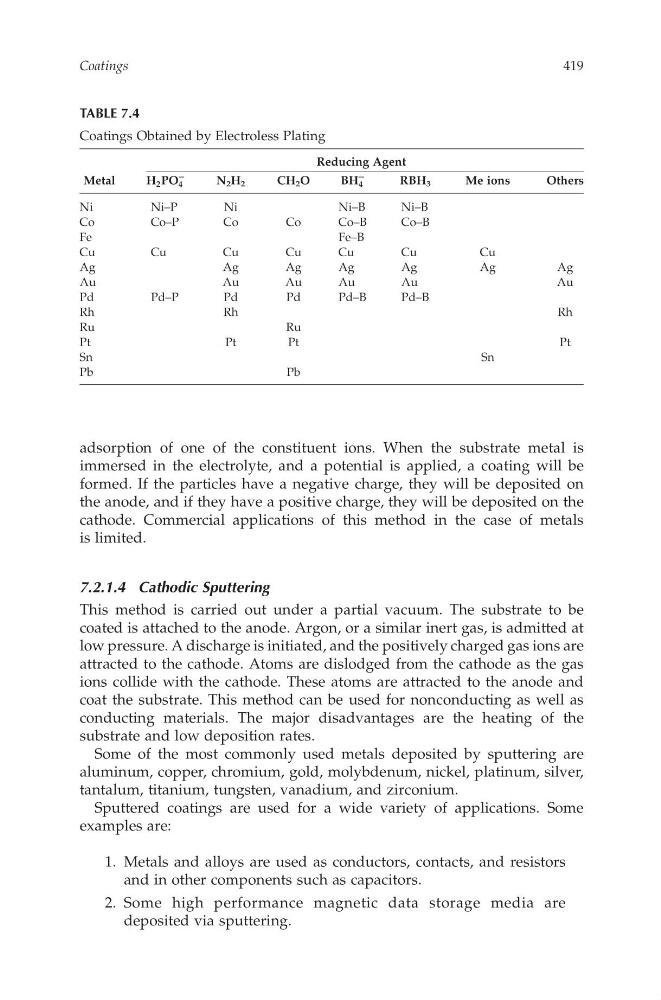
TABLE 7.4
Coatings Obtained by Electroless Plating
Reducing Agent
Metal
H 2 PO
L
4
N 2 H 2
CH 2 OB H
L
4
RBH 3
Me ions
Others
Ni
Ni–P
Ni
Ni–B
Ni–B
Co
Co–P
Co
Co
Co–B
Co–B
Fe
Fe–B
Cu
Cu
Cu
Cu
Cu
Cu
Cu
Ag
Ag
Ag
Ag
Ag
Ag
Ag
Au
Au
Au
Au
Au
Au
Pd
Pd–P
Pd
Pd
Pd–B
Pd–B
Rh
Rh
Rh
Ru
Ru
Pt
Pt
Pt
Pt
Sn
Sn
Pb
Pb
Coatings
419
CAT8247—CHAPTER 7—17/10/2006—15:02—TRGANESH—XMLM ODEL B–pp. 403–485
immersedi nt he electrolyte, and ap otential is applied, ac oating will be
formed. If the particles have an egative charge, they will be deposited on
the anode, and if they have apositive charge, they will be deposited on the
cathode. Commercial applications of this method in the case of metals
is limited.
7.2.1.4 Cathodic Sputtering
This method is carried out under ap artial vacuum. The substrate to be
coated is attached to the anode. Argon, or asimilar inert gas, is admitted at
low pressure. Adischarge is initiated, and the positivelycharged gas ionsare
attractedt ot he cathode. Atoms are dislodged from the cathode as the gas
ions collide with the cathode. These atoms are attracted to the anode and
coat the substrate. Thism ethod can be used for nonconducting as wella s
conducting materials. The major disadvantages are the heating of the
substrate and low deposition rates.
Some of the most commonly used metals depositedb ys puttering are
aluminum, copper,c hromium, gold, molybdenum, nickel, platinum, silver,
tantalum, titanium, tungsten, vanadium, and zirconium.
Sputtered coatings are used for aw ide variety of applications. Some
examples are:
1. Metals and alloys areu sed as conductors, contacts, and resistors
and in other components suchasc apacitors.
2. Some high performance magnetic datas toragem edia are
deposited via sputtering.
TABLE 7.4
Coatings Obtained by Electroless Plating
Reducing Agent
Metal
H 2 PO
L
4
N 2 H 2
CH 2 OB H
L
4
RBH 3
Me ions
Others
Ni
Ni–P
Ni
Ni–B
Ni–B
Co
Co–P
Co
Co
Co–B
Co–B
Fe
Fe–B
Cu
Cu
Cu
Cu
Cu
Cu
Cu
Ag
Ag
Ag
Ag
Ag
Ag
Ag
Au
Au
Au
Au
Au
Au
Pd
Pd–P
Pd
Pd
Pd–B
Pd–B
Rh
Rh
Rh
Ru
Ru
Pt
Pt
Pt
Pt
Sn
Sn
Pb
Pb
Coatings
419
CAT8247—CHAPTER 7—17/10/2006—15:02—TRGANESH—XMLM ODEL B–pp. 403–485