

condition. Metal dissolution and metal ion deposition are usually controlled
by the activationoverpotential.
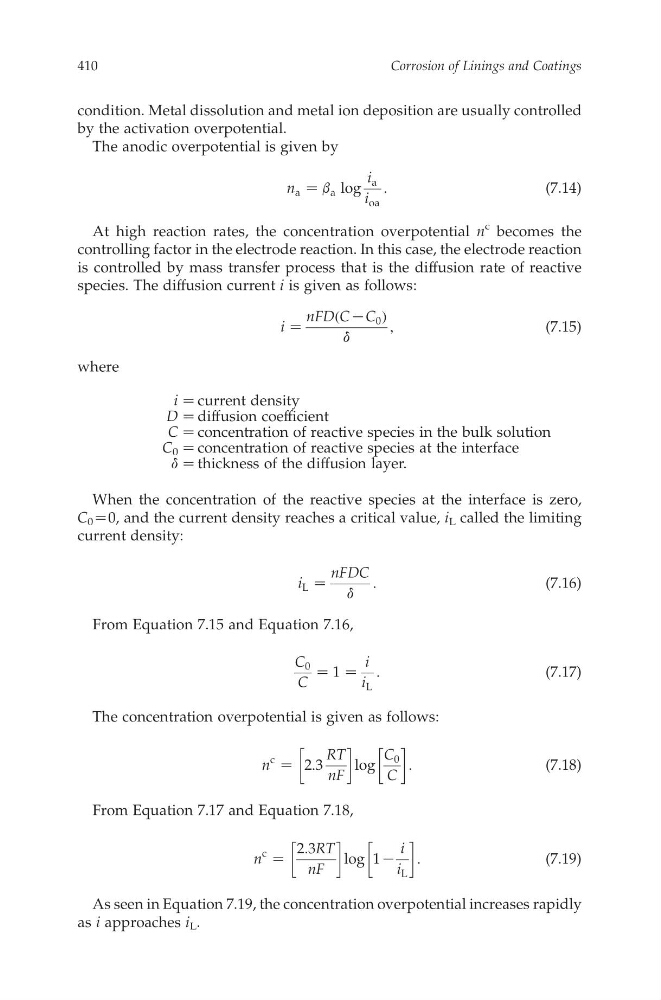
The anodicoverpotential is given by
n a Z b a log
i a
i oa
:
(7.14)
At high reaction rates,t he concentration overpotential n
c
becomes the
controlling factor in the electrode reaction. In this case, the electrode reaction
is controlled by mass transfer process that is the diffusion rate of reactive
species. The diffusion current i is given as follows:
i Z
nFDð C K C 0 Þ
d
;
(7.15)
where
i Z current density
D Z diffusion coefficient
C Z concentration of reactive speciesi nthe bulk solution
C 0 Z concentration of reactive speciesa tthe interface
d Z thickness of the diffusion layer.
When the concentration of the reactive species at the interface is zero,
C 0 Z 0, and the current density reaches acritical value, i L called the limiting
current density:
i L Z
nFDC
d
:
(7.16)
From Equation 7.15 and Equation 7.16,
C 0
C
Z 1 Z
i
i L
:
(7.17)
The concentration overpotential is given as follows:
n
c Z 2 : 3
RT
nF
log
C 0
C
:
(7.18)
From Equation 7.17 and Equation 7.18,
n
c Z
2 : 3 RT
nF
log 1 K
i
i L
:
(7.19)
As seen in Equation 7.19, the concentration overpotential increases rapidly
as i approaches i L .
Corrosion of Linings and Coatings
410
CAT8247—CHAPTER 7—17/10/2006—15:02—TRGANESH—XMLM ODEL B–pp. 403–485
by the activationoverpotential.
The anodicoverpotential is given by
n a Z b a log
i a
i oa
:
(7.14)
At high reaction rates,t he concentration overpotential n
c
becomes the
controlling factor in the electrode reaction. In this case, the electrode reaction
is controlled by mass transfer process that is the diffusion rate of reactive
species. The diffusion current i is given as follows:
i Z
nFDð C K C 0 Þ
d
;
(7.15)
where
i Z current density
D Z diffusion coefficient
C Z concentration of reactive speciesi nthe bulk solution
C 0 Z concentration of reactive speciesa tthe interface
d Z thickness of the diffusion layer.
When the concentration of the reactive species at the interface is zero,
C 0 Z 0, and the current density reaches acritical value, i L called the limiting
current density:
i L Z
nFDC
d
:
(7.16)
From Equation 7.15 and Equation 7.16,
C 0
C
Z 1 Z
i
i L
:
(7.17)
The concentration overpotential is given as follows:
n
c Z 2 : 3
RT
nF
log
C 0
C
:
(7.18)
From Equation 7.17 and Equation 7.18,
n
c Z
2 : 3 RT
nF
log 1 K
i
i L
:
(7.19)
As seen in Equation 7.19, the concentration overpotential increases rapidly
as i approaches i L .
Corrosion of Linings and Coatings
410
CAT8247—CHAPTER 7—17/10/2006—15:02—TRGANESH—XMLM ODEL B–pp. 403–485