

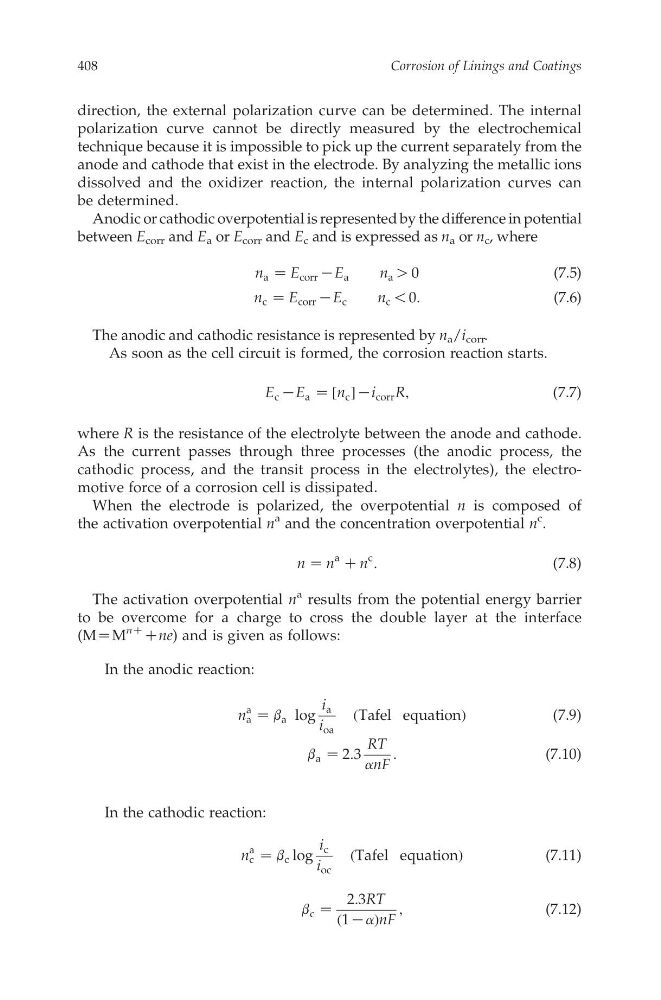
direction, the external polarization curve can be determined. The internal
polarization curve cannot be directly measured by the electrochemical
technique because it is impossible to pick up the currentseparately from the
anodeand cathode that exist in the electrode. By analyzing the metallic ions
dissolved and the oxidizer reaction, the internal polarization curves can
be determined.
Anodic or cathodic overpotentialisrepresented by thedifferenceinpotential
between E corr and E a or E corr and E c andisexpressed as n a or n c ,where
n a Z E corr K E a
n a O 0( 7.5)
n c Z E corr K E c
n c ! 0 :
(7.6)
Theanodicand cathodic resistance is representedby n a / i corr .
As soon as the cell circuiti sf ormed, the corrosionreaction starts.
E c K E a Z ½ n c K i corr R ;
(7.7)
where R is the resistance of the electrolyte betweenthe anode andcathode.
As the current passes through three processes (thea nodicp rocess, the
cathodic process, andt he transit process in the electrolytes), the electromotive force of ac orrosion cell is dissipated.
When the electrode is polarized, the overpotential n is composed of
the activationoverpotential n
a and the concentration overpotential n
c .
n Z n
a C n
c :
(7.8)
The activationo verpotential n
a
results from the potential energy barrier
to be overcome for ac harge to cross the double layer at the interface
(MZ M
n C C ne)and is given as follows:
In the anodic reaction:
n
a
a Z b a log
i a
i oa
ð Tafel equationÞ
(7.9)
b a Z 2 : 3
RT
a nF
:
(7.10)
In the cathodic reaction:
n
a
c Z b c log
i c
i oc
ð Tafel equationÞ
(7.11)
b c Z
2 : 3 RT
ð 1 K a Þ nF
;
(7.12)
Corrosion of Linings and Coatings
408
CAT8247—CHAPTER 7—17/10/2006—15:02—TRGANESH—XMLM ODEL B–pp. 403–485
polarization curve cannot be directly measured by the electrochemical
technique because it is impossible to pick up the currentseparately from the
anodeand cathode that exist in the electrode. By analyzing the metallic ions
dissolved and the oxidizer reaction, the internal polarization curves can
be determined.
Anodic or cathodic overpotentialisrepresented by thedifferenceinpotential
between E corr and E a or E corr and E c andisexpressed as n a or n c ,where
n a Z E corr K E a
n a O 0( 7.5)
n c Z E corr K E c
n c ! 0 :
(7.6)
Theanodicand cathodic resistance is representedby n a / i corr .
As soon as the cell circuiti sf ormed, the corrosionreaction starts.
E c K E a Z ½ n c K i corr R ;
(7.7)
where R is the resistance of the electrolyte betweenthe anode andcathode.
As the current passes through three processes (thea nodicp rocess, the
cathodic process, andt he transit process in the electrolytes), the electromotive force of ac orrosion cell is dissipated.
When the electrode is polarized, the overpotential n is composed of
the activationoverpotential n
a and the concentration overpotential n
c .
n Z n
a C n
c :
(7.8)
The activationo verpotential n
a
results from the potential energy barrier
to be overcome for ac harge to cross the double layer at the interface
(MZ M
n C C ne)and is given as follows:
In the anodic reaction:
n
a
a Z b a log
i a
i oa
ð Tafel equationÞ
(7.9)
b a Z 2 : 3
RT
a nF
:
(7.10)
In the cathodic reaction:
n
a
c Z b c log
i c
i oc
ð Tafel equationÞ
(7.11)
b c Z
2 : 3 RT
ð 1 K a Þ nF
;
(7.12)
Corrosion of Linings and Coatings
408
CAT8247—CHAPTER 7—17/10/2006—15:02—TRGANESH—XMLM ODEL B–pp. 403–485