

and abrasion resistance over its entire operating range, and good tensile,
flexural, and wear related properties.
Halar is very similar in its corrosionr esistance to PTFE, but it does
not have the permeation problem associated with PTFE, PFA, and FEP.
It is resistant to strong mineraland oxidizingacids, alkalies, metal etchants,
liquido xygen, andp ractically all organic solvents except hot amines,
aniline, dimethylamine,e tc. ECTFEi sn ot subjectt oc hemically
induceds tressc rackingf roms tronga cids,b ases, or solvents.S ome
halogenated solventsc an cause ECTFEt ob ecome slightly plasticized
when it comes into contactw ith them. Under normal circumstances,
this does not affect the usefulness of the polymerb ecause upon removal
of the solvent from contacta nd upon drying, its mechanical properties
return to their original values, indicating that no chemical attack has
takenplace.
Like other fluoropolymers, ECTFE will be attacked by metallic sodium
and potassium. Table 6.34 provides the compatibility of ECTFE with selected
corrodents.R eference [1]p rovidesamore comprehensivel isting of
corrosion resistance.
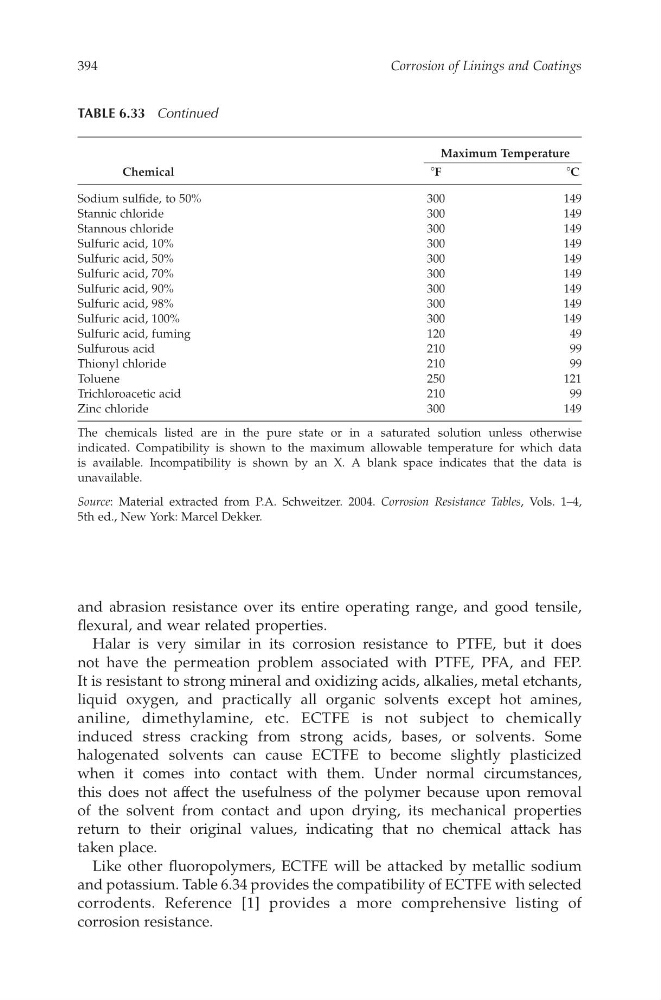
TABLE 6.33 Continued
Maximum Te mperature
Chemical
8 F
8 C
Sodium sulfide, to 50%
300
149
Stannic chloride
300
149
Stannous chloride
300
149
Sulfuric acid, 10%
300
149
Sulfuric acid, 50%
300
149
Sulfuric acid, 70%
300
149
Sulfuric acid, 90%
300
149
Sulfuric acid, 98%
300
149
Sulfuric acid, 100%
300
149
Sulfuric acid, fuming
120
49
Sulfurous acid
210
99
Thionyl chloride
210
99
Toluene
250
121
Trichloroacetic acid
210
99
Zinc chloride
300
149
The chemicals listed are in the pure state or in as aturated solution unless otherwise
indicated. Compatibility is shown to the maximum allowable temperaturef or which data
is available. Incompatibilityi ss hown by an X. Ab lank space indicates that the data is
unavailable.
Source:M aterial extracted from P. A. Schweitzer.2 004. Corrosion Resistance Ta bles,V ols. 1–4,
5th ed., New York: Marcel Dekker.
Corrosion of Linings and Coatings
394
CAT8247—CHAPTER 6—6/10/2006—12:32—SRIDHAR—XML MODEL B–pp. 287–402
flexural, and wear related properties.
Halar is very similar in its corrosionr esistance to PTFE, but it does
not have the permeation problem associated with PTFE, PFA, and FEP.
It is resistant to strong mineraland oxidizingacids, alkalies, metal etchants,
liquido xygen, andp ractically all organic solvents except hot amines,
aniline, dimethylamine,e tc. ECTFEi sn ot subjectt oc hemically
induceds tressc rackingf roms tronga cids,b ases, or solvents.S ome
halogenated solventsc an cause ECTFEt ob ecome slightly plasticized
when it comes into contactw ith them. Under normal circumstances,
this does not affect the usefulness of the polymerb ecause upon removal
of the solvent from contacta nd upon drying, its mechanical properties
return to their original values, indicating that no chemical attack has
takenplace.
Like other fluoropolymers, ECTFE will be attacked by metallic sodium
and potassium. Table 6.34 provides the compatibility of ECTFE with selected
corrodents.R eference [1]p rovidesamore comprehensivel isting of
corrosion resistance.
TABLE 6.33 Continued
Maximum Te mperature
Chemical
8 F
8 C
Sodium sulfide, to 50%
300
149
Stannic chloride
300
149
Stannous chloride
300
149
Sulfuric acid, 10%
300
149
Sulfuric acid, 50%
300
149
Sulfuric acid, 70%
300
149
Sulfuric acid, 90%
300
149
Sulfuric acid, 98%
300
149
Sulfuric acid, 100%
300
149
Sulfuric acid, fuming
120
49
Sulfurous acid
210
99
Thionyl chloride
210
99
Toluene
250
121
Trichloroacetic acid
210
99
Zinc chloride
300
149
The chemicals listed are in the pure state or in as aturated solution unless otherwise
indicated. Compatibility is shown to the maximum allowable temperaturef or which data
is available. Incompatibilityi ss hown by an X. Ab lank space indicates that the data is
unavailable.
Source:M aterial extracted from P. A. Schweitzer.2 004. Corrosion Resistance Ta bles,V ols. 1–4,
5th ed., New York: Marcel Dekker.
Corrosion of Linings and Coatings
394
CAT8247—CHAPTER 6—6/10/2006—12:32—SRIDHAR—XML MODEL B–pp. 287–402