

without some of the disadvantages. ECTFE can be welded with ordinary
thermoplastic welding equipment. It is used to line vesselsa nd pipe. Liner
thicknesses are usually 0.160 in. thick, that resists permeation. The water
absorption rate of ECTFE is low,beingless than 0.1%.
Halar has ab road use temperature range from cryogenic to 3408 F/1718 C
with continuous service to 3008 F/149 8 C. It exhibits excellentimpact strength
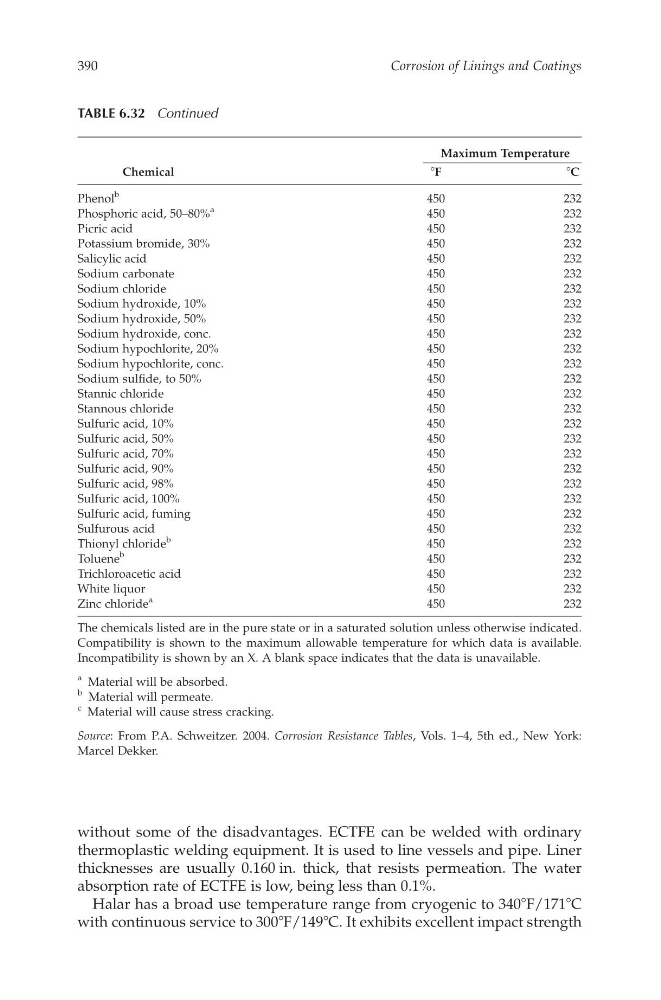
TABLE 6.32 Continued
Maximum Te mperature
Chemical
8 F
8 C
Phenol
b
450
232
Phosphoric acid, 50–80%
a
450
232
Picric acid
450
232
Potassium bromide, 30%
450
232
Salicylic acid
450
232
Sodium carbonate
450
232
Sodium chloride
450
232
Sodium hydroxide, 10%
450
232
Sodium hydroxide, 50%
450
232
Sodium hydroxide, conc.
450
232
Sodium hypochlorite,20%
450
232
Sodium hypochlorite,conc.
450
232
Sodium sulfide, to 50%
450
232
Stannic chloride
450
232
Stannous chloride
450
232
Sulfuric acid, 10%
450
232
Sulfuric acid, 50%
450
232
Sulfuric acid, 70%
450
232
Sulfuric acid, 90%
450
232
Sulfuric acid, 98%
450
232
Sulfuric acid, 100%
450
232
Sulfuric acid, fuming
450
232
Sulfurous acid
450
232
Thionyl chloride
b
450
232
Toluene
b
450
232
Trichloroacetic acid
450
232
White liquor
450
232
Zinc chloride
a
450
232
The chemicals listed are in the pure state or in asaturated solution unless otherwise indicated.
Compatibility is shown to the maximuma llowable temperature for which data is available.
Incompatibility is shown by an X. Ab lank space indicates that the data is unavailable.
a Material will be absorbed.
b Material will permeate.
c Material will cause stress cracking.
Source:F rom P. A. Schweitzer.2 004. Corrosion Resistance Ta bles,V ols. 1–4, 5th ed., New York:
Marcel Dekker.
Corrosion of Linings and Coatings
390
CAT8247—CHAPTER 6—6/10/2006—12:32—SRIDHAR—XML MODEL B–pp. 287–402
thermoplastic welding equipment. It is used to line vesselsa nd pipe. Liner
thicknesses are usually 0.160 in. thick, that resists permeation. The water
absorption rate of ECTFE is low,beingless than 0.1%.
Halar has ab road use temperature range from cryogenic to 3408 F/1718 C
with continuous service to 3008 F/149 8 C. It exhibits excellentimpact strength
TABLE 6.32 Continued
Maximum Te mperature
Chemical
8 F
8 C
Phenol
b
450
232
Phosphoric acid, 50–80%
a
450
232
Picric acid
450
232
Potassium bromide, 30%
450
232
Salicylic acid
450
232
Sodium carbonate
450
232
Sodium chloride
450
232
Sodium hydroxide, 10%
450
232
Sodium hydroxide, 50%
450
232
Sodium hydroxide, conc.
450
232
Sodium hypochlorite,20%
450
232
Sodium hypochlorite,conc.
450
232
Sodium sulfide, to 50%
450
232
Stannic chloride
450
232
Stannous chloride
450
232
Sulfuric acid, 10%
450
232
Sulfuric acid, 50%
450
232
Sulfuric acid, 70%
450
232
Sulfuric acid, 90%
450
232
Sulfuric acid, 98%
450
232
Sulfuric acid, 100%
450
232
Sulfuric acid, fuming
450
232
Sulfurous acid
450
232
Thionyl chloride
b
450
232
Toluene
b
450
232
Trichloroacetic acid
450
232
White liquor
450
232
Zinc chloride
a
450
232
The chemicals listed are in the pure state or in asaturated solution unless otherwise indicated.
Compatibility is shown to the maximuma llowable temperature for which data is available.
Incompatibility is shown by an X. Ab lank space indicates that the data is unavailable.
a Material will be absorbed.
b Material will permeate.
c Material will cause stress cracking.
Source:F rom P. A. Schweitzer.2 004. Corrosion Resistance Ta bles,V ols. 1–4, 5th ed., New York:
Marcel Dekker.
Corrosion of Linings and Coatings
390
CAT8247—CHAPTER 6—6/10/2006—12:32—SRIDHAR—XML MODEL B–pp. 287–402