

PFAw illb ea ttacked by certainh alogenated complexesc ontaining
fluorine. These include chlorine trifluoride, bromine trifluoride, iodine
pentafluoride, and fluorine. PFAc an also be attacked by suchm etals as
sodiumorp otassium, particularly in the moltenstate.
PFAh as the advantage over PTFE in that it can be thermoformed, heat
sealed, welded, and heat laminated. Thism akes the material much easier
to produce lining from than that of PTFE. PFAc an be bonded to am etal
substrate. Refer to Table 6.32 for the compatibility of PFAw ith selected
corrodents. Reference [1]provides additional listings.
6.6.9E thylene Tetrafluoroethylene
Ethylene Tetrafluoroethylene (ETFE) is sold under the trade nameo fT efzel
by DuPont. It is ap artially fluorinated copolymero fe thylenea nd
tetrafluoroethylene with am aximum service temperature of 3008 F/1498 C.
Tefzel can be melt bondedtou ntreated aluminum, steel, and copper.Itc an
also be melt bondedt oi tself. To adhesive bond Tefzel with polyester or
epoxy compounds, the surface must be chemically etched or subjected to
corona or flametreatments.
ETFE is ar ugged thermoplastic. It is less dense, tougher,s tiffer,a nd
exhibits ah igher tensile strength and creep resistance than PTFE and FEP
fluorocarbon resins.
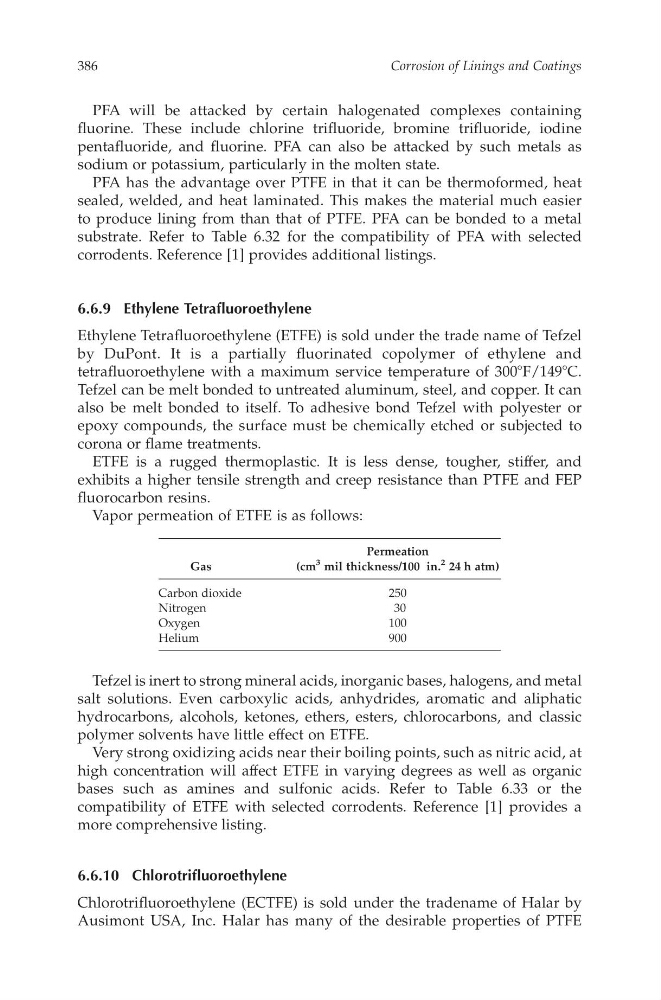
Vapor permeation of ETFE is as follows:
Gas
Permeation
(cm
3 mil thickness/100 in.
2 24 hatm)
Carbon dioxide
250
Nitrogen
30
Oxygen
100
Helium
900
Tefzel is inert to strong mineralacids, inorganic bases, halogens, and metal
salt solutions. Even carboxylic acids, anhydrides, aromatic and aliphatic
hydrocarbons, alcohols, ketones, ethers, esters,c hlorocarbons, and classic
polymer solvents have little effect on ETFE.
Ve ry strong oxidizing acids near theirboiling points, suchasnitric acid,at
high concentration will affect ETFE in varying degrees as well as organic
basess ucha sa minesa nd sulfonic acids. Refert oT able 6.33 or the
compatibility of ETFE with selected corrodents. Reference [1]p rovides a
more comprehensive listing.
6.6.10 Chlorotrifluoroethylene
Chlorotrifluoroethylene (ECTFE) is sold under the tradename of Halar by
Ausimont USA, Inc. Halar has many of the desirable properties of PTFE
Corrosion of Linings and Coatings
386
CAT8247—CHAPTER 6—6/10/2006—12:32—SRIDHAR—XML MODEL B–pp. 287–402
fluorine. These include chlorine trifluoride, bromine trifluoride, iodine
pentafluoride, and fluorine. PFAc an also be attacked by suchm etals as
sodiumorp otassium, particularly in the moltenstate.
PFAh as the advantage over PTFE in that it can be thermoformed, heat
sealed, welded, and heat laminated. Thism akes the material much easier
to produce lining from than that of PTFE. PFAc an be bonded to am etal
substrate. Refer to Table 6.32 for the compatibility of PFAw ith selected
corrodents. Reference [1]provides additional listings.
6.6.9E thylene Tetrafluoroethylene
Ethylene Tetrafluoroethylene (ETFE) is sold under the trade nameo fT efzel
by DuPont. It is ap artially fluorinated copolymero fe thylenea nd
tetrafluoroethylene with am aximum service temperature of 3008 F/1498 C.
Tefzel can be melt bondedtou ntreated aluminum, steel, and copper.Itc an
also be melt bondedt oi tself. To adhesive bond Tefzel with polyester or
epoxy compounds, the surface must be chemically etched or subjected to
corona or flametreatments.
ETFE is ar ugged thermoplastic. It is less dense, tougher,s tiffer,a nd
exhibits ah igher tensile strength and creep resistance than PTFE and FEP
fluorocarbon resins.
Vapor permeation of ETFE is as follows:
Gas
Permeation
(cm
3 mil thickness/100 in.
2 24 hatm)
Carbon dioxide
250
Nitrogen
30
Oxygen
100
Helium
900
Tefzel is inert to strong mineralacids, inorganic bases, halogens, and metal
salt solutions. Even carboxylic acids, anhydrides, aromatic and aliphatic
hydrocarbons, alcohols, ketones, ethers, esters,c hlorocarbons, and classic
polymer solvents have little effect on ETFE.
Ve ry strong oxidizing acids near theirboiling points, suchasnitric acid,at
high concentration will affect ETFE in varying degrees as well as organic
basess ucha sa minesa nd sulfonic acids. Refert oT able 6.33 or the
compatibility of ETFE with selected corrodents. Reference [1]p rovides a
more comprehensive listing.
6.6.10 Chlorotrifluoroethylene
Chlorotrifluoroethylene (ECTFE) is sold under the tradename of Halar by
Ausimont USA, Inc. Halar has many of the desirable properties of PTFE
Corrosion of Linings and Coatings
386
CAT8247—CHAPTER 6—6/10/2006—12:32—SRIDHAR—XML MODEL B–pp. 287–402