

FEP basically has the same corrosion resistance properties as PTFE but
at lower maximum temperatures. It is resistant to practically all chemicals,
the exception being extremely potento xidizers sucha sc hlorine trifluoride
and related compounds. Some chemicals will attackF EP when present in
high concentrations, at or near the service temperature limit.
Refer to Table 6.29 for the compatibility of FEP with selected corrodents.
Reference [1]p rovides additional listings.
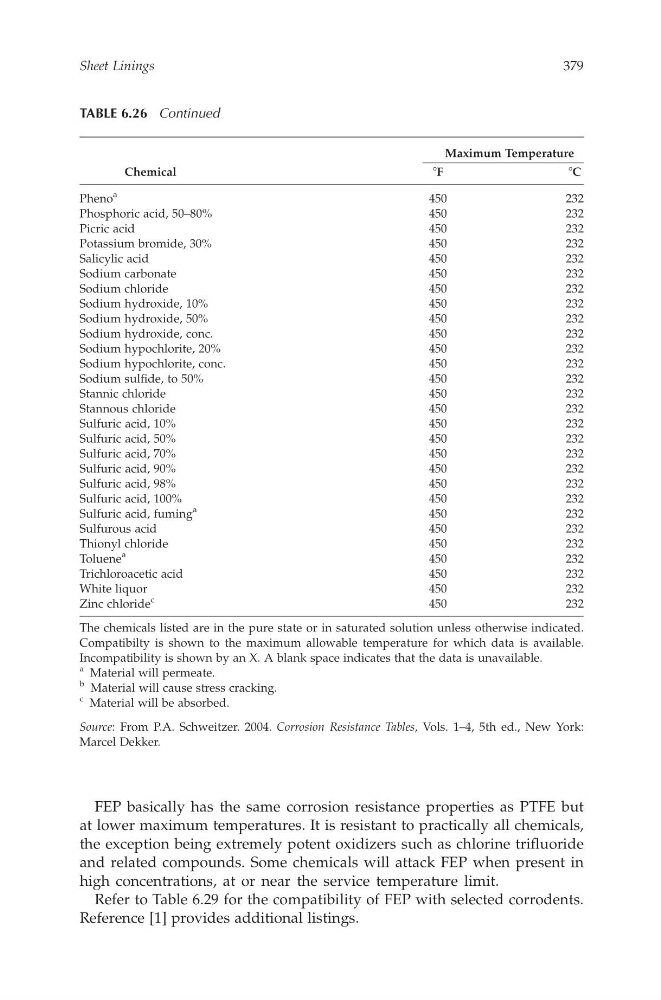
TABLE 6.26 Continued
Maximum Te mperature
Chemical
8 F
8 C
Pheno
a
450
232
Phosphoric acid, 50–80%
450
232
Picric acid
450
232
Potassium bromide, 30%
450
232
Salicylic acid
450
232
Sodium carbonate
450
232
Sodium chloride
450
232
Sodium hydroxide, 10%
450
232
Sodium hydroxide, 50%
450
232
Sodium hydroxide, conc.
450
232
Sodium hypochlorite, 20%
450
232
Sodium hypochlorite, conc.
450
232
Sodium sulfide, to 50%
450
232
Stannic chloride
450
232
Stannousc hloride4 50
232
Sulfuric acid, 10%
450
232
Sulfuric acid, 50%
450
232
Sulfuric acid, 70%
450
232
Sulfuric acid, 90%
450
232
Sulfuric acid, 98%
450
232
Sulfuric acid, 100%
450
232
Sulfuric acid, fuming
a
450
232
Sulfurous acid
450
232
Thionyl chloride
450
232
Toluene
a
450
232
Trichloroacetic acid
450
232
White liquor
450
232
Zinc chloride
c
450
232
The chemicals listed are in the pure state or in saturated solution unless otherwise indicated.
Compatibilty is shown to the maximum allowable temperaturef or which data is available.
Incompatibility is shown by an X. Ab lank space indicates that the data is unavailable.
a Material will permeate.
b Material will cause stress cracking.
c Material will be absorbed.
Source:F romP .A. Schweitzer.2 004. Corrosion Resistance Ta bles,V ols. 1–4, 5th ed., New York:
Marcel Dekker.
Sheet Linings
379
CAT8247—CHAPTER 6—6/10/2006—12:31—SRIDHAR—XML MODEL B–pp. 287–402
at lower maximum temperatures. It is resistant to practically all chemicals,
the exception being extremely potento xidizers sucha sc hlorine trifluoride
and related compounds. Some chemicals will attackF EP when present in
high concentrations, at or near the service temperature limit.
Refer to Table 6.29 for the compatibility of FEP with selected corrodents.
Reference [1]p rovides additional listings.
TABLE 6.26 Continued
Maximum Te mperature
Chemical
8 F
8 C
Pheno
a
450
232
Phosphoric acid, 50–80%
450
232
Picric acid
450
232
Potassium bromide, 30%
450
232
Salicylic acid
450
232
Sodium carbonate
450
232
Sodium chloride
450
232
Sodium hydroxide, 10%
450
232
Sodium hydroxide, 50%
450
232
Sodium hydroxide, conc.
450
232
Sodium hypochlorite, 20%
450
232
Sodium hypochlorite, conc.
450
232
Sodium sulfide, to 50%
450
232
Stannic chloride
450
232
Stannousc hloride4 50
232
Sulfuric acid, 10%
450
232
Sulfuric acid, 50%
450
232
Sulfuric acid, 70%
450
232
Sulfuric acid, 90%
450
232
Sulfuric acid, 98%
450
232
Sulfuric acid, 100%
450
232
Sulfuric acid, fuming
a
450
232
Sulfurous acid
450
232
Thionyl chloride
450
232
Toluene
a
450
232
Trichloroacetic acid
450
232
White liquor
450
232
Zinc chloride
c
450
232
The chemicals listed are in the pure state or in saturated solution unless otherwise indicated.
Compatibilty is shown to the maximum allowable temperaturef or which data is available.
Incompatibility is shown by an X. Ab lank space indicates that the data is unavailable.
a Material will permeate.
b Material will cause stress cracking.
c Material will be absorbed.
Source:F romP .A. Schweitzer.2 004. Corrosion Resistance Ta bles,V ols. 1–4, 5th ed., New York:
Marcel Dekker.
Sheet Linings
379
CAT8247—CHAPTER 6—6/10/2006—12:31—SRIDHAR—XML MODEL B–pp. 287–402