

as vinylidenefluoride, hexafluoroprene, and tetrafluoroethylene. The result
is ah igh-performance rubber with exceptional resistancet oo ilsa nd
chemicals at elevatedtemperatures.
As with other rubbers, fluoropolymers are capableofbeing compounded
with variousa dditivest oe nhance specific properties forp articular
applications.
Fluoropolymers are manufactured under various tradenames by different
manufacturers. Three typical materials are listed below:
Tr ade Name
Manufacturer
Viton
DuPont
Technoflon
Ausimont
Fluorel
3M
The temperature resistance of the fluoroelastomers is exceptionally good
over aw idet emperature range. At high temperatures, their mechanical
properties are retained better than those of any other elastomer.Compounds
remain usefullye lastic indefinitelyw hene xposed to agingu pt o
4008 F/204 8 C. Continuous service limits are generallyc onsidered to be as
follows:
3000 hat4508 F/2328 C
1000 hat5008 F/2608 C
240 hat5 508 F/2688 C
48 hat6 008 F/3138 C
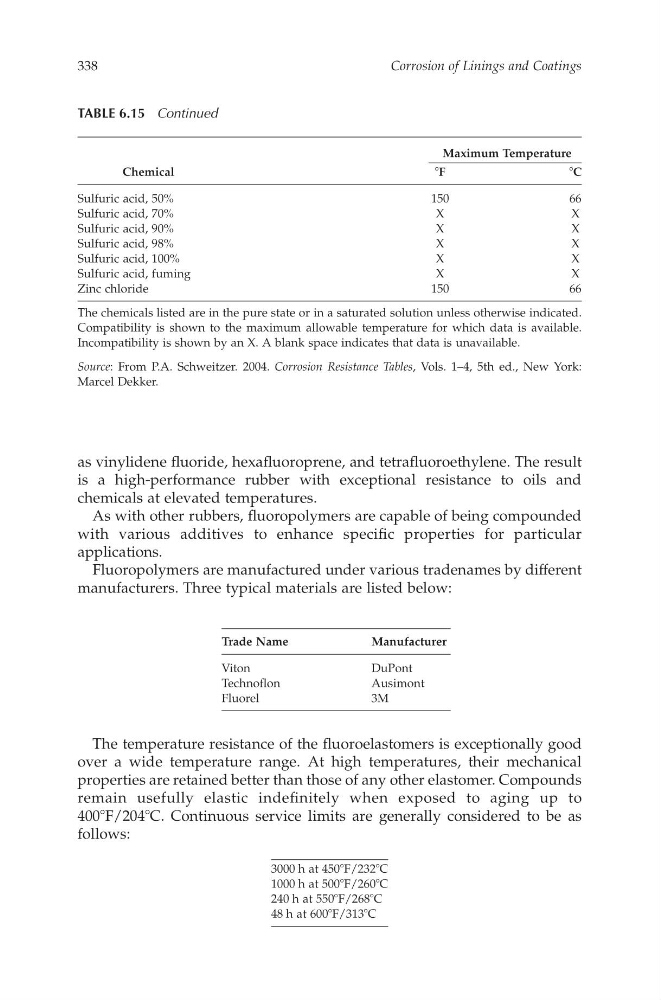
TABLE 6.15 Continued
Maximum Te mperature
Chemical
8 F
8 C
Sulfuric acid, 50%
150
66
Sulfuric acid, 70%
XX
Sulfuric acid, 90%
XX
Sulfuric acid, 98%
XX
Sulfuric acid, 100%
XX
Sulfuric acid, fuming
XX
Zinc chloride
150
66
The chemicals listed are in the pure state or in asaturated solution unless otherwise indicated.
Compatibility is shown to the maximuma llowable temperature for which data is available.
Incompatibility is shown by an X. Ab lank space indicates that data is unavailable.
Source:F rom P. A. Schweitzer.2 004. Corrosion Resistance Ta bles,V ols. 1–4, 5th ed., New York:
Marcel Dekker.
Corrosion of Linings and Coatings
338
CAT8247—CHAPTER 6—6/10/2006—12:29—SRIDHAR—XML MODEL B–pp. 287–402
is ah igh-performance rubber with exceptional resistancet oo ilsa nd
chemicals at elevatedtemperatures.
As with other rubbers, fluoropolymers are capableofbeing compounded
with variousa dditivest oe nhance specific properties forp articular
applications.
Fluoropolymers are manufactured under various tradenames by different
manufacturers. Three typical materials are listed below:
Tr ade Name
Manufacturer
Viton
DuPont
Technoflon
Ausimont
Fluorel
3M
The temperature resistance of the fluoroelastomers is exceptionally good
over aw idet emperature range. At high temperatures, their mechanical
properties are retained better than those of any other elastomer.Compounds
remain usefullye lastic indefinitelyw hene xposed to agingu pt o
4008 F/204 8 C. Continuous service limits are generallyc onsidered to be as
follows:
3000 hat4508 F/2328 C
1000 hat5008 F/2608 C
240 hat5 508 F/2688 C
48 hat6 008 F/3138 C
TABLE 6.15 Continued
Maximum Te mperature
Chemical
8 F
8 C
Sulfuric acid, 50%
150
66
Sulfuric acid, 70%
XX
Sulfuric acid, 90%
XX
Sulfuric acid, 98%
XX
Sulfuric acid, 100%
XX
Sulfuric acid, fuming
XX
Zinc chloride
150
66
The chemicals listed are in the pure state or in asaturated solution unless otherwise indicated.
Compatibility is shown to the maximuma llowable temperature for which data is available.
Incompatibility is shown by an X. Ab lank space indicates that data is unavailable.
Source:F rom P. A. Schweitzer.2 004. Corrosion Resistance Ta bles,V ols. 1–4, 5th ed., New York:
Marcel Dekker.
Corrosion of Linings and Coatings
338
CAT8247—CHAPTER 6—6/10/2006—12:29—SRIDHAR—XML MODEL B–pp. 287–402