

The advantages of EPDM as al ining material are many:
It has ah igh heat resistance.
It is unaffected by cold or rapidt emperature changes.
It has excellent resistance to sunlight, ozone, and weather.
It has good abrasion and chemical resistance.
On the negative side is the fact that it is neither oil nor flameresistant, and
it is difficult to apply.
EPDM has been used to line sodiumh ypochlorite storage andm ake-up
tanks and has been used as aliningfor other bleach solutions. Pumps have
also been lined with EPDM.
The compatibility of ethylene propylene terpolymer (EPT) rubbers with
selected corrodents can be found in Reference [1].
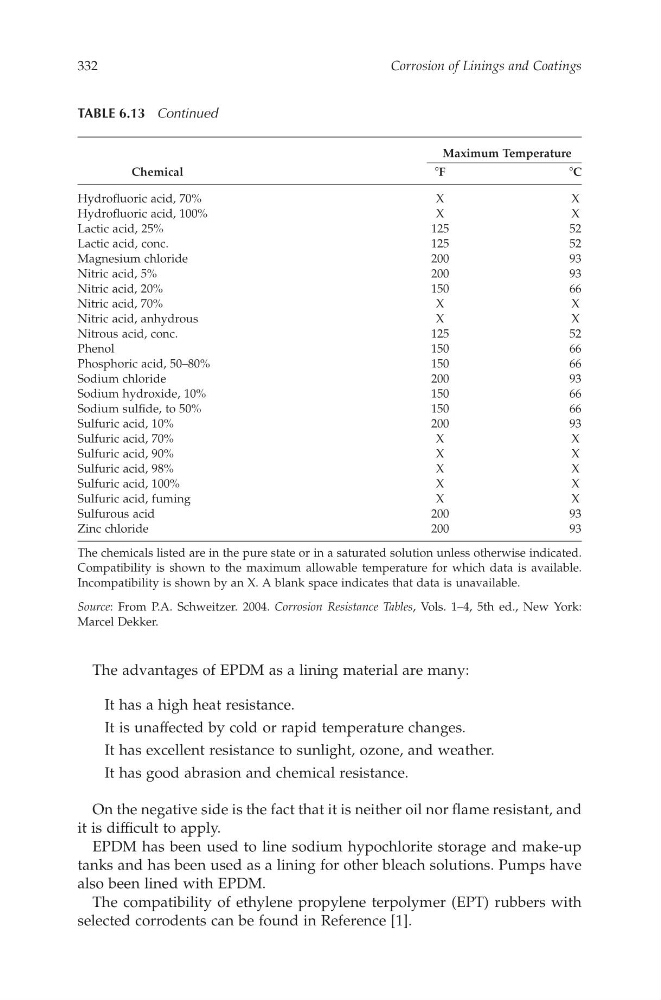
TABLE 6.13 Continued
Maximum Te mperature
Chemical
8 F
8 C
Hydrofluoric acid, 70%
XX
Hydrofluoric acid, 100%
XX
Lactic acid, 25%
125
52
Lactic acid, conc.
125
52
Magnesium chloride
200
93
Nitric acid, 5%
200
93
Nitric acid, 20%
150
66
Nitric acid, 70%
XX
Nitric acid, anhydrous
XX
Nitrous acid, conc.
125
52
Phenol
150
66
Phosphoric acid, 50–80%
150
66
Sodium chloride
200
93
Sodium hydroxide, 10%
150
66
Sodium sulfide, to 50%
150
66
Sulfuric acid, 10%
200
93
Sulfuric acid, 70%
XX
Sulfuric acid, 90%
XX
Sulfuric acid, 98%
XX
Sulfuric acid, 100%
XX
Sulfuric acid, fuming
XX
Sulfurous acid
200
93
Zinc chloride
200
93
The chemicals listed are in the pure state or in asaturated solution unless otherwise indicated.
Compatibility is shown to the maximuma llowable temperature for which data is available.
Incompatibility is shown by an X. Ab lank space indicates that data is unavailable.
Source:F rom P. A. Schweitzer.2 004. Corrosion Resistance Ta bles,V ols. 1–4, 5th ed., New York:
Marcel Dekker.
Corrosion of Linings and Coatings
332
CAT8247—CHAPTER 6—6/10/2006—12:29—SRIDHAR—XML MODEL B–pp. 287–402
It has ah igh heat resistance.
It is unaffected by cold or rapidt emperature changes.
It has excellent resistance to sunlight, ozone, and weather.
It has good abrasion and chemical resistance.
On the negative side is the fact that it is neither oil nor flameresistant, and
it is difficult to apply.
EPDM has been used to line sodiumh ypochlorite storage andm ake-up
tanks and has been used as aliningfor other bleach solutions. Pumps have
also been lined with EPDM.
The compatibility of ethylene propylene terpolymer (EPT) rubbers with
selected corrodents can be found in Reference [1].
TABLE 6.13 Continued
Maximum Te mperature
Chemical
8 F
8 C
Hydrofluoric acid, 70%
XX
Hydrofluoric acid, 100%
XX
Lactic acid, 25%
125
52
Lactic acid, conc.
125
52
Magnesium chloride
200
93
Nitric acid, 5%
200
93
Nitric acid, 20%
150
66
Nitric acid, 70%
XX
Nitric acid, anhydrous
XX
Nitrous acid, conc.
125
52
Phenol
150
66
Phosphoric acid, 50–80%
150
66
Sodium chloride
200
93
Sodium hydroxide, 10%
150
66
Sodium sulfide, to 50%
150
66
Sulfuric acid, 10%
200
93
Sulfuric acid, 70%
XX
Sulfuric acid, 90%
XX
Sulfuric acid, 98%
XX
Sulfuric acid, 100%
XX
Sulfuric acid, fuming
XX
Sulfurous acid
200
93
Zinc chloride
200
93
The chemicals listed are in the pure state or in asaturated solution unless otherwise indicated.
Compatibility is shown to the maximuma llowable temperature for which data is available.
Incompatibility is shown by an X. Ab lank space indicates that data is unavailable.
Source:F rom P. A. Schweitzer.2 004. Corrosion Resistance Ta bles,V ols. 1–4, 5th ed., New York:
Marcel Dekker.
Corrosion of Linings and Coatings
332
CAT8247—CHAPTER 6—6/10/2006—12:29—SRIDHAR—XML MODEL B–pp. 287–402