

Limitations of CIIR include its inability to be used with hydrochloric acid
or oils. It is more expensive than natural rubber.
6.5.9E thylene Propylene Rubber
Ethylene Propylene Rubber (EPDM) has exceptional heat resistance, being
able to operate at temperatures of 300–3508 F/148–1768 C, while also finding
applications as low as K 708 F/K 568 C. As with other elastomeric materials, it
can be compounded to improve specific properties. EPDM remains flexible at
low temperatures. Standard compoundshave brittle points of K 908 F/K 688 C
or below.
EPDM resists attackf romo xygenated solventss uch as acetone, methyl
ethyl ketone, ethyl acetate,w eak acids, and alkalies, detergents, phosphate
esters, alcohols, and glycols. It exhibits exceptional resistance to hot water
and high pressures team. The elastomer,b eingh ydrocarbon-based, is not
resistantt oh ydrocarbon solvents or oils, chlorinated hydrocarbons,
or turpentine.
Ethylene propylene terpolymer rubbers are, in general, resistant to most of
the same corrodents as EPDMb ut do not have as broad ar esistance to
mineral acids and someo rganics.
Ethylene propylene rubbers are particularly resistant to sun,weather, and
ozonea ttack.O zoner esistance is inherent in the polymer, and for all
practicalp urposes, it can be considered immune to ozonea ttack.
The compatibility of EPDMrubberwith selected corrodents will be found
in Table 6.14 with additional listings in Reference [1].
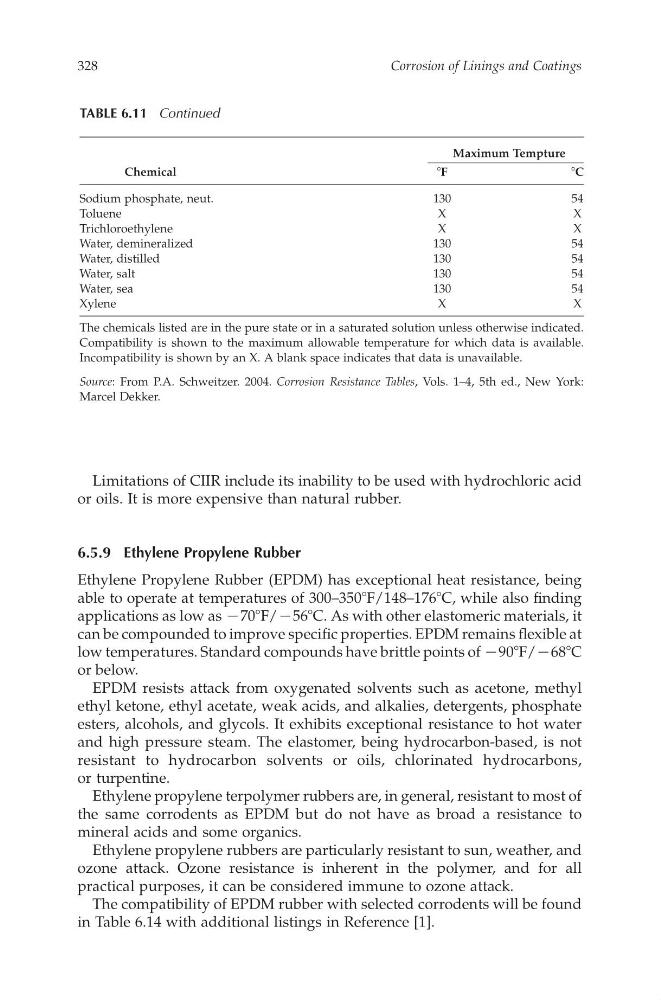
TABLE 6.11 Continued
Maximum Te mpture
Chemical
8 F
8 C
Sodium phosphate,neut.
130
54
Toluene
XX
Trichloroethylene
XX
Water,demineralized1 30
54
Water,distilled
130
54
Water,salt
130
54
Water,sea
130
54
Xylene
XX
The chemicalslisted are in the purestate or in asaturated solution unless otherwise indicated.
Compatibility is shown to the maximum allowable temperaturef or which data is available.
Incompatibility is shown by an X. Ab lank space indicates that data is unavailable.
Source:F romP .A. Schweitzer.2 004. Corrosion Resistance Ta bles,V ols. 1–4, 5th ed., New York:
Marcel Dekker.
Corrosion of Linings and Coatings
328
CAT8247—CHAPTER 6—6/10/2006—12:29—SRIDHAR—XML MODEL B–pp. 287–402
or oils. It is more expensive than natural rubber.
6.5.9E thylene Propylene Rubber
Ethylene Propylene Rubber (EPDM) has exceptional heat resistance, being
able to operate at temperatures of 300–3508 F/148–1768 C, while also finding
applications as low as K 708 F/K 568 C. As with other elastomeric materials, it
can be compounded to improve specific properties. EPDM remains flexible at
low temperatures. Standard compoundshave brittle points of K 908 F/K 688 C
or below.
EPDM resists attackf romo xygenated solventss uch as acetone, methyl
ethyl ketone, ethyl acetate,w eak acids, and alkalies, detergents, phosphate
esters, alcohols, and glycols. It exhibits exceptional resistance to hot water
and high pressures team. The elastomer,b eingh ydrocarbon-based, is not
resistantt oh ydrocarbon solvents or oils, chlorinated hydrocarbons,
or turpentine.
Ethylene propylene terpolymer rubbers are, in general, resistant to most of
the same corrodents as EPDMb ut do not have as broad ar esistance to
mineral acids and someo rganics.
Ethylene propylene rubbers are particularly resistant to sun,weather, and
ozonea ttack.O zoner esistance is inherent in the polymer, and for all
practicalp urposes, it can be considered immune to ozonea ttack.
The compatibility of EPDMrubberwith selected corrodents will be found
in Table 6.14 with additional listings in Reference [1].
TABLE 6.11 Continued
Maximum Te mpture
Chemical
8 F
8 C
Sodium phosphate,neut.
130
54
Toluene
XX
Trichloroethylene
XX
Water,demineralized1 30
54
Water,distilled
130
54
Water,salt
130
54
Water,sea
130
54
Xylene
XX
The chemicalslisted are in the purestate or in asaturated solution unless otherwise indicated.
Compatibility is shown to the maximum allowable temperaturef or which data is available.
Incompatibility is shown by an X. Ab lank space indicates that data is unavailable.
Source:F romP .A. Schweitzer.2 004. Corrosion Resistance Ta bles,V ols. 1–4, 5th ed., New York:
Marcel Dekker.
Corrosion of Linings and Coatings
328
CAT8247—CHAPTER 6—6/10/2006—12:29—SRIDHAR—XML MODEL B–pp. 287–402