

remains flexible and has good resistance to thermal shock. The standard
compositions can be used at temperatures as low as K 808 F( K 188 C).
Urethane rubbers have little or no resistance to burning. Some slight
improvement can be made in this area by special compounding, but the
material will still ignite in an actual fire situation.
The urethane rubbers are resistant to most minerala nd vegetable oils,
greases, and fuels, and to aliphatic and chlorinated hydrocarbons.
Aromatic hydrocarbons, polar solvents, esters, andk etonesw ill attack
urethane. Alcohols will soften and swell the urethane rubbers. These rubbers
have limited service in weak acid solutions andc annotb eu sed with
concentrated acids. Nor are they resistant to steam or caustic, but they are
resistant to the swelling and deteriorating effects of being immersed in water.
The urethane rubbers exhibit excellentresistance to ozone attackand have
good resistance to weathering. However,e xtendede xposure to ultraviolet
light will reduce their physical properties and will cause the rubbert o
darken. Table 6.10l ists the compatibility of urethane rubbers with selected
corrodents, and Table 6.11l ists the compatibility of polyether urethane
rubbers with selected corrodents.
Urethane is used to line tanks and piping. It is also applied as acoating to
prevent seepage of the corrodent into the concrete and attacko ft he
reinforcing steel. Protection from abrasion and corrosion is also supplied.
6.5.7P olyester Elastomer
In general, the fluid resistance of thesep olyesterr ubbers increases with
increasing hardness. Since these rubbers contain no plasticizers, they are not
susceptible to the solvent extraction or heat volatilization of such additives.
Manyfluids and chemicals willextract plasticizersfromelastomers causing
as ignificant increase in stiffness (modulus) and volume shrinkage.
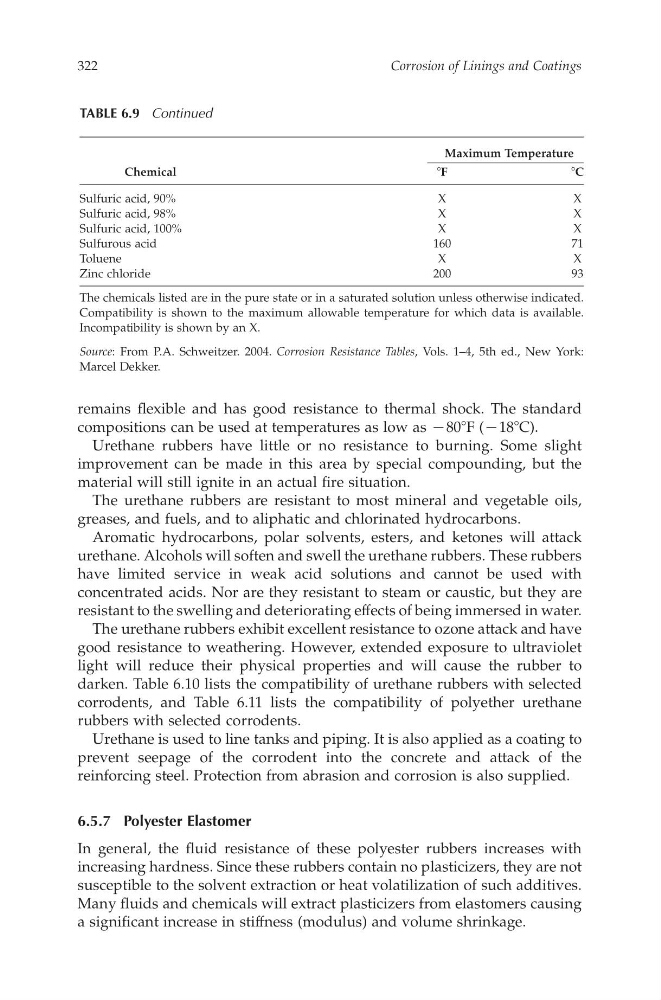
TABLE 6.9 Continued
Maximum Te mperature
Chemical
8 F
8 C
Sulfuric acid, 90%
XX
Sulfuric acid, 98%
XX
Sulfuric acid, 100%
XX
Sulfurous acid
160
71
Toluene
XX
Zinc chloride
200
93
The chemicalslisted are in the purestate or in asaturated solution unless otherwise indicated.
Compatibility is shown to the maximum allowable temperaturef or which data is available.
Incompatibility is shown by an X.
Source:F romP .A. Schweitzer.2 004. Corrosion Resistance Ta bles,V ols. 1–4, 5th ed., New York:
Marcel Dekker.
Corrosion of Linings and Coatings
322
CAT8247—CHAPTER 6—6/10/2006—12:29—SRIDHAR—XML MODEL B–pp. 287–402
compositions can be used at temperatures as low as K 808 F( K 188 C).
Urethane rubbers have little or no resistance to burning. Some slight
improvement can be made in this area by special compounding, but the
material will still ignite in an actual fire situation.
The urethane rubbers are resistant to most minerala nd vegetable oils,
greases, and fuels, and to aliphatic and chlorinated hydrocarbons.
Aromatic hydrocarbons, polar solvents, esters, andk etonesw ill attack
urethane. Alcohols will soften and swell the urethane rubbers. These rubbers
have limited service in weak acid solutions andc annotb eu sed with
concentrated acids. Nor are they resistant to steam or caustic, but they are
resistant to the swelling and deteriorating effects of being immersed in water.
The urethane rubbers exhibit excellentresistance to ozone attackand have
good resistance to weathering. However,e xtendede xposure to ultraviolet
light will reduce their physical properties and will cause the rubbert o
darken. Table 6.10l ists the compatibility of urethane rubbers with selected
corrodents, and Table 6.11l ists the compatibility of polyether urethane
rubbers with selected corrodents.
Urethane is used to line tanks and piping. It is also applied as acoating to
prevent seepage of the corrodent into the concrete and attacko ft he
reinforcing steel. Protection from abrasion and corrosion is also supplied.
6.5.7P olyester Elastomer
In general, the fluid resistance of thesep olyesterr ubbers increases with
increasing hardness. Since these rubbers contain no plasticizers, they are not
susceptible to the solvent extraction or heat volatilization of such additives.
Manyfluids and chemicals willextract plasticizersfromelastomers causing
as ignificant increase in stiffness (modulus) and volume shrinkage.
TABLE 6.9 Continued
Maximum Te mperature
Chemical
8 F
8 C
Sulfuric acid, 90%
XX
Sulfuric acid, 98%
XX
Sulfuric acid, 100%
XX
Sulfurous acid
160
71
Toluene
XX
Zinc chloride
200
93
The chemicalslisted are in the purestate or in asaturated solution unless otherwise indicated.
Compatibility is shown to the maximum allowable temperaturef or which data is available.
Incompatibility is shown by an X.
Source:F romP .A. Schweitzer.2 004. Corrosion Resistance Ta bles,V ols. 1–4, 5th ed., New York:
Marcel Dekker.
Corrosion of Linings and Coatings
322
CAT8247—CHAPTER 6—6/10/2006—12:29—SRIDHAR—XML MODEL B–pp. 287–402