

oils and fuels, even at elevated temperatures. It is also resistant to such
oxidizingc hemicals as sodium hypochlorite, sodium peroxide,f erric
chloride,a nd sulfuric,c hromic, andh ydrofluoric acids. Concentrated
hydrochloric acid (37%) can be handled below 1588 F( 708 C). Belowt his
temperature, Hypaloncan handle all concentrations without adverse effect.
Nitric acid up to 60% concentration at room temperature can also be handled
without adverse effect. Hypalon is also resistant to salt solutions, alcohols,
and both weak and concentrated alkalies.
Aliphatic,a romatic, andc hlorinated hydrocarbons,a ldehydes, and
ketones will attack Hypalon.
Hypalon is one of the most weatherr esistant elastomers available.
Oxidation takesplace at avery low rate. Sunlight and ultraviolet light have
little, if any,adverse effect on its physical properties. It is inherently resistant
to ozone attackwithout the need for the addition of special antioxidants or
antiozonates to the formulation.
Refert oT able 6.9f or thec ompatibility of Hypalonw iths elected
corrodents. Reference [1]provides amoredetailed listing.
Hypalon’sa dvantagesi nclude some oilr esistance, excellentr esistancet o
ozone, sunlight,weathering, andchemicals as well as resistance to permeation
andabrasion. It is unaffected by cold weatherorrapidtemperature changes.
Hypalonisdifficulttoapply,ismorecostlythannatural rubber,isnot resistant
to oxygenated solvents,and requiresapressure cure.
Applications includel inings of tanks and tank cars containing chromic
and high concentrations of sulfuric and nitric acids and other oxidizing
chemicals. It is also used for pondl iners.
6.5.6U rethane Rubbers
Theu rethaner ubbers arep roducedf rom an umbero fp olyurethane
polymers. Urethaner ubberso peratet hrough ther ange of 50–2128 F
(10–100 8 C). Standard compounds exhibit good low temperature impact
resistance and low brittle points. At very low temperatures, the material
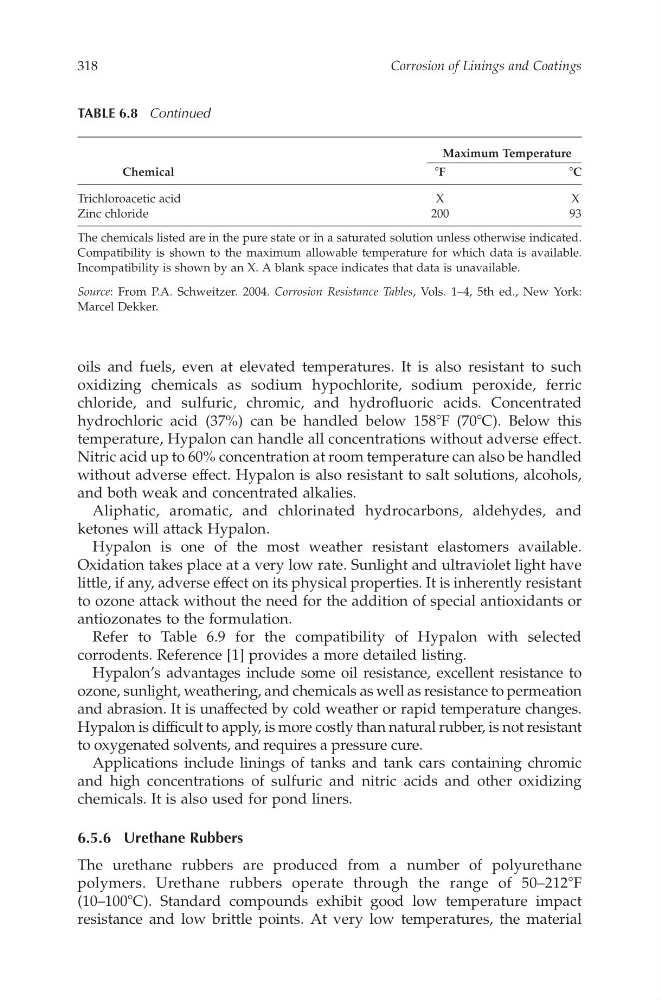
TABLE 6.8 Continued
Maximum Te mperature
Chemical
8 F
8 C
Trichloroacetic acid
XX
Zinc chloride
200
93
The chemicals listed are in the pure state or in asaturated solution unless otherwise indicated.
Compatibility is shown to the maximuma llowable temperature for which data is available.
Incompatibility is shown by an X. Ab lank space indicates that data is unavailable.
Source:F rom P. A. Schweitzer.2 004. Corrosion Resistance Ta bles,V ols. 1–4, 5th ed., New York:
Marcel Dekker.
Corrosion of Linings and Coatings
318
CAT8247—CHAPTER 6—6/10/2006—12:29—SRIDHAR—XML MODEL B–pp. 287–402
oxidizingc hemicals as sodium hypochlorite, sodium peroxide,f erric
chloride,a nd sulfuric,c hromic, andh ydrofluoric acids. Concentrated
hydrochloric acid (37%) can be handled below 1588 F( 708 C). Belowt his
temperature, Hypaloncan handle all concentrations without adverse effect.
Nitric acid up to 60% concentration at room temperature can also be handled
without adverse effect. Hypalon is also resistant to salt solutions, alcohols,
and both weak and concentrated alkalies.
Aliphatic,a romatic, andc hlorinated hydrocarbons,a ldehydes, and
ketones will attack Hypalon.
Hypalon is one of the most weatherr esistant elastomers available.
Oxidation takesplace at avery low rate. Sunlight and ultraviolet light have
little, if any,adverse effect on its physical properties. It is inherently resistant
to ozone attackwithout the need for the addition of special antioxidants or
antiozonates to the formulation.
Refert oT able 6.9f or thec ompatibility of Hypalonw iths elected
corrodents. Reference [1]provides amoredetailed listing.
Hypalon’sa dvantagesi nclude some oilr esistance, excellentr esistancet o
ozone, sunlight,weathering, andchemicals as well as resistance to permeation
andabrasion. It is unaffected by cold weatherorrapidtemperature changes.
Hypalonisdifficulttoapply,ismorecostlythannatural rubber,isnot resistant
to oxygenated solvents,and requiresapressure cure.
Applications includel inings of tanks and tank cars containing chromic
and high concentrations of sulfuric and nitric acids and other oxidizing
chemicals. It is also used for pondl iners.
6.5.6U rethane Rubbers
Theu rethaner ubbers arep roducedf rom an umbero fp olyurethane
polymers. Urethaner ubberso peratet hrough ther ange of 50–2128 F
(10–100 8 C). Standard compounds exhibit good low temperature impact
resistance and low brittle points. At very low temperatures, the material
TABLE 6.8 Continued
Maximum Te mperature
Chemical
8 F
8 C
Trichloroacetic acid
XX
Zinc chloride
200
93
The chemicals listed are in the pure state or in asaturated solution unless otherwise indicated.
Compatibility is shown to the maximuma llowable temperature for which data is available.
Incompatibility is shown by an X. Ab lank space indicates that data is unavailable.
Source:F rom P. A. Schweitzer.2 004. Corrosion Resistance Ta bles,V ols. 1–4, 5th ed., New York:
Marcel Dekker.
Corrosion of Linings and Coatings
318
CAT8247—CHAPTER 6—6/10/2006—12:29—SRIDHAR—XML MODEL B–pp. 287–402