

Applicationsi ncludel inings forh ydrochloric acid storagea nd processing
vessels andmixed acid wastes. Butylrubber is also used to linepipe andfittings.
6.5.5C hlorosulfonated Polyethylene (Hypalon)
The maximum temperature that Hypalon can be exposed to on acontinuous
basis is 2508 F( 1218 C). Hypalon is highly resistant to attackbyh ydrocarbon
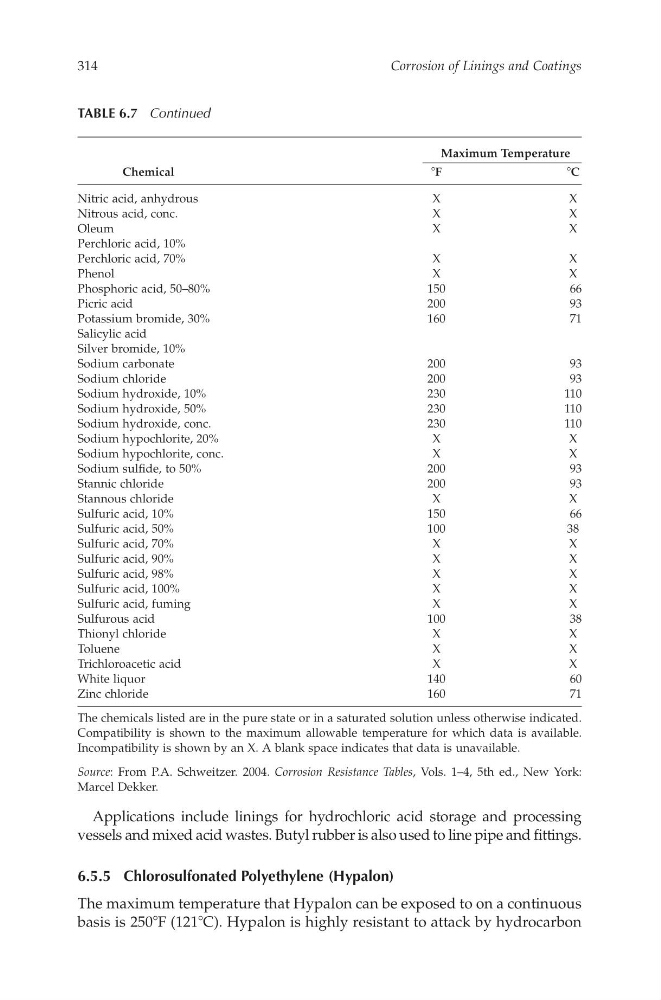
TABLE 6.7 Continued
Maximum Te mperature
Chemical
8 F
8 C
Nitric acid, anhydrous
XX
Nitrous acid, conc.
XX
Oleum
XX
Perchloric acid, 10%
Perchloric acid, 70%
XX
Phenol
XX
Phosphoric acid, 50–80%
150
66
Picric acid
200
93
Potassium bromide, 30%
160
71
Salicylic acid
Silver bromide, 10%
Sodium carbonate
200
93
Sodium chloride
200
93
Sodium hydroxide, 10%
230
110
Sodium hydroxide, 50%
230
110
Sodium hydroxide, conc.
230
110
Sodium hypochlorite,20%
XX
Sodium hypochlorite,conc.
XX
Sodium sulfide, to 50%
200
93
Stannic chloride
200
93
Stannous chloride
XX
Sulfuric acid, 10%
150
66
Sulfuric acid, 50%
100
38
Sulfuric acid, 70%
XX
Sulfuric acid, 90%
XX
Sulfuric acid, 98%
XX
Sulfuric acid, 100%
XX
Sulfuric acid, fuming
XX
Sulfurous acid
100
38
Thionyl chloride
XX
Toluene
XX
Trichloroacetic acid
XX
White liquor
140
60
Zinc chloride
160
71
The chemicals listed are in the pure state or in asaturated solution unless otherwise indicated.
Compatibility is shown to the maximuma llowable temperature for which data is available.
Incompatibility is shown by an X. Ab lank space indicates that data is unavailable.
Source:F rom P. A. Schweitzer.2 004. Corrosion Resistance Ta bles,V ols. 1–4, 5th ed., New York:
Marcel Dekker.
Corrosion of Linings and Coatings
314
CAT8247—CHAPTER 6—6/10/2006—12:29—SRIDHAR—XML MODEL B–pp. 287–402
vessels andmixed acid wastes. Butylrubber is also used to linepipe andfittings.
6.5.5C hlorosulfonated Polyethylene (Hypalon)
The maximum temperature that Hypalon can be exposed to on acontinuous
basis is 2508 F( 1218 C). Hypalon is highly resistant to attackbyh ydrocarbon
TABLE 6.7 Continued
Maximum Te mperature
Chemical
8 F
8 C
Nitric acid, anhydrous
XX
Nitrous acid, conc.
XX
Oleum
XX
Perchloric acid, 10%
Perchloric acid, 70%
XX
Phenol
XX
Phosphoric acid, 50–80%
150
66
Picric acid
200
93
Potassium bromide, 30%
160
71
Salicylic acid
Silver bromide, 10%
Sodium carbonate
200
93
Sodium chloride
200
93
Sodium hydroxide, 10%
230
110
Sodium hydroxide, 50%
230
110
Sodium hydroxide, conc.
230
110
Sodium hypochlorite,20%
XX
Sodium hypochlorite,conc.
XX
Sodium sulfide, to 50%
200
93
Stannic chloride
200
93
Stannous chloride
XX
Sulfuric acid, 10%
150
66
Sulfuric acid, 50%
100
38
Sulfuric acid, 70%
XX
Sulfuric acid, 90%
XX
Sulfuric acid, 98%
XX
Sulfuric acid, 100%
XX
Sulfuric acid, fuming
XX
Sulfurous acid
100
38
Thionyl chloride
XX
Toluene
XX
Trichloroacetic acid
XX
White liquor
140
60
Zinc chloride
160
71
The chemicals listed are in the pure state or in asaturated solution unless otherwise indicated.
Compatibility is shown to the maximuma llowable temperature for which data is available.
Incompatibility is shown by an X. Ab lank space indicates that data is unavailable.
Source:F rom P. A. Schweitzer.2 004. Corrosion Resistance Ta bles,V ols. 1–4, 5th ed., New York:
Marcel Dekker.
Corrosion of Linings and Coatings
314
CAT8247—CHAPTER 6—6/10/2006—12:29—SRIDHAR—XML MODEL B–pp. 287–402