

These liningsa re limited by their inability to resist oil or flames and the
fact that they ares ubject to damage by cold weather, suddene xtreme
temperature changes, or mechanical stresses. In addition,t hey are not
abrasion resistant. Applications include chemical process tanks, pumps,
fans, pipe, and fittings.
6.5.1.4 Hard Natural RubberL inings
Hard natural rubber linings have the advantage of:
Ease of application, cure, and repair
Better chemical, heat, and permeation resistance than soft natural
rubber.R efer to Table 6.6.
Heat resistance to 2008 F/938 C
Moderate cost
Limitations of these liningsare:
Not oil or flame resistant
Subject to damage by cold weather,e xposure, suddene xtreme
temperature changes, or mechanical stresses
Not abrasion resistant
Not to be used in transport vehicles
Typical applications include chemical storage tanks, pickling tanks, pipe
and fittings, platingtanks, and variousaccessories as agitators, pumps, etc.
6.5.2I soprene
Natural rubber is chemically an atural cis-polyisoprene. Isoprene (IR) is a
synthetic cis-polyisoprene. The corrosion resistance of IR is the same as that
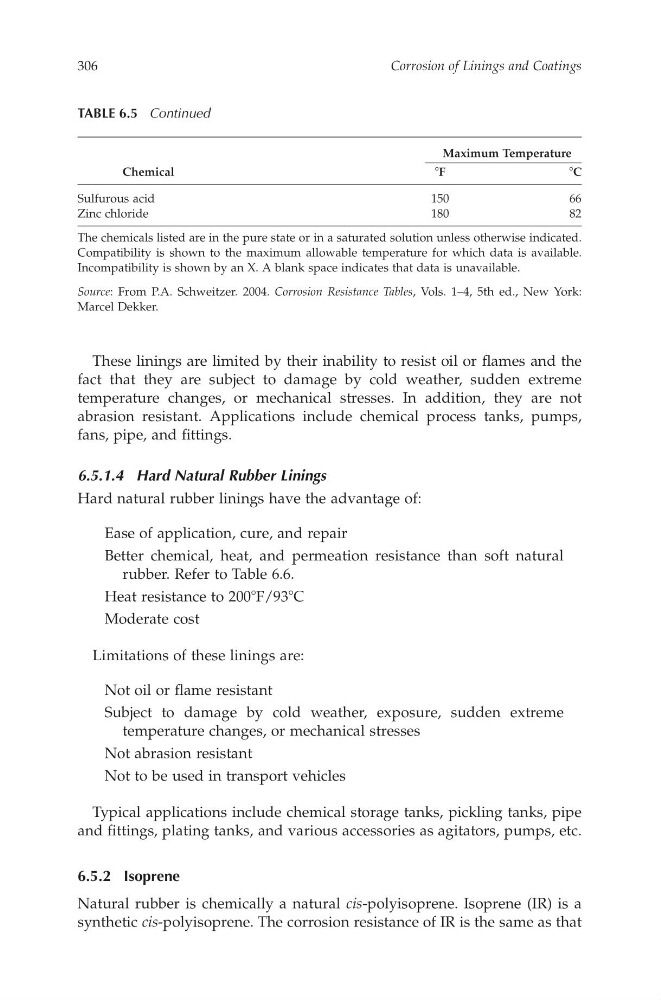
TABLE 6.5 Continued
Maximum Te mperature
Chemical
8 F
8 C
Sulfurous acid
150
66
Zinc chloride
180
82
The chemicals listed are in the pure state or in asaturated solution unless otherwise indicated.
Compatibility is shown to the maximuma llowable temperature for which data is available.
Incompatibility is shown by an X. Ab lank space indicates that data is unavailable.
Source:F rom P. A. Schweitzer.2 004. Corrosion Resistance Ta bles,V ols. 1–4, 5th ed., New York:
Marcel Dekker.
Corrosion of Linings and Coatings
306
CAT8247—CHAPTER 6—6/10/2006—12:28—SRIDHAR—XML MODEL B–pp. 287–402
fact that they ares ubject to damage by cold weather, suddene xtreme
temperature changes, or mechanical stresses. In addition,t hey are not
abrasion resistant. Applications include chemical process tanks, pumps,
fans, pipe, and fittings.
6.5.1.4 Hard Natural RubberL inings
Hard natural rubber linings have the advantage of:
Ease of application, cure, and repair
Better chemical, heat, and permeation resistance than soft natural
rubber.R efer to Table 6.6.
Heat resistance to 2008 F/938 C
Moderate cost
Limitations of these liningsare:
Not oil or flame resistant
Subject to damage by cold weather,e xposure, suddene xtreme
temperature changes, or mechanical stresses
Not abrasion resistant
Not to be used in transport vehicles
Typical applications include chemical storage tanks, pickling tanks, pipe
and fittings, platingtanks, and variousaccessories as agitators, pumps, etc.
6.5.2I soprene
Natural rubber is chemically an atural cis-polyisoprene. Isoprene (IR) is a
synthetic cis-polyisoprene. The corrosion resistance of IR is the same as that
TABLE 6.5 Continued
Maximum Te mperature
Chemical
8 F
8 C
Sulfurous acid
150
66
Zinc chloride
180
82
The chemicals listed are in the pure state or in asaturated solution unless otherwise indicated.
Compatibility is shown to the maximuma llowable temperature for which data is available.
Incompatibility is shown by an X. Ab lank space indicates that data is unavailable.
Source:F rom P. A. Schweitzer.2 004. Corrosion Resistance Ta bles,V ols. 1–4, 5th ed., New York:
Marcel Dekker.
Corrosion of Linings and Coatings
306
CAT8247—CHAPTER 6—6/10/2006—12:28—SRIDHAR—XML MODEL B–pp. 287–402