

6.5.1N atural Rubber
The maximum temperature for continuous use of natural rubber (NR)
is 1758 F(808 C). The degree of curing that NR is subjected to will determine
whether it is classified as soft, semihard, or hard. Soft rubberi st he form
primarily used for lining material, although, somehard liningsare produced.
Natural rubber provides excellentr esistance to most inorganics alt
solutions, alkalies, and nonoxidizing acids. Hydrochloric acid will react
with soft rubbert of ormr ubber hydrochloride and, therefore, it is not
recommended that NR be used in contactw itht his acid. Strong oxidizing
medias ucha sn itrica cid, concentrateds ulfurica cid, permanganates,
dichromates, chlorine dioxide, and sodiumhypochlorite will severely attack
rubber.M ineral andv egetableo ils, gasoline,b enzene,t oluene,a nd
chlorinated hydrocarbons also affect rubber.C old water tends to preserve
NR. Natural rubber offers good resistance to radiationand alcohols.
6.5.1.1 Soft Natural Rubber Linings
These linings have the advantage of:
Ease of application, cure, and repair unaffected by mechanical
stresseso rr apid temperaturec hanges,m akingi ti deal for
outdoor tanks.
Good chemicalr esistance within temperaturel imitation. See
Table 6.3.
Excellent to superiorp hysicalp roperties. Maximum tensile elongation,abrasion, and tear resistance.
Low cost.
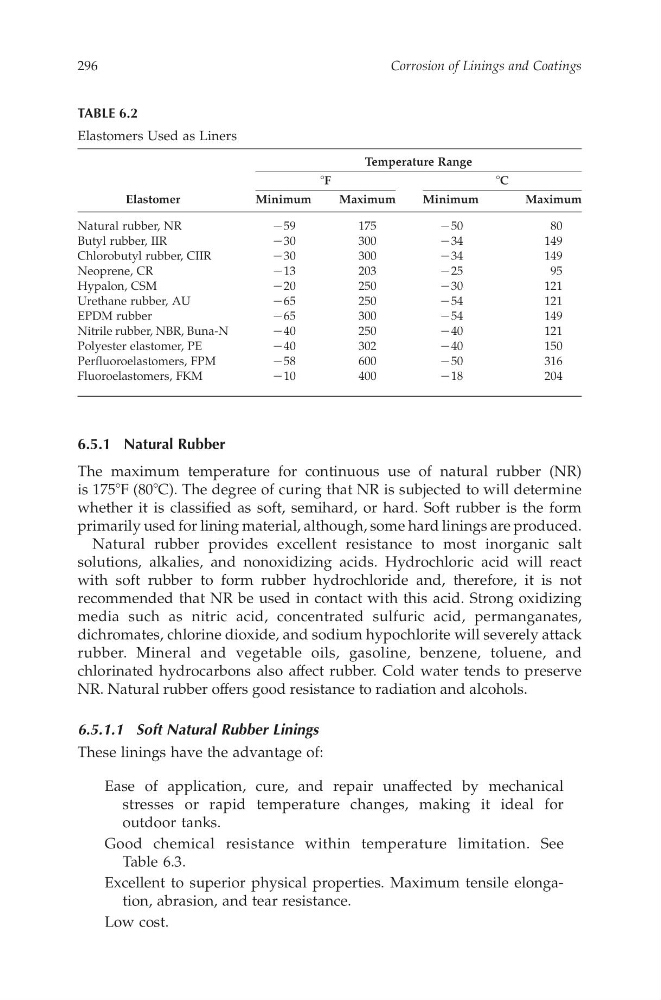
TABLE 6.2
Elastomers Used as Liners
Te mperature Range
8 F
8 C
Elastomer
Minimum
Maximum
Minimum
Maximum
Natural rubber,NR
K 59
175
K 50
80
Butyl rubber,IIR
K 30
300
K 34
149
Chlorobutyl rubber,CIIR
K 30
300
K 34
149
Neoprene, CR
K 13
203
K 25
95
Hypalon, CSM
K 20
250
K 30
121
Urethane rubber,AU
K 65
250
K 54
121
EPDM rubber
K 65
300
K 54
149
Nitrile rubber,NBR, Buna-N
K 40
250
K 40
121
Polyester elastomer, PE
K 40
302
K 40
150
Perfluoroelastomers, FPM
K 58
600
K 50
316
Fluoroelastomers, FKM
K 10
400
K 18
204
Corrosion of Linings and Coatings
296
CAT8247—CHAPTER 6—6/10/2006—12:28—SRIDHAR—XML MODEL B–pp. 287–402
The maximum temperature for continuous use of natural rubber (NR)
is 1758 F(808 C). The degree of curing that NR is subjected to will determine
whether it is classified as soft, semihard, or hard. Soft rubberi st he form
primarily used for lining material, although, somehard liningsare produced.
Natural rubber provides excellentr esistance to most inorganics alt
solutions, alkalies, and nonoxidizing acids. Hydrochloric acid will react
with soft rubbert of ormr ubber hydrochloride and, therefore, it is not
recommended that NR be used in contactw itht his acid. Strong oxidizing
medias ucha sn itrica cid, concentrateds ulfurica cid, permanganates,
dichromates, chlorine dioxide, and sodiumhypochlorite will severely attack
rubber.M ineral andv egetableo ils, gasoline,b enzene,t oluene,a nd
chlorinated hydrocarbons also affect rubber.C old water tends to preserve
NR. Natural rubber offers good resistance to radiationand alcohols.
6.5.1.1 Soft Natural Rubber Linings
These linings have the advantage of:
Ease of application, cure, and repair unaffected by mechanical
stresseso rr apid temperaturec hanges,m akingi ti deal for
outdoor tanks.
Good chemicalr esistance within temperaturel imitation. See
Table 6.3.
Excellent to superiorp hysicalp roperties. Maximum tensile elongation,abrasion, and tear resistance.
Low cost.
TABLE 6.2
Elastomers Used as Liners
Te mperature Range
8 F
8 C
Elastomer
Minimum
Maximum
Minimum
Maximum
Natural rubber,NR
K 59
175
K 50
80
Butyl rubber,IIR
K 30
300
K 34
149
Chlorobutyl rubber,CIIR
K 30
300
K 34
149
Neoprene, CR
K 13
203
K 25
95
Hypalon, CSM
K 20
250
K 30
121
Urethane rubber,AU
K 65
250
K 54
121
EPDM rubber
K 65
300
K 54
149
Nitrile rubber,NBR, Buna-N
K 40
250
K 40
121
Polyester elastomer, PE
K 40
302
K 40
150
Perfluoroelastomers, FPM
K 58
600
K 50
316
Fluoroelastomers, FKM
K 10
400
K 18
204
Corrosion of Linings and Coatings
296
CAT8247—CHAPTER 6—6/10/2006—12:28—SRIDHAR—XML MODEL B–pp. 287–402