

The isophthalic polyesters are the most common typeu sed for chemical
service applications. They have aw ide range of corrosion resistance, being
satisfactory foru se up to 1258 F( 528 C) in sucha cids as 10% acetic, benzoic,
citric, oleic, 25%p hosphoric, 10 to 25% sulfuric, and fatty acids. Most
inorganic salts are compatible with isophthalic polyesters. Solvents such
as amyla lcohol, ethylene glycol, formaldehyde, gasoline, kerosene, and
naphtha are also compatible.
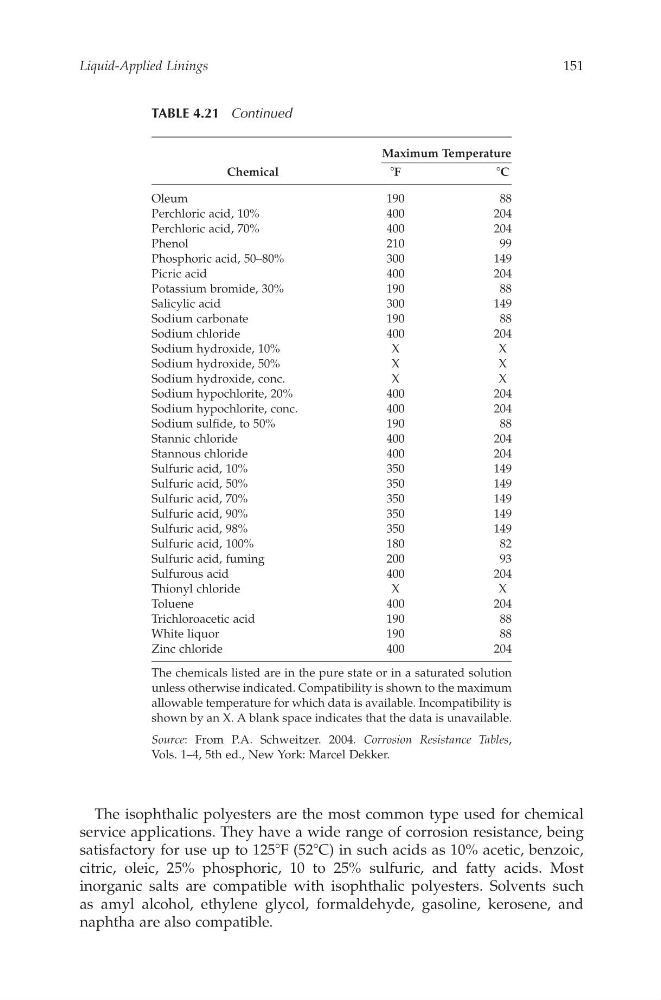
TABLE 4.21 Continued
Maximum Te mperature
Chemical
8 F
8 C
Oleum
190
88
Perchloric acid, 10%
400
204
Perchloric acid, 70%
400
204
Phenol
210
99
Phosphoric acid, 50–80%
300
149
Picric acid
400
204
Potassium bromide, 30%
190
88
Salicylic acid
300
149
Sodium carbonate
190
88
Sodium chloride
400
204
Sodium hydroxide, 10%
XX
Sodium hydroxide, 50%
XX
Sodium hydroxide, conc.
XX
Sodium hypochlorite,2 0%
400
204
Sodium hypochlorite,c onc.
400
204
Sodium sulfide, to 50%
190
88
Stannic chloride
400
204
Stannous chloride
400
204
Sulfuric acid, 10%
350
149
Sulfuric acid, 50%
350
149
Sulfuric acid, 70%
350
149
Sulfuric acid, 90%
350
149
Sulfuric acid, 98%
350
149
Sulfuric acid, 100%
180
82
Sulfuric acid, fuming
200
93
Sulfurous acid
400
204
Thionyl chloride
XX
Toluene
400
204
Trichloroacetic acid
190
88
White liquor
190
88
Zinc chloride4 00
204
The chemicals listed are in the pure state or in as aturated solution
unless otherwise indicated. Compatibility is shown to the maximum
allowable temperaturefor which data is available. Incompatibilityis
shown by an X. Ablank space indicates that the data is unavailable.
Source:F rom P. A. Schweitzer.2 004. Corrosion ResistanceT ables ,
Vols. 1–4, 5th ed., New York: Marcel Dekker.
Liquid-Applied Linings
151
CAT8247—CHAPTER 4—17/10/2006—14:35—SRIDHAR—XML MODEL B–pp. 69–174
service applications. They have aw ide range of corrosion resistance, being
satisfactory foru se up to 1258 F( 528 C) in sucha cids as 10% acetic, benzoic,
citric, oleic, 25%p hosphoric, 10 to 25% sulfuric, and fatty acids. Most
inorganic salts are compatible with isophthalic polyesters. Solvents such
as amyla lcohol, ethylene glycol, formaldehyde, gasoline, kerosene, and
naphtha are also compatible.
TABLE 4.21 Continued
Maximum Te mperature
Chemical
8 F
8 C
Oleum
190
88
Perchloric acid, 10%
400
204
Perchloric acid, 70%
400
204
Phenol
210
99
Phosphoric acid, 50–80%
300
149
Picric acid
400
204
Potassium bromide, 30%
190
88
Salicylic acid
300
149
Sodium carbonate
190
88
Sodium chloride
400
204
Sodium hydroxide, 10%
XX
Sodium hydroxide, 50%
XX
Sodium hydroxide, conc.
XX
Sodium hypochlorite,2 0%
400
204
Sodium hypochlorite,c onc.
400
204
Sodium sulfide, to 50%
190
88
Stannic chloride
400
204
Stannous chloride
400
204
Sulfuric acid, 10%
350
149
Sulfuric acid, 50%
350
149
Sulfuric acid, 70%
350
149
Sulfuric acid, 90%
350
149
Sulfuric acid, 98%
350
149
Sulfuric acid, 100%
180
82
Sulfuric acid, fuming
200
93
Sulfurous acid
400
204
Thionyl chloride
XX
Toluene
400
204
Trichloroacetic acid
190
88
White liquor
190
88
Zinc chloride4 00
204
The chemicals listed are in the pure state or in as aturated solution
unless otherwise indicated. Compatibility is shown to the maximum
allowable temperaturefor which data is available. Incompatibilityis
shown by an X. Ablank space indicates that the data is unavailable.
Source:F rom P. A. Schweitzer.2 004. Corrosion ResistanceT ables ,
Vols. 1–4, 5th ed., New York: Marcel Dekker.
Liquid-Applied Linings
151
CAT8247—CHAPTER 4—17/10/2006—14:35—SRIDHAR—XML MODEL B–pp. 69–174