

These reactants are among the most violent oxidizing and reducing agents
known.E lemental sodium in contact with fluorocarbons removes fluorine
from the polymer molecule. The other alkali metals (potassium,lithium,etc.)
react in as imilar manner.
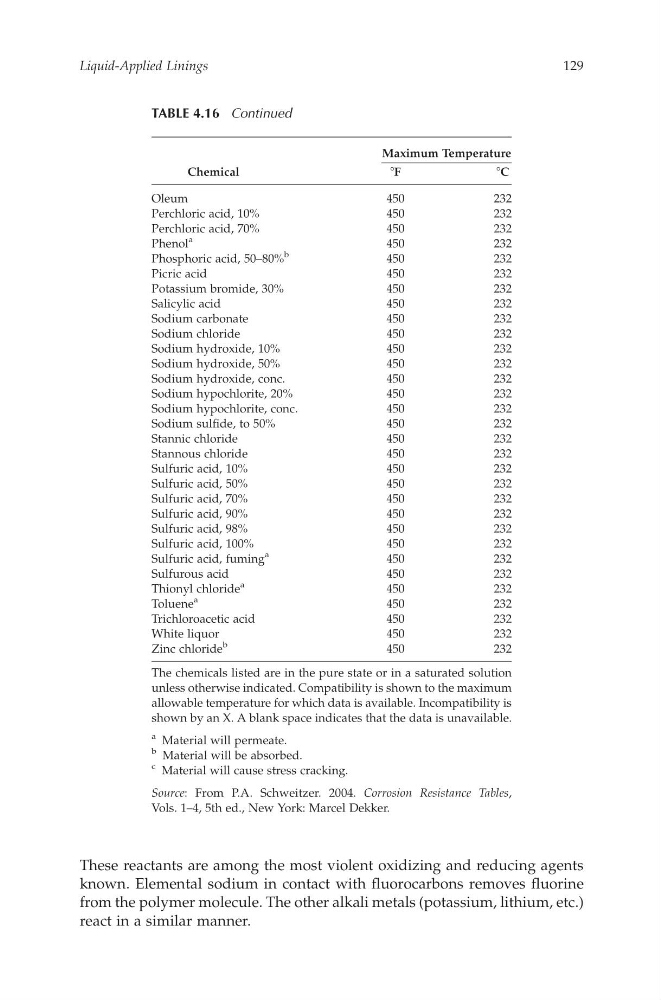
TABLE 4.16 Continued
Maximum Te mperature
Chemical
8 F
8 C
Oleum
450
232
Perchloric acid, 10%
450
232
Perchloric acid, 70%
450
232
Phenol
a
450
232
Phosphoric acid, 50–80%
b
450
232
Picric acid
450
232
Potassium bromide, 30%
450
232
Salicylic acid
450
232
Sodium carbonate
450
232
Sodium chloride
450
232
Sodium hydroxide, 10%
450
232
Sodium hydroxide, 50%
450
232
Sodium hydroxide, conc.
450
232
Sodium hypochlorite,2 0%
450
232
Sodium hypochlorite,c onc.
450
232
Sodium sulfide, to 50%
450
232
Stannic chloride
450
232
Stannous chloride
450
232
Sulfuric acid, 10%
450
232
Sulfuric acid, 50%
450
232
Sulfuric acid, 70%
450
232
Sulfuric acid, 90%
450
232
Sulfuric acid, 98%
450
232
Sulfuric acid, 100%
450
232
Sulfuric acid, fuming
a
450
232
Sulfurous acid
450
232
Thionyl chloride
a
450
232
Toluene
a
450
232
Trichloroacetic acid
450
232
White liquor
450
232
Zinc chloride
b
450
232
The chemicals listed are in the pure state or in as aturated solution
unless otherwise indicated. Compatibility is shown to the maximum
allowable temperaturefor which data is available. Incompatibilityis
shown by an X. Ablank space indicates that the data is unavailable.
a Material will permeate.
b Material will be absorbed.
c Material will cause stress cracking.
Source:F rom P. A. Schweitzer.2 004. Corrosion ResistanceT ables ,
Vols. 1–4, 5th ed., New York: Marcel Dekker.
Liquid-Applied Linings
129
CAT8247—CHAPTER 4—17/10/2006—14:35—SRIDHAR—XML MODEL B–pp. 69–174
known.E lemental sodium in contact with fluorocarbons removes fluorine
from the polymer molecule. The other alkali metals (potassium,lithium,etc.)
react in as imilar manner.
TABLE 4.16 Continued
Maximum Te mperature
Chemical
8 F
8 C
Oleum
450
232
Perchloric acid, 10%
450
232
Perchloric acid, 70%
450
232
Phenol
a
450
232
Phosphoric acid, 50–80%
b
450
232
Picric acid
450
232
Potassium bromide, 30%
450
232
Salicylic acid
450
232
Sodium carbonate
450
232
Sodium chloride
450
232
Sodium hydroxide, 10%
450
232
Sodium hydroxide, 50%
450
232
Sodium hydroxide, conc.
450
232
Sodium hypochlorite,2 0%
450
232
Sodium hypochlorite,c onc.
450
232
Sodium sulfide, to 50%
450
232
Stannic chloride
450
232
Stannous chloride
450
232
Sulfuric acid, 10%
450
232
Sulfuric acid, 50%
450
232
Sulfuric acid, 70%
450
232
Sulfuric acid, 90%
450
232
Sulfuric acid, 98%
450
232
Sulfuric acid, 100%
450
232
Sulfuric acid, fuming
a
450
232
Sulfurous acid
450
232
Thionyl chloride
a
450
232
Toluene
a
450
232
Trichloroacetic acid
450
232
White liquor
450
232
Zinc chloride
b
450
232
The chemicals listed are in the pure state or in as aturated solution
unless otherwise indicated. Compatibility is shown to the maximum
allowable temperaturefor which data is available. Incompatibilityis
shown by an X. Ablank space indicates that the data is unavailable.
a Material will permeate.
b Material will be absorbed.
c Material will cause stress cracking.
Source:F rom P. A. Schweitzer.2 004. Corrosion ResistanceT ables ,
Vols. 1–4, 5th ed., New York: Marcel Dekker.
Liquid-Applied Linings
129
CAT8247—CHAPTER 4—17/10/2006—14:35—SRIDHAR—XML MODEL B–pp. 69–174