

Coating thickness rangef rom0 .010t o0 .060 in.w ith am aximum service
temperature of 3908 F(1998 C). Damage to these coatings cannot be repaired.
The coating is af usion from aw ater or solvent dispersiona nd requires a
heat cure temperature of 500–6608 F( 260–3158 C). Application is by spray.
Previously glass-linked tanks can be refurbished with this lining.
4.10.15 PTFE( Teflon)
PTFE coatings are spray applied as water or solvent dispersions. They
requireheat curing at approximately 7508 F(3998 C). Their maximum service
temperature is 5008 F( 2608 C).
PTFE is chemically inert in the presence of most corrodents. There are
very few chemicals that willa ttack PTFE within normal use temperatures.
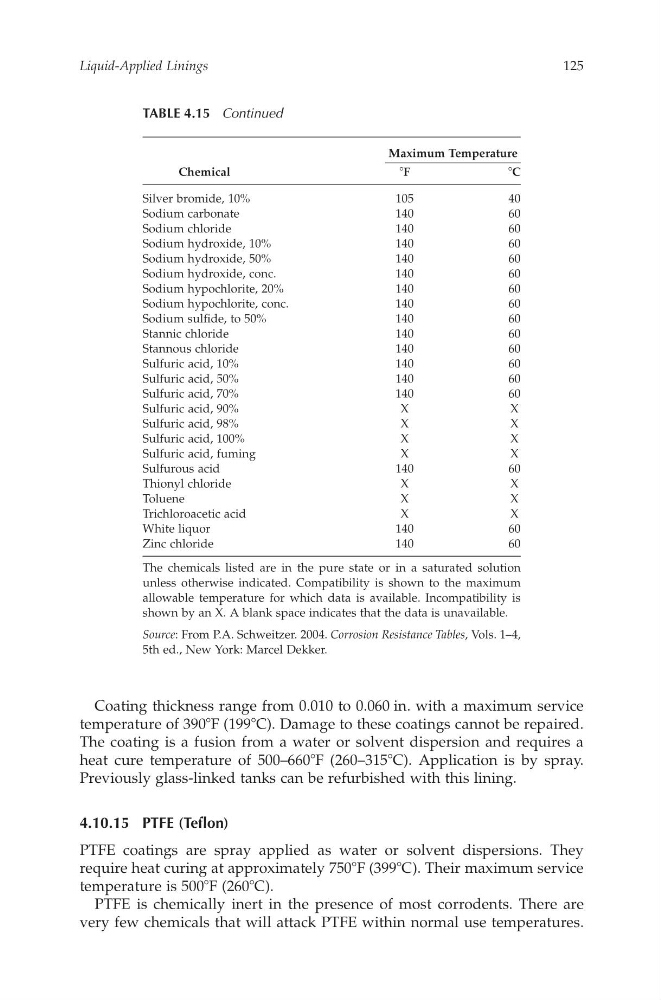
TABLE 4.15 Continued
Maximum Te mperature
Chemical
8 F
8 C
Silver bromide, 10%
105
40
Sodium carbonate
140
60
Sodium chloride
140
60
Sodium hydroxide, 10%
140
60
Sodium hydroxide, 50%
140
60
Sodium hydroxide, conc.
140
60
Sodium hypochlorite, 20%
140
60
Sodium hypochlorite, conc.
140
60
Sodium sulfide, to 50%
140
60
Stannic chloride
140
60
Stannous chloride1 40
60
Sulfuric acid, 10%
140
60
Sulfuric acid, 50%
140
60
Sulfuric acid, 70%
140
60
Sulfuric acid, 90%
XX
Sulfuric acid, 98%
XX
Sulfuric acid, 100%
XX
Sulfuric acid, fuming
XX
Sulfurous acid
140
60
Thionyl chloride
XX
Toluene
XX
Trichloroacetic acid
XX
White liquor
140
60
Zinc chloride
140
60
The chemicalsl isted are in the pure state or in as aturated solution
unless otherwise indicated. Compatibility is shown to the maximum
allowable temperaturef or which data is available. Incompatibilityi s
shown by an X. Ab lank space indicates that the data is unavailable.
Source:FromP .A. Schweitzer.2004. Corrosion Resistance Ta bles,V ols. 1–4,
5th ed., New York: Marcel Dekker.
Liquid-Applied Linings
125
CAT8247—CHAPTER 4—17/10/2006—14:34—SRIDHAR—XML MODEL B–pp. 69–174
temperature of 3908 F(1998 C). Damage to these coatings cannot be repaired.
The coating is af usion from aw ater or solvent dispersiona nd requires a
heat cure temperature of 500–6608 F( 260–3158 C). Application is by spray.
Previously glass-linked tanks can be refurbished with this lining.
4.10.15 PTFE( Teflon)
PTFE coatings are spray applied as water or solvent dispersions. They
requireheat curing at approximately 7508 F(3998 C). Their maximum service
temperature is 5008 F( 2608 C).
PTFE is chemically inert in the presence of most corrodents. There are
very few chemicals that willa ttack PTFE within normal use temperatures.
TABLE 4.15 Continued
Maximum Te mperature
Chemical
8 F
8 C
Silver bromide, 10%
105
40
Sodium carbonate
140
60
Sodium chloride
140
60
Sodium hydroxide, 10%
140
60
Sodium hydroxide, 50%
140
60
Sodium hydroxide, conc.
140
60
Sodium hypochlorite, 20%
140
60
Sodium hypochlorite, conc.
140
60
Sodium sulfide, to 50%
140
60
Stannic chloride
140
60
Stannous chloride1 40
60
Sulfuric acid, 10%
140
60
Sulfuric acid, 50%
140
60
Sulfuric acid, 70%
140
60
Sulfuric acid, 90%
XX
Sulfuric acid, 98%
XX
Sulfuric acid, 100%
XX
Sulfuric acid, fuming
XX
Sulfurous acid
140
60
Thionyl chloride
XX
Toluene
XX
Trichloroacetic acid
XX
White liquor
140
60
Zinc chloride
140
60
The chemicalsl isted are in the pure state or in as aturated solution
unless otherwise indicated. Compatibility is shown to the maximum
allowable temperaturef or which data is available. Incompatibilityi s
shown by an X. Ab lank space indicates that the data is unavailable.
Source:FromP .A. Schweitzer.2004. Corrosion Resistance Ta bles,V ols. 1–4,
5th ed., New York: Marcel Dekker.
Liquid-Applied Linings
125
CAT8247—CHAPTER 4—17/10/2006—14:34—SRIDHAR—XML MODEL B–pp. 69–174