

The viscosity of plastisol is controlled by formulator techniques, and is
oftenkept low by the addition of inactive diluents suchasodorless mineral
spirits. If more than minor amounts of diluents areused, the product is often
referred to as an organsol.
These compounds share common compounding technology.The primary
components are the dispersion grade resin, plasticizers, PVC stabilizers
(which are common to all PVC), and assorted fillers, pigments, and aw ide
variety of additives to controlp roperties of the product in storage,d uring
processing, and in the finished state.
Plasticizers are liquids that provide mobility to the plastisolsystem.They
are of primary significance, and they are selected first when formulating.
Plasticizers differ in the performance characteristics that they impart to
the finished product. The blendofplasticizerswill also assist in the control
of viscosity andi ts stability,a nd in the fusion characteristicso ft he
finished plastisol.
Because plasticized PVC is compounded of aP VC dispersion of high
molecular weight vinyl chloride polymers in as uitable liquid plasticizer,
formulationsc an be made for special applications. By selective compounding, bothp hysical and corrosion-resistant properties can be modified.F or
certain applications, this feature can be advantageous.
Twot ypes of PVC resin are produced: normal impact (type1 )a nd high
impact (type 2). Type 1i su nplasticized PVC havingn ormal impact and
optimum chemical resistance. Type 2isaplasticizedPVC and has optimum
impact strength and reducedc hemical resistance. Plastisol PVC is the
lattertype.
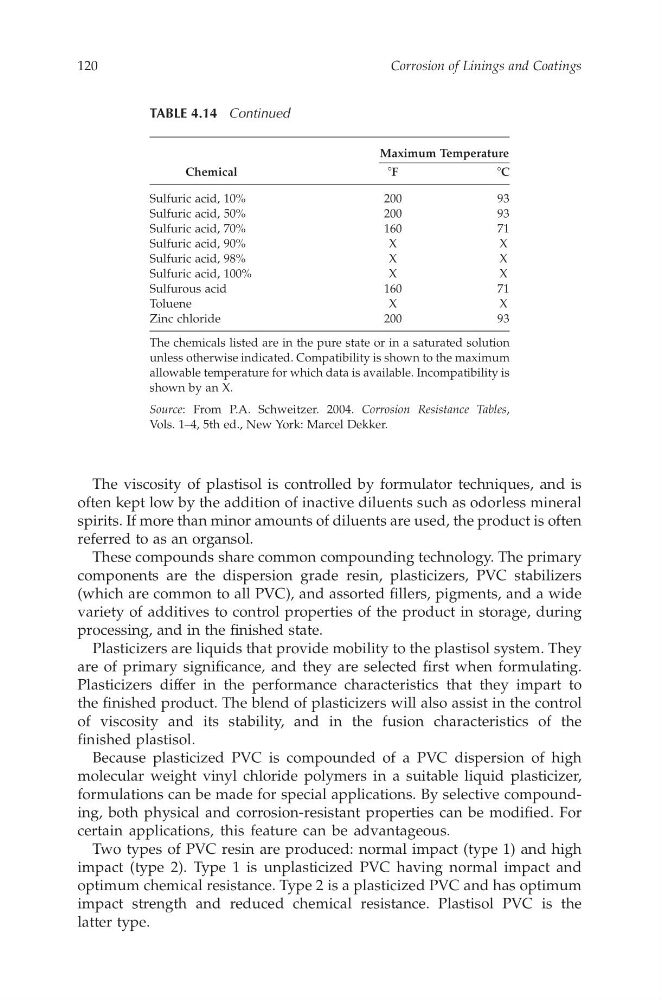
TABLE 4.14 Continued
Maximum Te mperature
Chemical
8 F
8 C
Sulfuric acid, 10%
200
93
Sulfuric acid, 50%
200
93
Sulfuric acid, 70%
160
71
Sulfuric acid, 90%
XX
Sulfuric acid, 98%
XX
Sulfuric acid, 100%
XX
Sulfurous acid
160
71
Toluene
XX
Zinc chloride
200
93
The chemicals listed are in the pures tate or in as aturated solution
unless otherwise indicated. Compatibility is shown to the maximum
allowable temperaturefor which data is available. Incompatibility is
shown by an X.
Source:F rom P. A. Schweitzer.2 004. CorrosionR esistanceT ables,
Vo ls. 1–4, 5th ed., New York: Marcel Dekker.
Corrosion of Linings and Coatings
120
CAT8247—CHAPTER 4—17/10/2006—14:34—SRIDHAR—XML MODEL B–pp. 69–174
oftenkept low by the addition of inactive diluents suchasodorless mineral
spirits. If more than minor amounts of diluents areused, the product is often
referred to as an organsol.
These compounds share common compounding technology.The primary
components are the dispersion grade resin, plasticizers, PVC stabilizers
(which are common to all PVC), and assorted fillers, pigments, and aw ide
variety of additives to controlp roperties of the product in storage,d uring
processing, and in the finished state.
Plasticizers are liquids that provide mobility to the plastisolsystem.They
are of primary significance, and they are selected first when formulating.
Plasticizers differ in the performance characteristics that they impart to
the finished product. The blendofplasticizerswill also assist in the control
of viscosity andi ts stability,a nd in the fusion characteristicso ft he
finished plastisol.
Because plasticized PVC is compounded of aP VC dispersion of high
molecular weight vinyl chloride polymers in as uitable liquid plasticizer,
formulationsc an be made for special applications. By selective compounding, bothp hysical and corrosion-resistant properties can be modified.F or
certain applications, this feature can be advantageous.
Twot ypes of PVC resin are produced: normal impact (type1 )a nd high
impact (type 2). Type 1i su nplasticized PVC havingn ormal impact and
optimum chemical resistance. Type 2isaplasticizedPVC and has optimum
impact strength and reducedc hemical resistance. Plastisol PVC is the
lattertype.
TABLE 4.14 Continued
Maximum Te mperature
Chemical
8 F
8 C
Sulfuric acid, 10%
200
93
Sulfuric acid, 50%
200
93
Sulfuric acid, 70%
160
71
Sulfuric acid, 90%
XX
Sulfuric acid, 98%
XX
Sulfuric acid, 100%
XX
Sulfurous acid
160
71
Toluene
XX
Zinc chloride
200
93
The chemicals listed are in the pures tate or in as aturated solution
unless otherwise indicated. Compatibility is shown to the maximum
allowable temperaturefor which data is available. Incompatibility is
shown by an X.
Source:F rom P. A. Schweitzer.2 004. CorrosionR esistanceT ables,
Vo ls. 1–4, 5th ed., New York: Marcel Dekker.
Corrosion of Linings and Coatings
120
CAT8247—CHAPTER 4—17/10/2006—14:34—SRIDHAR—XML MODEL B–pp. 69–174