

compatibility of Hypalon with selected corrodents and Reference [1] for a
more completel isting.
Hypalon finds usefula pplicationsi nm anyi ndustriesa nd many
fields. Because of its outstanding resistance to oxidizing acids, it is used to
line railroad tank cars and other tanks containing oxidizing chemicals
and acids.
4.10.12 Plastisols
PVC plastisols are dispersions of PVC and/or PVC copolymer resins in
compatible plasticizers. Theseliquids can vary in viscosity from thin, milklike fluids to heavy pastes havingt he consistencyo fm olasses. The lowest
viscosity products are generallyu sed for spray coating. PVC plastisol
coatings have limited adhesion and requirep rimers; the coatings must be
heat cured.
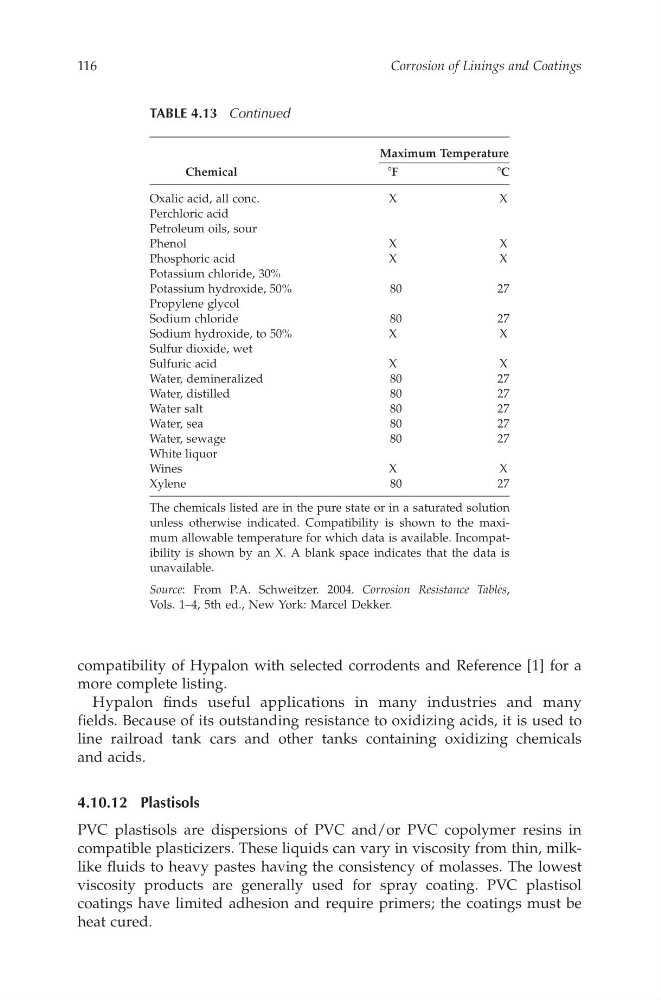
TABLE 4.13 Continued
Maximum Te mperature
Chemical
8 F
8 C
Oxalic acid, all conc.
XX
Perchloric acid
Petroleum oils, sour
Phenol
XX
Phosphoric acid
XX
Potassium chloride, 30%
Potassium hydroxide, 50%
80
27
Propylene glycol
Sodium chloride
80
27
Sodium hydroxide, to 50%
XX
Sulfur dioxide, wet
Sulfuric acid
XX
Water,demineralized8 02 7
Water,distilled
80
27
Water salt
80
27
Water,sea
80
27
Water,sewage
80
27
White liquor
Wines
XX
Xylene
80
27
The chemicals listed are in the pures tate or in as aturated solution
unless otherwise indicated. Compatibility is shown to the maximum allowable temperaturef or which data is available. Incompatibility is shown by an X. Ab lank space indicates that the data is
unavailable.
Source:F rom P. A. Schweitzer.2 004. Corrosion ResistanceT ables,
Vo ls. 1–4, 5th ed., New York: Marcel Dekker.
Corrosion of Linings and Coatings
116
CAT8247—CHAPTER 4—17/10/2006—14:34—SRIDHAR—XML MODEL B–pp. 69–174
more completel isting.
Hypalon finds usefula pplicationsi nm anyi ndustriesa nd many
fields. Because of its outstanding resistance to oxidizing acids, it is used to
line railroad tank cars and other tanks containing oxidizing chemicals
and acids.
4.10.12 Plastisols
PVC plastisols are dispersions of PVC and/or PVC copolymer resins in
compatible plasticizers. Theseliquids can vary in viscosity from thin, milklike fluids to heavy pastes havingt he consistencyo fm olasses. The lowest
viscosity products are generallyu sed for spray coating. PVC plastisol
coatings have limited adhesion and requirep rimers; the coatings must be
heat cured.
TABLE 4.13 Continued
Maximum Te mperature
Chemical
8 F
8 C
Oxalic acid, all conc.
XX
Perchloric acid
Petroleum oils, sour
Phenol
XX
Phosphoric acid
XX
Potassium chloride, 30%
Potassium hydroxide, 50%
80
27
Propylene glycol
Sodium chloride
80
27
Sodium hydroxide, to 50%
XX
Sulfur dioxide, wet
Sulfuric acid
XX
Water,demineralized8 02 7
Water,distilled
80
27
Water salt
80
27
Water,sea
80
27
Water,sewage
80
27
White liquor
Wines
XX
Xylene
80
27
The chemicals listed are in the pures tate or in as aturated solution
unless otherwise indicated. Compatibility is shown to the maximum allowable temperaturef or which data is available. Incompatibility is shown by an X. Ab lank space indicates that the data is
unavailable.
Source:F rom P. A. Schweitzer.2 004. Corrosion ResistanceT ables,
Vo ls. 1–4, 5th ed., New York: Marcel Dekker.
Corrosion of Linings and Coatings
116
CAT8247—CHAPTER 4—17/10/2006—14:34—SRIDHAR—XML MODEL B–pp. 69–174