

Neoprene is also available in avariety of forms. In addition to aneoprene
latex that is similar to natural rubber latex, neoprene is produced in fluid
form as either ac ompounded latex dispersion or solvent solution. After
these materials have solidified or cured, they have the same physical and
mechanical properties as the solid or cellular formso fn eoprene.
Neoprene solvent solutions are prepared by dissolving neoprene in
standard rubber solvents. These solutions can be formulated in ar ange of
viscosities suitable for applicationb yb rush, spray,o rr oller.M ajora reas of
application include linings for storage tanks, industrial equipment, and
chemical processing equipment. These coatings protect the vessels from
corrosion by acids, salts,oils,alkalies, and most hydrocarbons.
Neoprene possesses excellentr esistance to attack from solvents, waxes,
fats, oils, greases, and manyother petroleum-basedproducts. It also exhibits
excellent service in contactw ith aliphatic compounds( methyl and ethyl
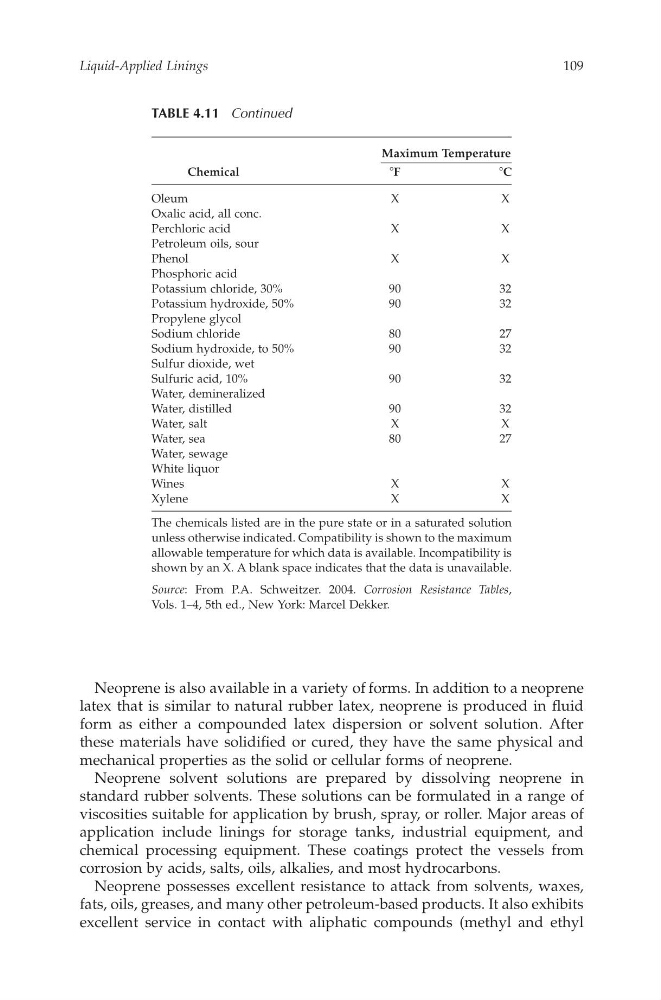
TABLE 4.11 Continued
Maximum Te mperature
Chemical
8 F
8 C
Oleum
XX
Oxalic acid, all conc.
Perchloric acid
XX
Petroleum oils, sour
Phenol
XX
Phosphoric acid
Potassium chloride, 30%
90
32
Potassium hydroxide, 50%
90
32
Propylene glycol
Sodium chloride
80
27
Sodium hydroxide, to 50%
90
32
Sulfur dioxide, wet
Sulfuric acid, 10%
90
32
Water,demineralized
Water,distilled
90
32
Water,salt
XX
Water,sea
80
27
Water,sewage
White liquor
Wines
XX
Xylene
XX
The chemicals listed are in the pure state or in as aturated solution
unless otherwise indicated. Compatibility is shown to the maximum
allowable temperaturefor which data is available. Incompatibilityis
shown by an X. Ablank space indicates that the data is unavailable.
Source:F rom P. A. Schweitzer.2 004. Corrosion ResistanceT ables ,
Vols. 1–4, 5th ed., New York: Marcel Dekker.
Liquid-Applied Linings
109
CAT8247—CHAPTER 4—17/10/2006—14:34—SRIDHAR—XML MODEL B–pp. 69–174
latex that is similar to natural rubber latex, neoprene is produced in fluid
form as either ac ompounded latex dispersion or solvent solution. After
these materials have solidified or cured, they have the same physical and
mechanical properties as the solid or cellular formso fn eoprene.
Neoprene solvent solutions are prepared by dissolving neoprene in
standard rubber solvents. These solutions can be formulated in ar ange of
viscosities suitable for applicationb yb rush, spray,o rr oller.M ajora reas of
application include linings for storage tanks, industrial equipment, and
chemical processing equipment. These coatings protect the vessels from
corrosion by acids, salts,oils,alkalies, and most hydrocarbons.
Neoprene possesses excellentr esistance to attack from solvents, waxes,
fats, oils, greases, and manyother petroleum-basedproducts. It also exhibits
excellent service in contactw ith aliphatic compounds( methyl and ethyl
TABLE 4.11 Continued
Maximum Te mperature
Chemical
8 F
8 C
Oleum
XX
Oxalic acid, all conc.
Perchloric acid
XX
Petroleum oils, sour
Phenol
XX
Phosphoric acid
Potassium chloride, 30%
90
32
Potassium hydroxide, 50%
90
32
Propylene glycol
Sodium chloride
80
27
Sodium hydroxide, to 50%
90
32
Sulfur dioxide, wet
Sulfuric acid, 10%
90
32
Water,demineralized
Water,distilled
90
32
Water,salt
XX
Water,sea
80
27
Water,sewage
White liquor
Wines
XX
Xylene
XX
The chemicals listed are in the pure state or in as aturated solution
unless otherwise indicated. Compatibility is shown to the maximum
allowable temperaturefor which data is available. Incompatibilityis
shown by an X. Ablank space indicates that the data is unavailable.
Source:F rom P. A. Schweitzer.2 004. Corrosion ResistanceT ables ,
Vols. 1–4, 5th ed., New York: Marcel Dekker.
Liquid-Applied Linings
109
CAT8247—CHAPTER 4—17/10/2006—14:34—SRIDHAR—XML MODEL B–pp. 69–174