

Coal tar finds application as ac oating both for interior and exterioro f
underground pipelines.
4.10.8U rethanes
Polyurethane-resin-based coatings are extremely versatile. They are priced
higher than alkyds but lower than epoxies. Polyurethane resins areavailable
as oil-modified,m oisture-curing, bleached,t wo-component, and lacquers.
Because of the versatility of the isocyanate reaction, wide diversity exists in
specific coating properties. Exposure to the isocyanate should be minimized
to avoid sensitivityt hatm ight resulti na na sthmatic-like breathing
condition. Continued exposure to humidity may result in gassing or
bubbling of the coating in humid conditions.
The urethane coatings have am aximum operating temperature of 250 8 F
(1218 C) dry and 1508 F( 668 C) wet. These coatings are resistant to most
minerala nd vegetable oils, greases, fuels, and to aliphatic and chlorinated
hydrocarbons. Aromatich ydrocarbons, polar solvents, esters,e thers, and
ketonesw ill attacku rethanes and alcoholsw ill softenurethanes.
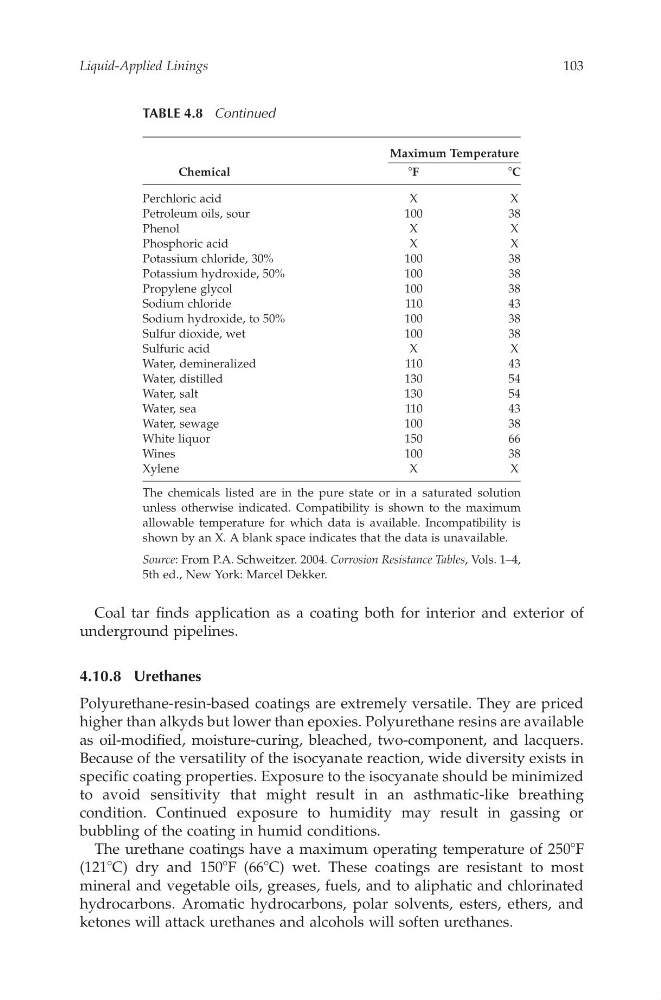
TABLE 4.8 Continued
Maximum Te mperature
Chemical
8 F
8 C
Perchloric acid
XX
Petroleum oils, sour
100
38
Phenol
XX
Phosphoric acid
XX
Potassium chloride, 30%
100
38
Potassium hydroxide, 50%
100
38
Propylene glycol
100
38
Sodium chloride
1104 3
Sodium hydroxide, to 50%
100
38
Sulfur dioxide, wet
100
38
Sulfuric acid
XX
Water,d emineralized
1104 3
Water,d istilled
130
54
Water,s alt
130
54
Water,s ea
1104 3
Water,s ewage
100
38
White liquor
150
66
Wines
100
38
Xylene
XX
The chemicalsl isted are in the pure state or in as aturated solution
unless otherwise indicated. Compatibility is shown to the maximum
allowable temperaturef or which data is available. Incompatibilityi s
shown by an X. Ab lank space indicates that the data is unavailable.
Source:FromP .A. Schweitzer.2004. Corrosion Resistance Ta bles,V ols. 1–4,
5th ed., New York: Marcel Dekker.
Liquid-Applied Linings
103
CAT8247—CHAPTER 4—17/10/2006—14:34—SRIDHAR—XML MODEL B–pp. 69–174
underground pipelines.
4.10.8U rethanes
Polyurethane-resin-based coatings are extremely versatile. They are priced
higher than alkyds but lower than epoxies. Polyurethane resins areavailable
as oil-modified,m oisture-curing, bleached,t wo-component, and lacquers.
Because of the versatility of the isocyanate reaction, wide diversity exists in
specific coating properties. Exposure to the isocyanate should be minimized
to avoid sensitivityt hatm ight resulti na na sthmatic-like breathing
condition. Continued exposure to humidity may result in gassing or
bubbling of the coating in humid conditions.
The urethane coatings have am aximum operating temperature of 250 8 F
(1218 C) dry and 1508 F( 668 C) wet. These coatings are resistant to most
minerala nd vegetable oils, greases, fuels, and to aliphatic and chlorinated
hydrocarbons. Aromatich ydrocarbons, polar solvents, esters,e thers, and
ketonesw ill attacku rethanes and alcoholsw ill softenurethanes.
TABLE 4.8 Continued
Maximum Te mperature
Chemical
8 F
8 C
Perchloric acid
XX
Petroleum oils, sour
100
38
Phenol
XX
Phosphoric acid
XX
Potassium chloride, 30%
100
38
Potassium hydroxide, 50%
100
38
Propylene glycol
100
38
Sodium chloride
1104 3
Sodium hydroxide, to 50%
100
38
Sulfur dioxide, wet
100
38
Sulfuric acid
XX
Water,d emineralized
1104 3
Water,d istilled
130
54
Water,s alt
130
54
Water,s ea
1104 3
Water,s ewage
100
38
White liquor
150
66
Wines
100
38
Xylene
XX
The chemicalsl isted are in the pure state or in as aturated solution
unless otherwise indicated. Compatibility is shown to the maximum
allowable temperaturef or which data is available. Incompatibilityi s
shown by an X. Ab lank space indicates that the data is unavailable.
Source:FromP .A. Schweitzer.2004. Corrosion Resistance Ta bles,V ols. 1–4,
5th ed., New York: Marcel Dekker.
Liquid-Applied Linings
103
CAT8247—CHAPTER 4—17/10/2006—14:34—SRIDHAR—XML MODEL B–pp. 69–174