

Coal tar exhibits excellentw ater resistance, good resistance to acids,
alkalies, minerals, animal and vegetable oils, and salts.T able 4.10 provides
the compatibility of coal tar with selected corrodents. Reference [1] provides
am ore extensive listing.
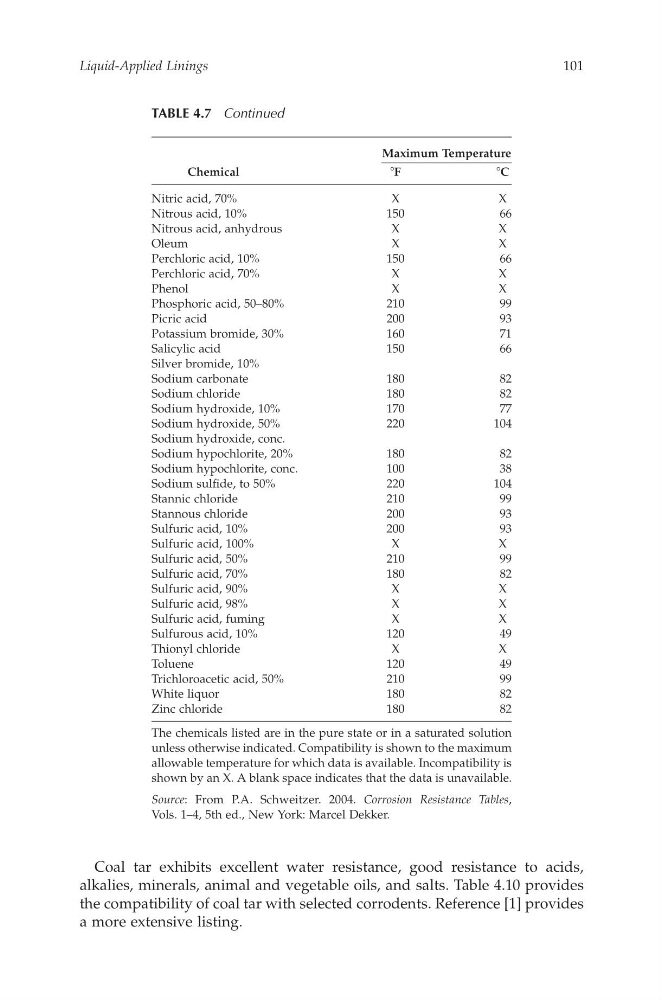
TABLE 4.7 Continued
Maximum Te mperature
Chemical
8 F
8 C
Nitric acid, 70%
XX
Nitrous acid, 10%
150
66
Nitrous acid, anhydrous
XX
Oleum
XX
Perchloric acid, 10%
150
66
Perchloric acid, 70%
XX
Phenol
XX
Phosphoric acid, 50–80%
210
99
Picric acid
200
93
Potassium bromide, 30%
160
71
Salicylic acid
150
66
Silver bromide, 10%
Sodium carbonate
180
82
Sodium chloride
180
82
Sodium hydroxide, 10%
170
77
Sodium hydroxide, 50%
220
104
Sodium hydroxide, conc.
Sodium hypochlorite,2 0%
180
82
Sodium hypochlorite,c onc.
100
38
Sodium sulfide, to 50%
220
104
Stannic chloride
210
99
Stannous chloride
200
93
Sulfuric acid, 10%
200
93
Sulfuric acid, 100%
XX
Sulfuric acid, 50%
210
99
Sulfuric acid, 70%
180
82
Sulfuric acid, 90%
XX
Sulfuric acid, 98%
XX
Sulfuric acid, fuming
XX
Sulfurous acid, 10%
120
49
Thionyl chloride
XX
Toluene
120
49
Trichloroacetic acid, 50%
210
99
White liquor
180
82
Zinc chloride1 80
82
The chemicals listed are in the pure state or in as aturated solution
unless otherwise indicated. Compatibility is shown to the maximum
allowable temperaturefor which data is available. Incompatibilityis
shown by an X. Ablank space indicates that the data is unavailable.
Source:F rom P. A. Schweitzer.2 004. Corrosion ResistanceT ables ,
Vols. 1–4, 5th ed., New York: Marcel Dekker.
Liquid-Applied Linings
101
CAT8247—CHAPTER 4—17/10/2006—14:34—SRIDHAR—XML MODEL B–pp. 69–174
alkalies, minerals, animal and vegetable oils, and salts.T able 4.10 provides
the compatibility of coal tar with selected corrodents. Reference [1] provides
am ore extensive listing.
TABLE 4.7 Continued
Maximum Te mperature
Chemical
8 F
8 C
Nitric acid, 70%
XX
Nitrous acid, 10%
150
66
Nitrous acid, anhydrous
XX
Oleum
XX
Perchloric acid, 10%
150
66
Perchloric acid, 70%
XX
Phenol
XX
Phosphoric acid, 50–80%
210
99
Picric acid
200
93
Potassium bromide, 30%
160
71
Salicylic acid
150
66
Silver bromide, 10%
Sodium carbonate
180
82
Sodium chloride
180
82
Sodium hydroxide, 10%
170
77
Sodium hydroxide, 50%
220
104
Sodium hydroxide, conc.
Sodium hypochlorite,2 0%
180
82
Sodium hypochlorite,c onc.
100
38
Sodium sulfide, to 50%
220
104
Stannic chloride
210
99
Stannous chloride
200
93
Sulfuric acid, 10%
200
93
Sulfuric acid, 100%
XX
Sulfuric acid, 50%
210
99
Sulfuric acid, 70%
180
82
Sulfuric acid, 90%
XX
Sulfuric acid, 98%
XX
Sulfuric acid, fuming
XX
Sulfurous acid, 10%
120
49
Thionyl chloride
XX
Toluene
120
49
Trichloroacetic acid, 50%
210
99
White liquor
180
82
Zinc chloride1 80
82
The chemicals listed are in the pure state or in as aturated solution
unless otherwise indicated. Compatibility is shown to the maximum
allowable temperaturefor which data is available. Incompatibilityis
shown by an X. Ablank space indicates that the data is unavailable.
Source:F rom P. A. Schweitzer.2 004. Corrosion ResistanceT ables ,
Vols. 1–4, 5th ed., New York: Marcel Dekker.
Liquid-Applied Linings
101
CAT8247—CHAPTER 4—17/10/2006—14:34—SRIDHAR—XML MODEL B–pp. 69–174