

4.10.6C oal TarEpoxy
Coal tar epoxies can be appliedt ob are steel or concrete without ap rimer.
They willn ot cure below 508 F( 108 C) and have at emperature resistance of
2258 F( 1058 C) dryo r1 508 F( 668 C) wet. They have al ow cost per
unit coverage.
Coal tar epoxies combine the moisture resistance of coal tar with the
chemical resistance of epoxy.I tp ossesses excellent resistance to salt water,
fresh water,m ild acids, and mild alkalies, but has poors olvent resistance.
Refer to Table 4.9 for the compatibility of coalt ar epoxy with selected
corrodents. Reference [1] has amorecompletel isting.
Coal tar epoxy finds application as ac oating for crude oil storage tanks,
and in sewage disposal plants and water works.
4.10.7C oal Tar
Unless cross-linked with another resin, coal tar is thermoplastic and will
flow at temperatures of 1008 F( 388 C) or less. It hardens and embrittles in
cold weather.
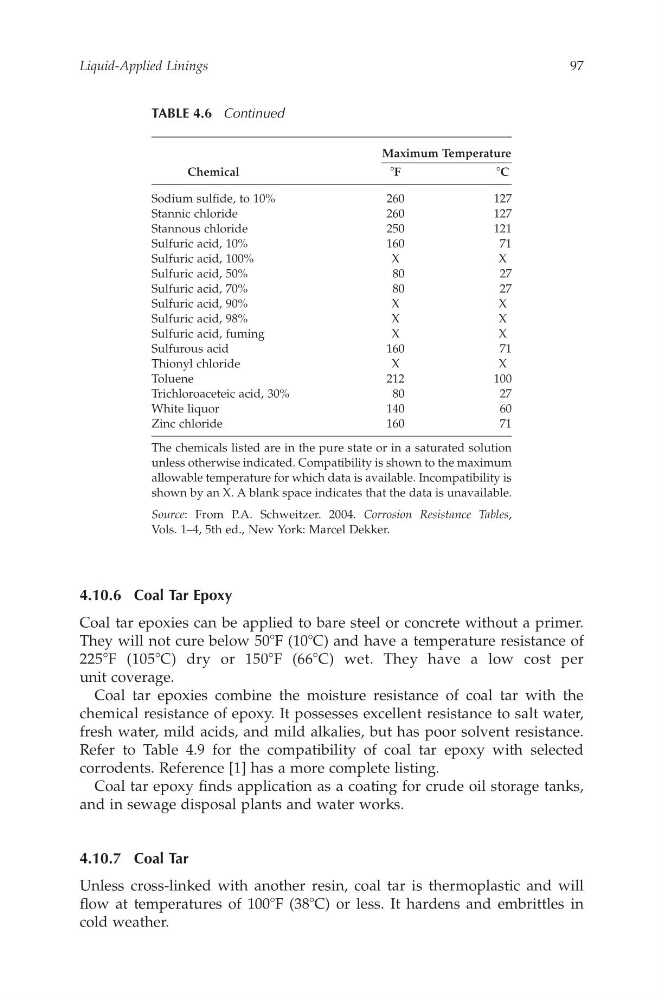
TABLE 4.6 Continued
Maximum Te mperature
Chemical
8 F
8 C
Sodium sulfide, to 10%
260
127
Stannic chloride
260
127
Stannous chloride
250
121
Sulfuric acid, 10%
160
71
Sulfuric acid, 100%
XX
Sulfuric acid, 50%
80
27
Sulfuric acid, 70%
80
27
Sulfuric acid, 90%
XX
Sulfuric acid, 98%
XX
Sulfuric acid, fuming
XX
Sulfurous acid
160
71
Thionyl chloride
XX
Toluene
212
100
Trichloroaceteic acid, 30%
80
27
White liquor
140
60
Zinc chloride1 60
71
The chemicals listed are in the pure state or in as aturated solution
unless otherwise indicated. Compatibility is shown to the maximum
allowable temperaturefor which data is available. Incompatibilityis
shown by an X. Ablank space indicates that the data is unavailable.
Source:F rom P. A. Schweitzer.2 004. Corrosion ResistanceT ables ,
Vols. 1–4, 5th ed., New York: Marcel Dekker.
Liquid-Applied Linings
97
CAT8247—CHAPTER 4—17/10/2006—14:33—SRIDHAR—XML MODEL B–pp. 69–174
Coal tar epoxies can be appliedt ob are steel or concrete without ap rimer.
They willn ot cure below 508 F( 108 C) and have at emperature resistance of
2258 F( 1058 C) dryo r1 508 F( 668 C) wet. They have al ow cost per
unit coverage.
Coal tar epoxies combine the moisture resistance of coal tar with the
chemical resistance of epoxy.I tp ossesses excellent resistance to salt water,
fresh water,m ild acids, and mild alkalies, but has poors olvent resistance.
Refer to Table 4.9 for the compatibility of coalt ar epoxy with selected
corrodents. Reference [1] has amorecompletel isting.
Coal tar epoxy finds application as ac oating for crude oil storage tanks,
and in sewage disposal plants and water works.
4.10.7C oal Tar
Unless cross-linked with another resin, coal tar is thermoplastic and will
flow at temperatures of 1008 F( 388 C) or less. It hardens and embrittles in
cold weather.
TABLE 4.6 Continued
Maximum Te mperature
Chemical
8 F
8 C
Sodium sulfide, to 10%
260
127
Stannic chloride
260
127
Stannous chloride
250
121
Sulfuric acid, 10%
160
71
Sulfuric acid, 100%
XX
Sulfuric acid, 50%
80
27
Sulfuric acid, 70%
80
27
Sulfuric acid, 90%
XX
Sulfuric acid, 98%
XX
Sulfuric acid, fuming
XX
Sulfurous acid
160
71
Thionyl chloride
XX
Toluene
212
100
Trichloroaceteic acid, 30%
80
27
White liquor
140
60
Zinc chloride1 60
71
The chemicals listed are in the pure state or in as aturated solution
unless otherwise indicated. Compatibility is shown to the maximum
allowable temperaturefor which data is available. Incompatibilityis
shown by an X. Ablank space indicates that the data is unavailable.
Source:F rom P. A. Schweitzer.2 004. Corrosion ResistanceT ables ,
Vols. 1–4, 5th ed., New York: Marcel Dekker.
Liquid-Applied Linings
97
CAT8247—CHAPTER 4—17/10/2006—14:33—SRIDHAR—XML MODEL B–pp. 69–174