

406
17 Environmental Flow Definition and Management: A Case Study …
Table 17.17 Flows required for reach 1 under scenario 11
Component
Timing
Magnitude (m 3 /s)
Frequency (per
year)
Duration (days at
peak)
Low flow
Oct–Mar
0.5
Continuous
High flow
Apr–Sep
1.0
Continuous
Low flow pulse
Oct–Dec;
Jan–Mar
20
1 each period
1 day/period
High flow pulse
Apr
20
2
2
High flow pulse
May–Sep
20
2
1
Bankfull flow
Anytime
177
0.26
1
Source WET (2007)
Permission granted by WET project subject to proper citation
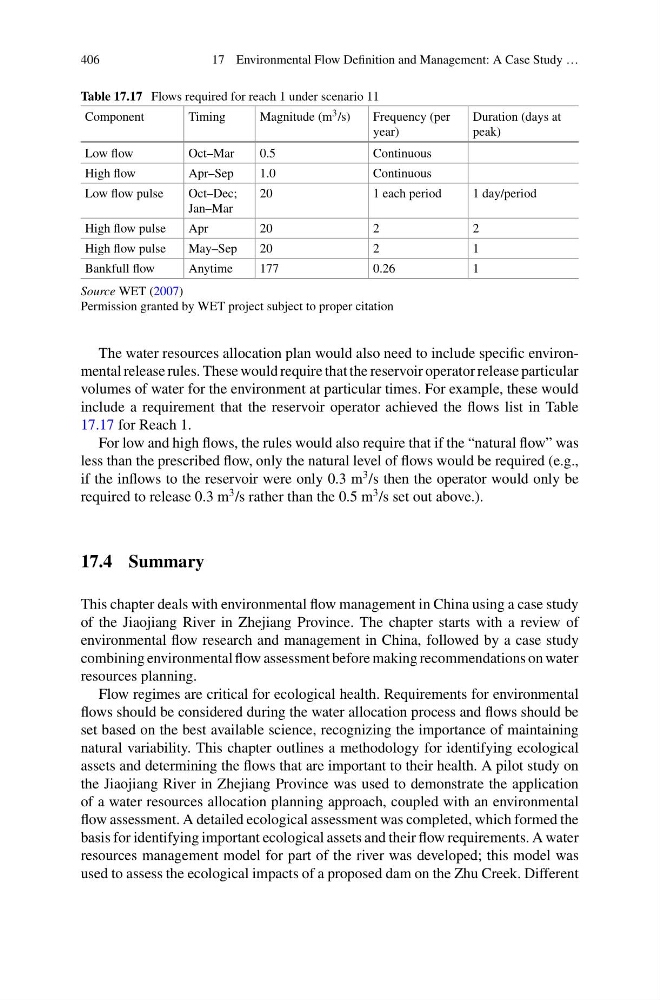
The water resources allocation plan would also need to include specific environmental release rules. These would require that the reservoir operator release particular
volumes of water for the environment at particular times. For example, these would
include a requirement that the reservoir operator achieved the flows list in Table
17.17 for Reach 1.
For low and high flows, the rules would also require that if the “natural flow” was
less than the prescribed flow, only the natural level of flows would be required (e.g.,
if the inflows to the reservoir were only 0.3 m
3 /s then the operator would only be
required to release 0.3 m
3 /s rather than the 0.5 m
3 /s set out above.).
17.4 Summary
This chapter deals with environmental flow management in China using a case study
of the Jiaojiang River in Zhejiang Province. The chapter starts with a review of
environmental flow research and management in China, followed by a case study
combining environmental flow assessment before making recommendations on water
resources planning.
Flow regimes are critical for ecological health. Requirements for environmental
flows should be considered during the water allocation process and flows should be
set based on the best available science, recognizing the importance of maintaining
natural variability. This chapter outlines a methodology for identifying ecological
assets and determining the flows that are important to their health. A pilot study on
the Jiaojiang River in Zhejiang Province was used to demonstrate the application
of a water resources allocation planning approach, coupled with an environmental
flow assessment. A detailed ecological assessment was completed, which formed the
basis for identifying important ecological assets and their flow requirements. A water
resources management model for part of the river was developed; this model was
used to assess the ecological impacts of a proposed dam on the Zhu Creek. Different
17 Environmental Flow Definition and Management: A Case Study …
Table 17.17 Flows required for reach 1 under scenario 11
Component
Timing
Magnitude (m 3 /s)
Frequency (per
year)
Duration (days at
peak)
Low flow
Oct–Mar
0.5
Continuous
High flow
Apr–Sep
1.0
Continuous
Low flow pulse
Oct–Dec;
Jan–Mar
20
1 each period
1 day/period
High flow pulse
Apr
20
2
2
High flow pulse
May–Sep
20
2
1
Bankfull flow
Anytime
177
0.26
1
Source WET (2007)
Permission granted by WET project subject to proper citation
The water resources allocation plan would also need to include specific environmental release rules. These would require that the reservoir operator release particular
volumes of water for the environment at particular times. For example, these would
include a requirement that the reservoir operator achieved the flows list in Table
17.17 for Reach 1.
For low and high flows, the rules would also require that if the “natural flow” was
less than the prescribed flow, only the natural level of flows would be required (e.g.,
if the inflows to the reservoir were only 0.3 m
3 /s then the operator would only be
required to release 0.3 m
3 /s rather than the 0.5 m
3 /s set out above.).
17.4 Summary
This chapter deals with environmental flow management in China using a case study
of the Jiaojiang River in Zhejiang Province. The chapter starts with a review of
environmental flow research and management in China, followed by a case study
combining environmental flow assessment before making recommendations on water
resources planning.
Flow regimes are critical for ecological health. Requirements for environmental
flows should be considered during the water allocation process and flows should be
set based on the best available science, recognizing the importance of maintaining
natural variability. This chapter outlines a methodology for identifying ecological
assets and determining the flows that are important to their health. A pilot study on
the Jiaojiang River in Zhejiang Province was used to demonstrate the application
of a water resources allocation planning approach, coupled with an environmental
flow assessment. A detailed ecological assessment was completed, which formed the
basis for identifying important ecological assets and their flow requirements. A water
resources management model for part of the river was developed; this model was
used to assess the ecological impacts of a proposed dam on the Zhu Creek. Different