

17.3 Environmental Flow Assessment and Water Resources…
389
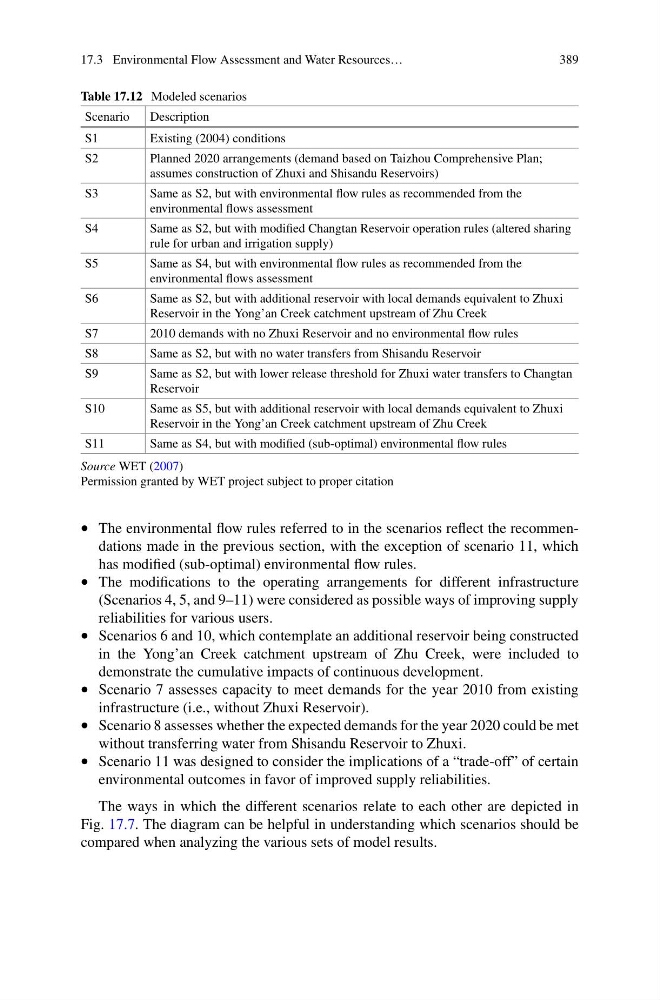
Table 17.12 Modeled scenarios
Scenario
Description
S1
Existing (2004) conditions
S2
Planned 2020 arrangements (demand based on Taizhou Comprehensive Plan;
assumes construction of Zhuxi and Shisandu Reservoirs)
S3
Same as S2, but with environmental flow rules as recommended from the
environmental flows assessment
S4
Same as S2, but with modified Changtan Reservoir operation rules (altered sharing
rule for urban and irrigation supply)
S5
Same as S4, but with environmental flow rules as recommended from the
environmental flows assessment
S6
Same as S2, but with additional reservoir with local demands equivalent to Zhuxi
Reservoir in the Yong’an Creek catchment upstream of Zhu Creek
S7
2010 demands with no Zhuxi Reservoir and no environmental flow rules
S8
Same as S2, but with no water transfers from Shisandu Reservoir
S9
Same as S2, but with lower release threshold for Zhuxi water transfers to Changtan
Reservoir
S10
Same as S5, but with additional reservoir with local demands equivalent to Zhuxi
Reservoir in the Yong’an Creek catchment upstream of Zhu Creek
S11
Same as S4, but with modified (sub-optimal) environmental flow rules
Source WET (2007)
Permission granted by WET project subject to proper citation
• The environmental flow rules referred to in the scenarios reflect the recommendations made in the previous section, with the exception of scenario 11, which
has modified (sub-optimal) environmental flow rules.
• The modifications to the operating arrangements for different infrastructure
(Scenarios 4, 5, and 9–11) were considered as possible ways of improving supply
reliabilities for various users.
• Scenarios 6 and 10, which contemplate an additional reservoir being constructed
in the Yong’an Creek catchment upstream of Zhu Creek, were included to
demonstrate the cumulative impacts of continuous development.
• Scenario 7 assesses capacity to meet demands for the year 2010 from existing
infrastructure (i.e., without Zhuxi Reservoir).
• Scenario 8 assesses whether the expected demands for the year 2020 could be met
without transferring water from Shisandu Reservoir to Zhuxi.
• Scenario 11 was designed to consider the implications of a “trade-off” of certain
environmental outcomes in favor of improved supply reliabilities.
The ways in which the different scenarios relate to each other are depicted in
Fig. 17.7. The diagram can be helpful in understanding which scenarios should be
compared when analyzing the various sets of model results.
389
Table 17.12 Modeled scenarios
Scenario
Description
S1
Existing (2004) conditions
S2
Planned 2020 arrangements (demand based on Taizhou Comprehensive Plan;
assumes construction of Zhuxi and Shisandu Reservoirs)
S3
Same as S2, but with environmental flow rules as recommended from the
environmental flows assessment
S4
Same as S2, but with modified Changtan Reservoir operation rules (altered sharing
rule for urban and irrigation supply)
S5
Same as S4, but with environmental flow rules as recommended from the
environmental flows assessment
S6
Same as S2, but with additional reservoir with local demands equivalent to Zhuxi
Reservoir in the Yong’an Creek catchment upstream of Zhu Creek
S7
2010 demands with no Zhuxi Reservoir and no environmental flow rules
S8
Same as S2, but with no water transfers from Shisandu Reservoir
S9
Same as S2, but with lower release threshold for Zhuxi water transfers to Changtan
Reservoir
S10
Same as S5, but with additional reservoir with local demands equivalent to Zhuxi
Reservoir in the Yong’an Creek catchment upstream of Zhu Creek
S11
Same as S4, but with modified (sub-optimal) environmental flow rules
Source WET (2007)
Permission granted by WET project subject to proper citation
• The environmental flow rules referred to in the scenarios reflect the recommendations made in the previous section, with the exception of scenario 11, which
has modified (sub-optimal) environmental flow rules.
• The modifications to the operating arrangements for different infrastructure
(Scenarios 4, 5, and 9–11) were considered as possible ways of improving supply
reliabilities for various users.
• Scenarios 6 and 10, which contemplate an additional reservoir being constructed
in the Yong’an Creek catchment upstream of Zhu Creek, were included to
demonstrate the cumulative impacts of continuous development.
• Scenario 7 assesses capacity to meet demands for the year 2010 from existing
infrastructure (i.e., without Zhuxi Reservoir).
• Scenario 8 assesses whether the expected demands for the year 2020 could be met
without transferring water from Shisandu Reservoir to Zhuxi.
• Scenario 11 was designed to consider the implications of a “trade-off” of certain
environmental outcomes in favor of improved supply reliabilities.
The ways in which the different scenarios relate to each other are depicted in
Fig. 17.7. The diagram can be helpful in understanding which scenarios should be
compared when analyzing the various sets of model results.