

17.3 Environmental Flow Assessment and Water Resources…
377
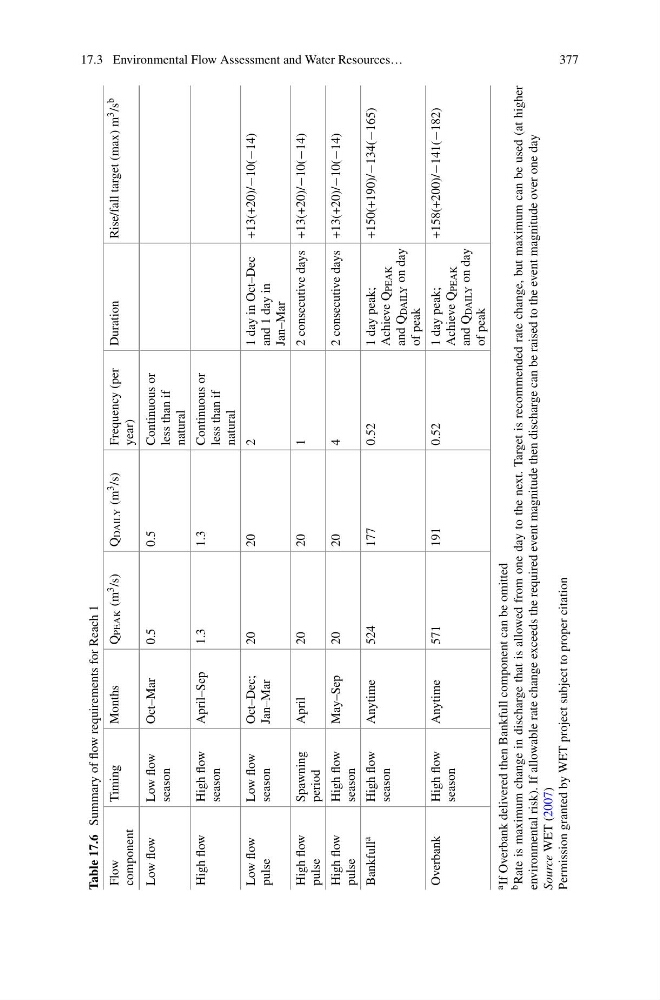
Table 17.6
Summary of flow requirements for Reach 1
Flow
component
Timing
Months
Q
PEAK (m 3
/s)
Q
DAILY (m 3
/s)
Frequency (per
year)
Duration
Rise/fall target (max) m 3
/s b
Low flow
Low flow
season
Oct–Mar
0.5
0.5
Continuous or
less than if
natural
High flow
High flow
season
April–Sep
1.3
1.3
Continuous or
less than if
natural
Low flow
pulse
Low flow
season
Oct–Dec;
Jan–Mar
20
20
2
1 day in Oct–Dec
and 1 day in
Jan–Mar
+13(+20)/−10(−14)
High flow
pulse
Spawning
period
April
20
20
1
2 consecutive days +13(+20)/−10(−14)
High flow
pulse
High flow
season
May–Sep
20
20
4
2 consecutive days +13(+20)/−10(−14)
Bankfull a
High flow
season
Anytime
524
177
0.52
1 day peak;
Achieve Q
PEAK
and Q
DAILY on day
of peak
+150(+190)/−134(−165)
Overbank
High flow
season
Anytime
571
191
0.52
1 day peak;
Achieve Q
PEAK
and Q
DAILY on day
of peak
+158(+200)/−141(−182)
a
If Overbank delivered then Bankfull component can be omitted
b
Rate is maximum change in discharge that is allowed from one day to the next. Target is recommended rate change, but maximum can be used (at higher
environmental risk). If allowable rate change exceeds the required event magnitude then discharge can be raised to the event magnitude over one day
Source
WET (2007)
Permission granted by WET project subject to proper citation
377
Table 17.6
Summary of flow requirements for Reach 1
Flow
component
Timing
Months
Q
PEAK (m 3
/s)
Q
DAILY (m 3
/s)
Frequency (per
year)
Duration
Rise/fall target (max) m 3
/s b
Low flow
Low flow
season
Oct–Mar
0.5
0.5
Continuous or
less than if
natural
High flow
High flow
season
April–Sep
1.3
1.3
Continuous or
less than if
natural
Low flow
pulse
Low flow
season
Oct–Dec;
Jan–Mar
20
20
2
1 day in Oct–Dec
and 1 day in
Jan–Mar
+13(+20)/−10(−14)
High flow
pulse
Spawning
period
April
20
20
1
2 consecutive days +13(+20)/−10(−14)
High flow
pulse
High flow
season
May–Sep
20
20
4
2 consecutive days +13(+20)/−10(−14)
Bankfull a
High flow
season
Anytime
524
177
0.52
1 day peak;
Achieve Q
PEAK
and Q
DAILY on day
of peak
+150(+190)/−134(−165)
Overbank
High flow
season
Anytime
571
191
0.52
1 day peak;
Achieve Q
PEAK
and Q
DAILY on day
of peak
+158(+200)/−141(−182)
a
If Overbank delivered then Bankfull component can be omitted
b
Rate is maximum change in discharge that is allowed from one day to the next. Target is recommended rate change, but maximum can be used (at higher
environmental risk). If allowable rate change exceeds the required event magnitude then discharge can be raised to the event magnitude over one day
Source
WET (2007)
Permission granted by WET project subject to proper citation