

300
14 Water Resource Allocation and Regulation in Yellow River Basin
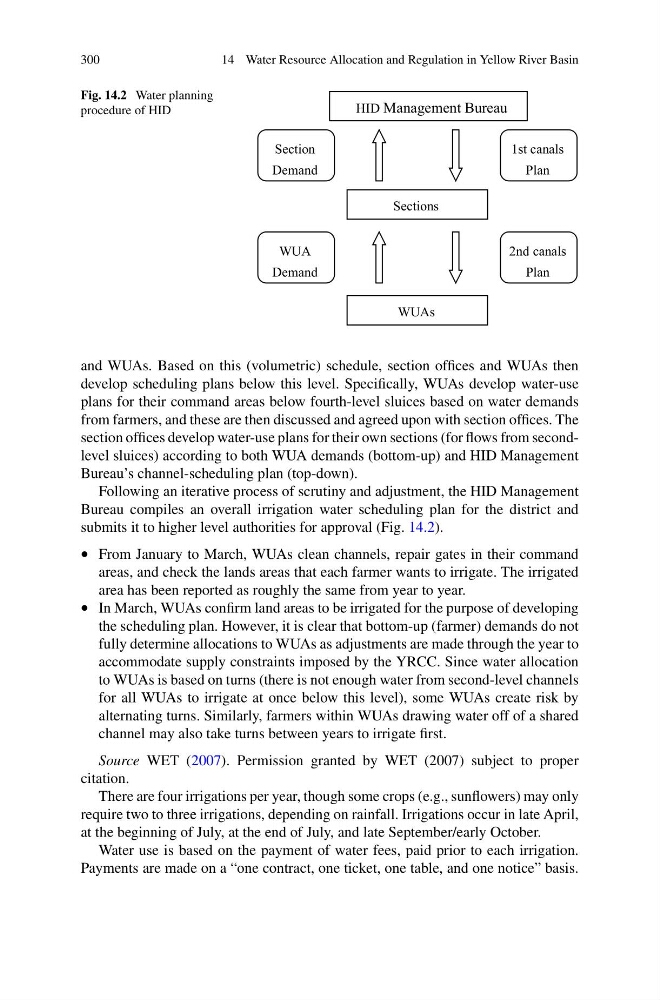
Fig. 14.2 Water planning
procedure of HID
HID Management Bureau
Sections
WUAs
Section
Demand
WUA
Demand
1st canals
Plan
2nd canals
Plan
and WUAs. Based on this (volumetric) schedule, section offices and WUAs then
develop scheduling plans below this level. Specifically, WUAs develop water-use
plans for their command areas below fourth-level sluices based on water demands
from farmers, and these are then discussed and agreed upon with section offices. The
section offices develop water-use plans for their own sections (for flows from secondlevel sluices) according to both WUA demands (bottom-up) and HID Management
Bureau’s channel-scheduling plan (top-down).
Following an iterative process of scrutiny and adjustment, the HID Management
Bureau compiles an overall irrigation water scheduling plan for the district and
submits it to higher level authorities for approval (Fig. 14.2).
• From January to March, WUAs clean channels, repair gates in their command
areas, and check the lands areas that each farmer wants to irrigate. The irrigated
area has been reported as roughly the same from year to year.
• In March, WUAs confirm land areas to be irrigated for the purpose of developing
the scheduling plan. However, it is clear that bottom-up (farmer) demands do not
fully determine allocations to WUAs as adjustments are made through the year to
accommodate supply constraints imposed by the YRCC. Since water allocation
to WUAs is based on turns (there is not enough water from second-level channels
for all WUAs to irrigate at once below this level), some WUAs create risk by
alternating turns. Similarly, farmers within WUAs drawing water off of a shared
channel may also take turns between years to irrigate first.
Source WET (2007). Permission granted by WET (2007) subject to proper
citation.
There are four irrigations per year, though some crops (e.g., sunflowers) may only
require two to three irrigations, depending on rainfall. Irrigations occur in late April,
at the beginning of July, at the end of July, and late September/early October.
Water use is based on the payment of water fees, paid prior to each irrigation.
Payments are made on a “one contract, one ticket, one table, and one notice” basis.
14 Water Resource Allocation and Regulation in Yellow River Basin
Fig. 14.2 Water planning
procedure of HID
HID Management Bureau
Sections
WUAs
Section
Demand
WUA
Demand
1st canals
Plan
2nd canals
Plan
and WUAs. Based on this (volumetric) schedule, section offices and WUAs then
develop scheduling plans below this level. Specifically, WUAs develop water-use
plans for their command areas below fourth-level sluices based on water demands
from farmers, and these are then discussed and agreed upon with section offices. The
section offices develop water-use plans for their own sections (for flows from secondlevel sluices) according to both WUA demands (bottom-up) and HID Management
Bureau’s channel-scheduling plan (top-down).
Following an iterative process of scrutiny and adjustment, the HID Management
Bureau compiles an overall irrigation water scheduling plan for the district and
submits it to higher level authorities for approval (Fig. 14.2).
• From January to March, WUAs clean channels, repair gates in their command
areas, and check the lands areas that each farmer wants to irrigate. The irrigated
area has been reported as roughly the same from year to year.
• In March, WUAs confirm land areas to be irrigated for the purpose of developing
the scheduling plan. However, it is clear that bottom-up (farmer) demands do not
fully determine allocations to WUAs as adjustments are made through the year to
accommodate supply constraints imposed by the YRCC. Since water allocation
to WUAs is based on turns (there is not enough water from second-level channels
for all WUAs to irrigate at once below this level), some WUAs create risk by
alternating turns. Similarly, farmers within WUAs drawing water off of a shared
channel may also take turns between years to irrigate first.
Source WET (2007). Permission granted by WET (2007) subject to proper
citation.
There are four irrigations per year, though some crops (e.g., sunflowers) may only
require two to three irrigations, depending on rainfall. Irrigations occur in late April,
at the beginning of July, at the end of July, and late September/early October.
Water use is based on the payment of water fees, paid prior to each irrigation.
Payments are made on a “one contract, one ticket, one table, and one notice” basis.