

71
2.5.7 Total Internal Reflection
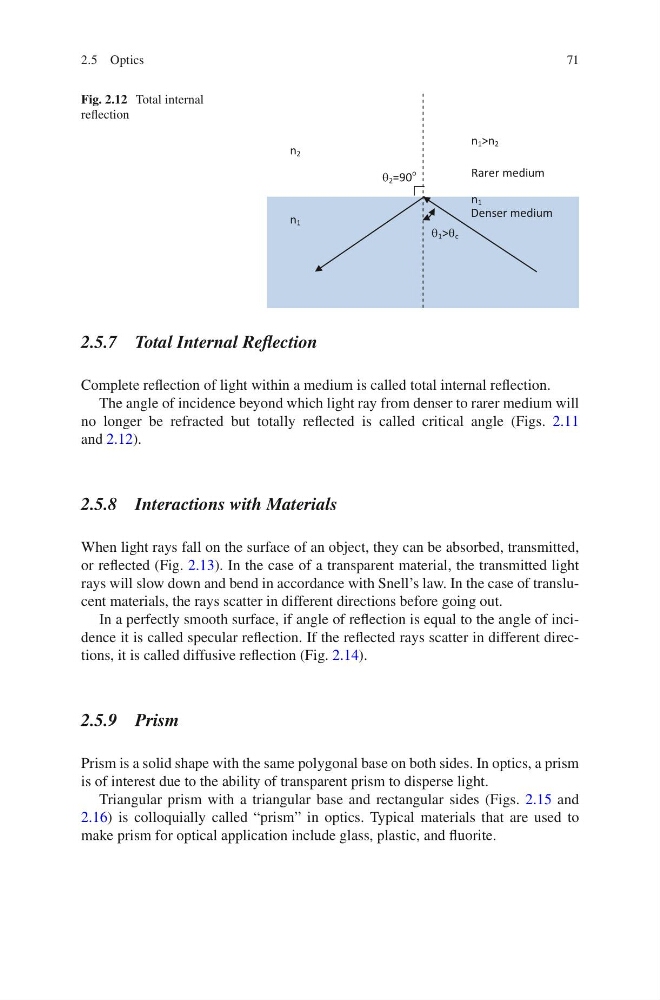
Complete reflection of light within a medium is called total internal reflection.
The angle of incidence beyond which light ray from denser to rarer medium will
no longer be refracted but totally reflected is called critical angle (Figs. 2.11
and 2.12).
2.5.8 Interactions with Materials
When light rays fall on the surface of an object, they can be absorbed, transmitted,
or reflected (Fig. 2.13). In the case of a transparent material, the transmitted light
rays will slow down and bend in accordance with Snell’s law. In the case of translucent materials, the rays scatter in different directions before going out.
In a perfectly smooth surface, if angle of reflection is equal to the angle of incidence it is called specular reflection. If the reflected rays scatter in different directions, it is called diffusive reflection (Fig. 2.14).
2.5.9 Prism
Prism is a solid shape with the same polygonal base on both sides. In optics, a prism
is of interest due to the ability of transparent prism to disperse light.
Triangular prism with a triangular base and rectangular sides (Figs. 2.15 and
2.16) is colloquially called “prism” in optics. Typical materials that are used to
make prism for optical application include glass, plastic, and fluorite.
θ 2 =90
o
θ 1 >θ c
n 2
n 1
Rarer medium
Denser medium
n 1 >n 2
n 1
Fig. 2.12 Total internal
reflection
2.5 Optics
2.5.7 Total Internal Reflection
Complete reflection of light within a medium is called total internal reflection.
The angle of incidence beyond which light ray from denser to rarer medium will
no longer be refracted but totally reflected is called critical angle (Figs. 2.11
and 2.12).
2.5.8 Interactions with Materials
When light rays fall on the surface of an object, they can be absorbed, transmitted,
or reflected (Fig. 2.13). In the case of a transparent material, the transmitted light
rays will slow down and bend in accordance with Snell’s law. In the case of translucent materials, the rays scatter in different directions before going out.
In a perfectly smooth surface, if angle of reflection is equal to the angle of incidence it is called specular reflection. If the reflected rays scatter in different directions, it is called diffusive reflection (Fig. 2.14).
2.5.9 Prism
Prism is a solid shape with the same polygonal base on both sides. In optics, a prism
is of interest due to the ability of transparent prism to disperse light.
Triangular prism with a triangular base and rectangular sides (Figs. 2.15 and
2.16) is colloquially called “prism” in optics. Typical materials that are used to
make prism for optical application include glass, plastic, and fluorite.
θ 2 =90
o
θ 1 >θ c
n 2
n 1
Rarer medium
Denser medium
n 1 >n 2
n 1
Fig. 2.12 Total internal
reflection
2.5 Optics