

61
Weight of the column of air above humans is very heavy. The reason humans, or
other organism, are crushed by the weight of this air is that this external pressure is
balanced by internal pressure within humans, which arises from various fluids as
well as materials humans are composed of.
2.4.3 Flow in Pipes
Flow of fluid differs from that of channel in a way that it is at pressure wherein
continuity equation and Bernoulli’s theorem are used for various calculations.
2.4.3.1 Continuity Equation
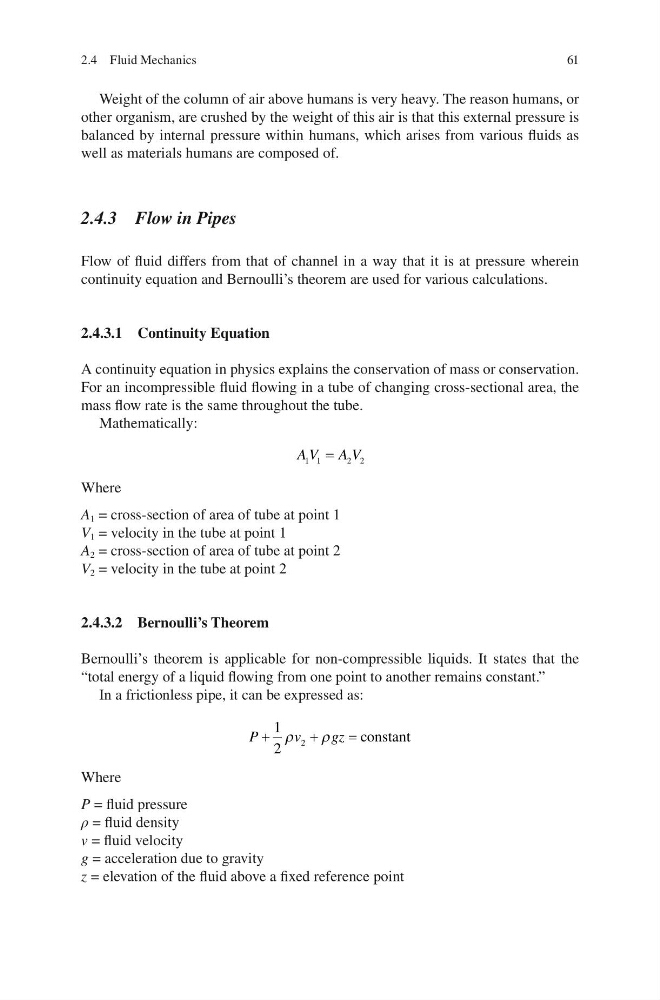
A continuity equation in physics explains the conservation of mass or conservation.
For an incompressible fluid flowing in a tube of changing cross-sectional area, the
mass flow rate is the same throughout the tube.
Mathematically:
A V A V
1 1
2 2
=
Where
A 1 = cross-section of area of tube at point 1
V 1 = velocity in the tube at point 1
A 2 = cross-section of area of tube at point 2
V 2 = velocity in the tube at point 2
2.4.3.2 Bernoulli’s Theorem
Bernoulli’s theorem is applicable for non-compressible liquids. It states that the
“total energy of a liquid flowing from one point to another remains constant.”
In a frictionless pipe, it can be expressed as:
P
v
gz
+
+
=
1
2
2
ρ
ρ
constant
Where
P = fluid pressure
ρ = fluid density
v = fluid velocity
g = acceleration due to gravity
z = elevation of the fluid above a fixed reference point
2.4 Fluid Mechanics
Weight of the column of air above humans is very heavy. The reason humans, or
other organism, are crushed by the weight of this air is that this external pressure is
balanced by internal pressure within humans, which arises from various fluids as
well as materials humans are composed of.
2.4.3 Flow in Pipes
Flow of fluid differs from that of channel in a way that it is at pressure wherein
continuity equation and Bernoulli’s theorem are used for various calculations.
2.4.3.1 Continuity Equation
A continuity equation in physics explains the conservation of mass or conservation.
For an incompressible fluid flowing in a tube of changing cross-sectional area, the
mass flow rate is the same throughout the tube.
Mathematically:
A V A V
1 1
2 2
=
Where
A 1 = cross-section of area of tube at point 1
V 1 = velocity in the tube at point 1
A 2 = cross-section of area of tube at point 2
V 2 = velocity in the tube at point 2
2.4.3.2 Bernoulli’s Theorem
Bernoulli’s theorem is applicable for non-compressible liquids. It states that the
“total energy of a liquid flowing from one point to another remains constant.”
In a frictionless pipe, it can be expressed as:
P
v
gz
+
+
=
1
2
2
ρ
ρ
constant
Where
P = fluid pressure
ρ = fluid density
v = fluid velocity
g = acceleration due to gravity
z = elevation of the fluid above a fixed reference point
2.4 Fluid Mechanics