

53
Newton’s Laws of Motion
Newton’s laws of motion are the foundation for mechanics.
Newton’s first law states that a body will remain at rest or in uniform motion in
the same direction unless acted by force.
The second law of motion defines a force to be equal to the change in momentum
per change in time.
Newton’s third law of motion states that every action has an equal and opposite
reaction.
Newton’s second law of motion is mathematically expressed as:
F m
dv
dt
=
Since the rate of change of velocity is acceleration,
F ma
=
RO
A
B
C
DP
E
A
B
C
DP
EO
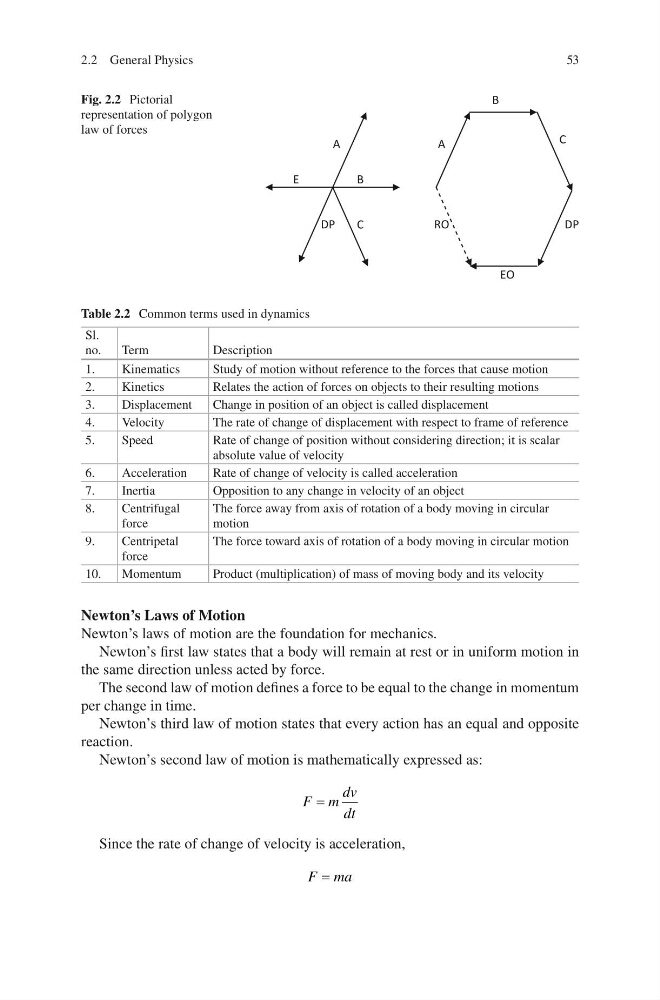
Fig. 2.2 Pictorial
representation of polygon
law of forces
Table 2.2 Common terms used in dynamics
Sl.
no.
Term
Description
1.
Kinematics
Study of motion without reference to the forces that cause motion
2.
Kinetics
Relates the action of forces on objects to their resulting motions
3.
Displacement
Change in position of an object is called displacement
4.
Velocity
The rate of change of displacement with respect to frame of reference
5.
Speed
Rate of change of position without considering direction; it is scalar
absolute value of velocity
6.
Acceleration
Rate of change of velocity is called acceleration
7.
Inertia
Opposition to any change in velocity of an object
8.
Centrifugal
force
The force away from axis of rotation of a body moving in circular
motion
9.
Centripetal
force
The force toward axis of rotation of a body moving in circular motion
10.
Momentum
Product (multiplication) of mass of moving body and its velocity
2.2 General Physics
Newton’s Laws of Motion
Newton’s laws of motion are the foundation for mechanics.
Newton’s first law states that a body will remain at rest or in uniform motion in
the same direction unless acted by force.
The second law of motion defines a force to be equal to the change in momentum
per change in time.
Newton’s third law of motion states that every action has an equal and opposite
reaction.
Newton’s second law of motion is mathematically expressed as:
F m
dv
dt
=
Since the rate of change of velocity is acceleration,
F ma
=
RO
A
B
C
DP
E
A
B
C
DP
EO
Fig. 2.2 Pictorial
representation of polygon
law of forces
Table 2.2 Common terms used in dynamics
Sl.
no.
Term
Description
1.
Kinematics
Study of motion without reference to the forces that cause motion
2.
Kinetics
Relates the action of forces on objects to their resulting motions
3.
Displacement
Change in position of an object is called displacement
4.
Velocity
The rate of change of displacement with respect to frame of reference
5.
Speed
Rate of change of position without considering direction; it is scalar
absolute value of velocity
6.
Acceleration
Rate of change of velocity is called acceleration
7.
Inertia
Opposition to any change in velocity of an object
8.
Centrifugal
force
The force away from axis of rotation of a body moving in circular
motion
9.
Centripetal
force
The force toward axis of rotation of a body moving in circular motion
10.
Momentum
Product (multiplication) of mass of moving body and its velocity
2.2 General Physics