

31
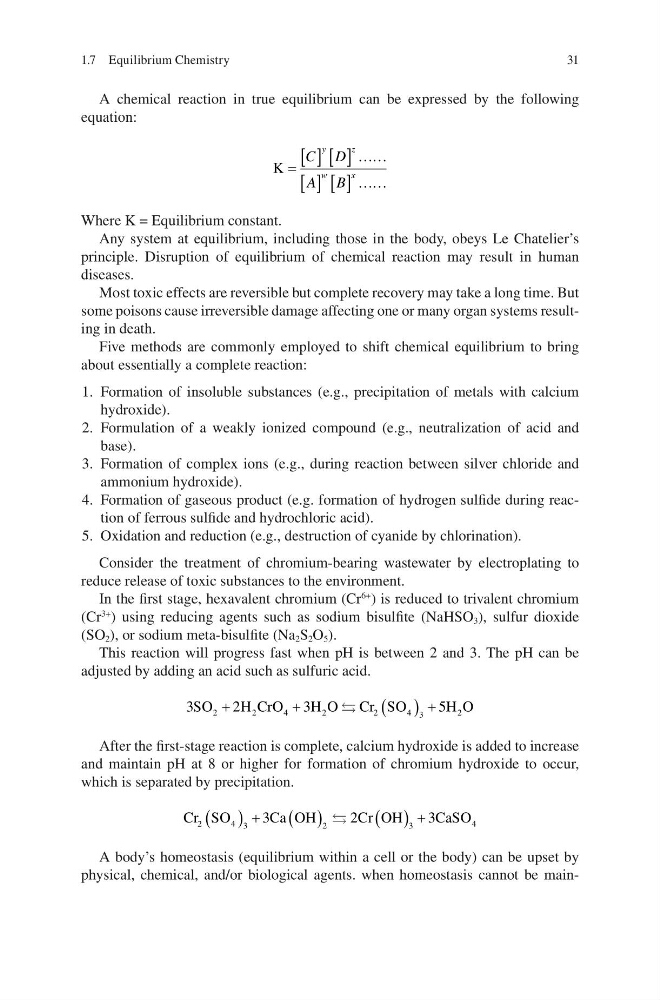
A chemical reaction in true equilibrium can be expressed by the following
equation:
K =
[ ] [ ] ……
[ ] [ ] ……
C D
A B
y
z
w
x
Where K = Equilibrium constant.
Any system at equilibrium, including those in the body, obeys Le Chatelier’s
principle. Disruption of equilibrium of chemical reaction may result in human
diseases.
Most toxic effects are reversible but complete recovery may take a long time. But
some poisons cause irreversible damage affecting one or many organ systems resulting in death.
Five methods are commonly employed to shift chemical equilibrium to bring
about essentially a complete reaction:
1. Formation of insoluble substances (e.g., precipitation of metals with calcium
hydroxide).
2. Formulation of a weakly ionized compound (e.g., neutralization of acid and
base).
3. Formation of complex ions (e.g., during reaction between silver chloride and
ammonium hydroxide).
4. Formation of gaseous product (e.g. formation of hydrogen sulfide during reaction of ferrous sulfide and hydrochloric acid).
5. Oxidation and reduction (e.g., destruction of cyanide by chlorination).
Consider the treatment of chromium-bearing wastewater by electroplating to
reduce release of toxic substances to the environment.
In the first stage, hexavalent chromium (Cr
6+
) is reduced to trivalent chromium
(Cr
3+
) using reducing agents such as sodium bisulfite (NaHSO 3 ), sulfur dioxide
(SO 2 ), or sodium meta-bisulfite (Na 2 S 2 O 5 ).
This reaction will progress fast when pH is between 2 and 3. The pH can be
adjusted by adding an acid such as sulfuric acid.
3
2
3
5
2
2
4
2
2
4 3
2
SO
H CrO
H O Cr SO
H O
+
+
( ) +
After the first-stage reaction is complete, calcium hydroxide is added to increase
and maintain pH at 8 or higher for formation of chromium hydroxide to occur,
which is separated by precipitation.
Cr SO
Ca OH
Cr OH
CaSO
2
4 3
2
3
4
3
2
3
( ) + ( )
( ) +
A body’s homeostasis (equilibrium within a cell or the body) can be upset by
physical, chemical, and/or biological agents. when homeostasis cannot be main1.7 Equilibrium Chemistry
A chemical reaction in true equilibrium can be expressed by the following
equation:
K =
[ ] [ ] ……
[ ] [ ] ……
C D
A B
y
z
w
x
Where K = Equilibrium constant.
Any system at equilibrium, including those in the body, obeys Le Chatelier’s
principle. Disruption of equilibrium of chemical reaction may result in human
diseases.
Most toxic effects are reversible but complete recovery may take a long time. But
some poisons cause irreversible damage affecting one or many organ systems resulting in death.
Five methods are commonly employed to shift chemical equilibrium to bring
about essentially a complete reaction:
1. Formation of insoluble substances (e.g., precipitation of metals with calcium
hydroxide).
2. Formulation of a weakly ionized compound (e.g., neutralization of acid and
base).
3. Formation of complex ions (e.g., during reaction between silver chloride and
ammonium hydroxide).
4. Formation of gaseous product (e.g. formation of hydrogen sulfide during reaction of ferrous sulfide and hydrochloric acid).
5. Oxidation and reduction (e.g., destruction of cyanide by chlorination).
Consider the treatment of chromium-bearing wastewater by electroplating to
reduce release of toxic substances to the environment.
In the first stage, hexavalent chromium (Cr
6+
) is reduced to trivalent chromium
(Cr
3+
) using reducing agents such as sodium bisulfite (NaHSO 3 ), sulfur dioxide
(SO 2 ), or sodium meta-bisulfite (Na 2 S 2 O 5 ).
This reaction will progress fast when pH is between 2 and 3. The pH can be
adjusted by adding an acid such as sulfuric acid.
3
2
3
5
2
2
4
2
2
4 3
2
SO
H CrO
H O Cr SO
H O
+
+
( ) +
After the first-stage reaction is complete, calcium hydroxide is added to increase
and maintain pH at 8 or higher for formation of chromium hydroxide to occur,
which is separated by precipitation.
Cr SO
Ca OH
Cr OH
CaSO
2
4 3
2
3
4
3
2
3
( ) + ( )
( ) +
A body’s homeostasis (equilibrium within a cell or the body) can be upset by
physical, chemical, and/or biological agents. when homeostasis cannot be main1.7 Equilibrium Chemistry